

“Instead of viewing her body as a tool for play and growth, she begins to see it as a project to be managed,” warned a director of a UAE-based psychological care centre.
At the age of seven, she should have been playing with dolls. Instead, she found herself in a dermatology clinic, looking at swollen, infected fingertips.
The cause was a glossy adult nail polish she had seen in a short video and applied after copying the routine. What followed was nine months of treatment for a bacterial and fungal infection that is highly unusual for a child of her age.
“Not a month goes by without a similar case crossing my clinic,” said Dr Salem Antabi, a specialist dermatologist at SkinMed Medical Centre, who has over 30 years of clinical experience.
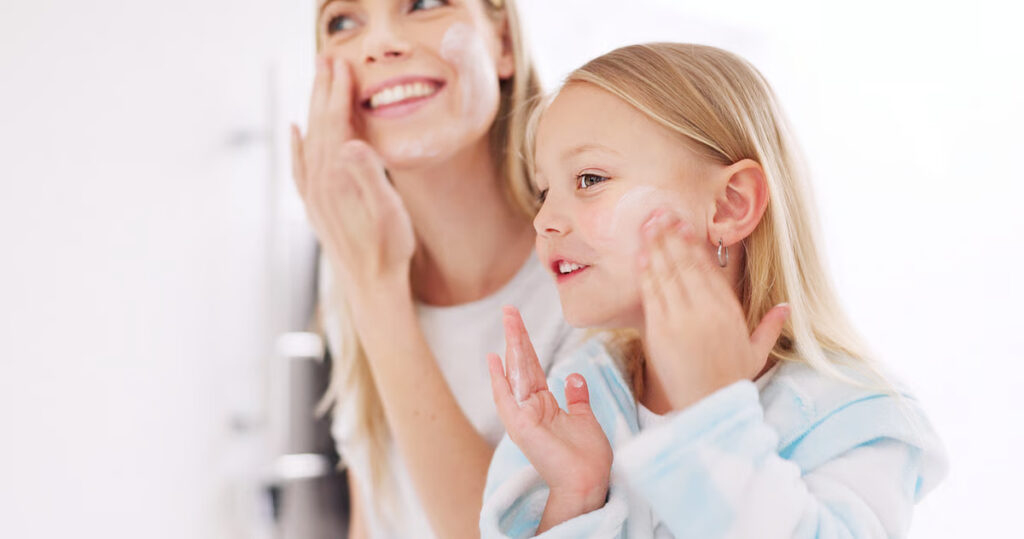
But the deeper harm—one that no cream can fix—is what many twelve-year-old girls are doing to themselves each night: standing in front of mirrors, scrutinising imaginary pores, and following elaborate eleven-step skincare routines learned from glowing screens.
This reflects a generation being pushed into adulthood far too early.
“A child’s skin is about 30% thinner than an adult’s,” explained Dr Salem Antabi, a specialist dermatologist at SkinMed Medical Centre, who has over three decades of clinical experience. “It is rich in water, poor in oil, and the protective lipid layer that develops after puberty is not yet formed.”
This means that substances applied to a child’s skin are absorbed more quickly and more deeply than in adults, increasing potential risks.
He noted that many cosmetic products contain ingredients such as phenol, linked to hormonal disruption; formaldehyde, a recognised toxin found in some nail polishes and lipsticks; benzophenones, associated with endocrine effects; and parabens, which have been linked to hormonal interference.
“Many of these ingredients can even appear in products labelled ‘for kids’ or ‘natural’,” Dr Antabi cautioned. “Parents should not assume that a label automatically means a product is safe.”
The second cost: a sense of self that has not yet fully formed
While skin may eventually heal, psychological impacts can take much longer to resolve.
Dr Eva Jajonie, Director of Neuron Psychological Care Centre, explains what may be happening in a young girl’s mind.
“Cosmeticorexia exploits a child’s natural desire to imitate adulthood by presenting skincare as a necessary ritual rather than a medical need,” she said. “When a young girl believes her skin needs fixing, her brain begins to develop premature self-surveillance.”
What follows, Jajonie warns, is a subtle disruption of childhood development itself.
“The natural process of forming identity gets replaced by a deficit-based mindset,” she explained. “Instead of seeing the body as something that grows and functions, it becomes something to manage. This can lead to a persistent stress response and an internal narrative centred on inadequacy, where the ‘true self’ feels hidden behind perceived flaws that only products can fix.”
According to her, the warning signs often become clear once recognised. These may include emotional distress if a step in a skincare routine is missed, excessive mirror-checking focused on imagined imperfections, and reduced social interaction in favour of product use.
Physical signs can also appear, such as redness, peeling, or irritation caused by active ingredients designed for mature skin.
She added that the long-term impact may extend into adulthood, shaping self-perception and emotional wellbeing. “For some, self-worth becomes tied to consumption. In certain cases, this can contribute to body image disorders, as the individual may never have experienced a version of themselves that felt ‘enough’ without external correction.”
A 2024 study published in the Journal of Pediatric Psychology also found an association between early exposure to beauty-related content and increased rates of anxiety and depression among adolescents.
On the front lines
Warda Al-Hashemi, mother of a 12-year-old, says she clearly sees how the pressure builds.
“The biggest factor is social media,” she said. “Especially when they see influencers their own age using these products every day. The girl feels she has to imitate just to be accepted.”
At home, her rules are simple: sunscreen, moisturiser, lip balm, and a light touch of blush—nothing more. When her daughter insists, saying, “All my friends have it,” Warda responds firmly but calmly.
“I refuse,” she said. “What matters most is her health and confidence, not following trends.”
What a mother can do
Experts say the approaches used by parents often converge on a small but clear set of protective measures.
Dr Eva Jajonie advises that conversations about skincare and appearance should begin early—typically when children first show interest in makeup or skincare, often between ages five and seven.
Her recommended two-step approach includes:
- Focus on function, not appearance: Emphasising what the skin does—protecting the body, sensing the environment, and healing—rather than how it looks.
- Demystify digital beauty: Helping children understand that the “glow” seen in advertisements is often the result of filters, lighting, and digital editing.
Dermatologists also recommend a limited, safe routine for children under 15, which may include a mineral sunscreen (such as zinc oxide or titanium dioxide), a fragrance-free moisturiser, a mild lip balm, and chamomile water.

