

What leads to extreme humidity, dust storms, and temperatures exceeding 50°C?
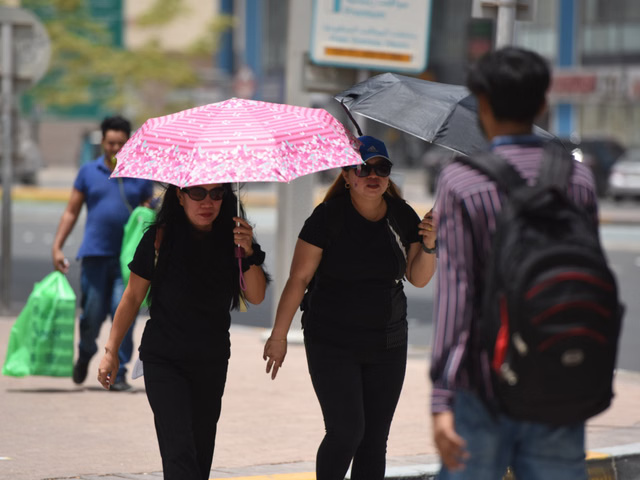
Dubai: The UAE is widely recognised for its modern skyline, rapid development, and a climate that demands caution during the peak summer months. For both residents and visitors, intense heat is a defining feature of life in the region.
But what drives such extreme weather patterns, and why does the air sometimes feel heavy and humid while at other times it is intensely dry? And what precautions should people take during peak summer conditions?
Why the UAE experiences extreme summer heat and humidity
The UAE’s high temperatures and humidity levels are caused by a combination of its location in the subtropical desert belt, the influence of the Indian Monsoon Low, and the surrounding warm waters of the Arabian Gulf, which supply significant atmospheric moisture.
According to the National Centre of Meteorology, three key meteorological factors shape the country’s summer climate. The first is a synoptic pattern driven by the extension of the Indian Monsoon Low, a low-pressure system that forms over northern India and Pakistan and extends westward across Iran, Kuwait, Iraq, and the Arabian Peninsula.
When this hot air mass reaches the Rub’ Al Khali (Empty Quarter)—one of the hottest and driest deserts in the world—the already extreme summer heat intensifies further. The National Centre of Meteorology explains that the monsoon low forms due to humid air masses moving in from the southeast and east, with the Indian Ocean acting as the main moisture source feeding the region’s humidity.
The second factor is the influence of thermal low-pressure systems over the Arabian Peninsula. These systems form due to intense surface heating, with peak temperatures in some inland and southern areas reaching up to 50°C, further intensifying summer conditions.
The third factor relates to prevailing wind patterns linked to this synoptic setup. The UAE is often affected by southeasterly and southwesterly winds, which originate from already hot desert regions. As these winds move across the country, they contribute to further increases in temperature and overall heat stress.
The centre also noted that on most summer days, the UAE experiences a repeating land and sea breeze cycle. During the midday and evening hours, northwesterly winds become more dominant, which contributes to an increase in relative humidity levels across the country.
On some occasions, dry southerly winds lift dust and sand into the air, reducing visibility across parts of the UAE. When northwesterly winds strengthen—driven by the advancing Indian Monsoon Low and interacting with a western high-pressure system—a strong pressure gradient forms. This accelerates winds that pick up dust from Iraq, northern Saudi Arabia, and Kuwait. These winds are locally known as Al Shamal, meaning “The North.”
Why the heat feels so unbearable
The sensation of extreme heat stress is especially intense during midday and even at night. According to the National Centre of Meteorology, this discomfort is not caused by temperature alone but is strongly linked to high humidity levels.
Moisture from the Indian Monsoon Low travels eastward over the warm waters of the Arabian Gulf, carrying humid air into the UAE. When this moisture-rich air combines with light or calm wind conditions, it creates a suffocating heat stress effect, making the weather feel far hotter than the actual temperature.
Role of the eastern mountains
The UAE’s eastern mountain ranges also influence summer weather. When humid air moves inland and meets these mountains, it undergoes dynamic lifting, forcing it upward where it cools and condenses. This process can form summer cumulus clouds, which occasionally develop into thunderstorms and bring localized rainfall, particularly over eastern regions during daytime hours.
Summer timeline according to experts
The National Centre of Meteorology (NCM) notes that the classification of summer varies globally, depending on regional climate conditions and geographical location.
According to Ibrahim Al Jarwan, Chairman of the Board of Directors of the Emirates Astronomical Society and member of the Arab Union for Astronomy and Space Sciences, the UAE begins to experience a steady rise in temperatures from May onwards, leading up to the official start of summer on June 21. The most intense heat period typically occurs between mid-June and mid-August.
He further explained that the Murabba’aniyah summer period begins on June 7 and continues until July 16. This phase is considered the time when temperatures reach their peak, forming part of a roughly 40-day stretch known as Jamrat Al Qaydh, which represents the height of summer heat in the region.
Al Jarwan further explained that Al Qaydh, in Arab tradition, represents the core of summer—the period of peak heat. It is believed to begin with the rising of the Pleiades star cluster (Thuraya) and end with the rising of Canopus (Suhail). The Pleiades becomes visible above the eastern horizon on the morning of June 7, marking the end of the Kanat Al Thuraya phase, during which the cluster is hidden for about 39 days.
He noted that during the Murabba’aniyah period, a phase known as Al Barid Al Kabeer (Barid Al Thuraya) occurs, characterised by the Al Bawarih winds. These strong northwesterly winds can exceed 50 km/h in the first half of June, carrying dry air and dust from desert regions in the northwest.
He also explained that Al Samoom winds dominate from mid-June to mid-August, bringing intense heatwaves that can push daytime temperatures above 48°C, while nighttime temperatures often remain above 30°C.
From mid-July to the end of October, moisture-laden air masses begin moving in from the Arabian Sea toward the southern Arabian Peninsula. This leads to a sharp rise in humidity along coastal regions, especially when high temperatures persist on calm days. During this period, Al Kawos winds—southeasterly winds carrying moisture—may develop. When these moist air masses meet the southern highlands, they trigger the formation of cumulus clouds and thunderstorms known locally as Al Rawayih, observed across parts of the UAE and Oman.
Historical records
May is considered a transitional month between winter and summer in the UAE. During this period, the sun continues its northward movement, gradually increasing daylight hours and overall solar heating.
The Siberian high-pressure system begins to retreat, while the region becomes increasingly influenced by low-pressure extensions, which contribute to rising temperatures.
Relative humidity typically decreases compared to April, particularly in the second half of May, as atmospheric patterns shift toward hotter, drier summer conditions.
The average mean temperature in May ranges between 30.6°C and 33.6°C. However, extreme records highlight the intensity of heat in the region, with the highest temperature ever recorded in the UAE during May reaching 51.6°C in Sweihan in 2025.
June marks the official start of summer on June 21, bringing a sharp rise in temperatures, especially in southern and inland regions of the UAE.
In July, the Murabba’aniyah period continues until July 16, during which the country typically experiences its most intense heat, with temperatures reaching their peak levels of the season.
Nighttime temperatures remain persistently high during peak summer, often staying above 30°C. August is typically the most intense heat month, particularly in its first half, when inland regions can repeatedly experience daily temperatures exceeding 50°C, while coastal cities such as Abu Dhabi and Dubai commonly record highs in the mid-40°C range, along with peak humidity levels.
The summer of 2025 was described as exceptional. According to the National Centre of Meteorology, the UAE recorded its hottest spring ever observed.
On August 1, 2025, temperatures in Sweihan reached 51.8°C, the highest since 2021 and close to the UAE’s all-time record of 52.1°C, set in July 2002.
Marine heatwaves and environmental impact
A study from the Mubadala Centre for Arabian Gulf Climate and Environmental Research at New York University Abu Dhabi found that marine heatwaves in the Arabian Gulf are influenced by shifts in wind systems. These events typically occur when Al Shamal winds weaken while Indian summer monsoon winds intensify, altering sea surface conditions and contributing to unusually warm ocean temperatures.
These changes also increase humidity over the Arabian Gulf and cause heat to become trapped at the sea surface, intensifying overall warming conditions. The risk becomes higher during La Niña phases, when the equatorial Pacific Ocean is cooler than average. When these global and regional patterns align, Gulf waters can reach their highest temperatures, posing risks to marine ecosystems, coral reefs, fish stocks, and coastal biodiversity.
Practical advice for UAE residents
The most hazardous period for heat stress is typically from mid-June to mid-August, when temperatures can exceed 45°C and humidity rises above 60%, creating potentially dangerous conditions. The hottest part of the day is usually between 12:00 pm and 4:00 pm, although high humidity can make nights feel almost equally uncomfortable.
To protect outdoor workers, the Ministry of Human Resources and Emiratisation (MoHRE) enforces the Midday Break, which bans work in direct sunlight and open areas between 12:30 pm and 3:00 pm, from 15 June to 15 September each year.
Now in its 22nd consecutive year, the Midday Break reflects the UAE’s broader sustainability and occupational safety approach, aligning with international best practices to protect workers from heat-related illnesses and injuries during extreme summer conditions.

