

24K gold is down Dh56.75 per gram from its June 2 peak in Dubai.
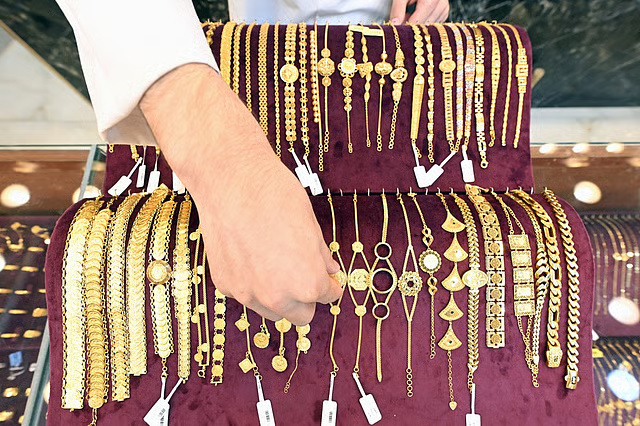
Dubai: Gold prices in Dubai fell again on Thursday morning, extending a sharp June decline that has pushed 24-karat gold to its lowest level of the month.
By 9:19am, 24-karat gold was priced at Dh485.75 per gram, down from Dh486.50 on Wednesday, while 22-karat gold stood at Dh449.75, compared with Dh450.50 a day earlier.
The latest move means 24-karat gold is now Dh56.75 per gram below its June 2 level of Dh542.50, while 22-karat gold has dropped Dh52.50 from its peak of Dh502.25 at the start of the month. For a 10-gram purchase, this translates into a decline of Dh567.50 in 24-karat gold from the June high, before making charges and VAT.
June rally fades
Gold opened the month at Dh539.75 for 24-karat and Dh500 for 22-karat on June 1, before rising to Dh542.50 and Dh502.25 respectively on June 2, the highest levels recorded in Dubai so far this month.
Prices remained elevated during the first week, with 24-karat gold staying above Dh520 between June 5 and June 8. The first significant drop came on June 10, when 24-karat gold fell to Dh492.50, before recovering to above Dh508 later in the week.
After touching Dh522.25 on June 16, the market turned lower again, with 24-karat gold sliding to Dh509.25 on June 18, Dh506 on June 22, Dh498.75 on June 23 and Dh486.50 on June 24, before easing further on Thursday.
The 22-karat rate followed a similar trajectory, falling from Dh483.50 on June 16 to Dh471.50 on June 18, Dh468.50 on June 22, Dh461.75 on June 23 and Dh450.50 on June 24, before easing to Dh449.75 on Thursday morning..
Global sell-off hits Dubai prices
The decline in Dubai retail gold prices comes as global bullion extended losses, after a stronger US dollar and rising expectations of higher interest rates pushed gold below $4,000 an ounce for the first time since November.
Spot gold fell as much as 0.9% to near $3,964 an ounce on Thursday, after losing almost 3% in the previous session. A dollar index gauge has gained 0.8% this week, making gold more expensive for buyers using other currencies.
Chris Weston, Head of Research at Pepperstone, said client activity in XAUUSD had been exceptionally strong, with trading alerts triggered when gold broke below the June 11 low of $4,023 and again when prices fell through the psychologically important $4,000 level.
He added that 68% of open XAUUSD positions held by Pepperstone clients were long and positioned for a potential rebound, suggesting many traders still expect the sell-off to be temporary and for gold to recover above $4,000.
The price trend, however, points to further downside risk. Weston said momentum traders are increasingly relying on the short- and medium-term downtrend, while a sustained break and hold below Wednesday’s low of $3,959 would likely strengthen conviction that XAUUSD could extend towards $3,900 and potentially lower.
Why gold is under pressure
The sell-off has raised questions among investors, as gold typically benefits from uncertainty, yet it failed to strengthen during the recent US-Iran conflict even as crude oil prices surged sharply.
Weston said gold’s diversification appeal has weakened because its rolling correlation with Nasdaq 100 and S&P 500 futures has turned positive and remained statistically significant in recent weeks. This has reduced its effectiveness as a portfolio hedge at a time when investors have been shifting more capital into higher-return segments of the market.

“There is no stronger driver of market psychology than price itself,” Weston said.
He noted that lower prices influence positioning, sentiment and systematic flows, with trend-following funds increasing short exposure, options dealers hedging their books by shorting gold futures, and discretionary investors becoming more reluctant to step in front of the decline.
A stronger dollar and higher US real yields have also weighed on the metal. US 10-year real Treasury yields have risen to 2.28%, their highest level since April 2025, increasing the relative appeal of interest-bearing assets and reducing demand for gold, which does not offer yield.
Rate hike risk changes the trade
Federal Reserve policymakers have signalled growing support for higher borrowing costs, with Chair Kevin Warsh taking a hawkish stance at his first rate-setting meeting last week. The latest dot plot showed nine of 18 FOMC members expecting further rate increases this year, with six projecting cumulative tightening of 50 basis points or more.
That has changed the debate for gold investors. Markets are now focused less on when the first US rate cut may arrive and more on whether another rate hike is coming, a shift that has strengthened the dollar and reduced demand for non-yielding assets.
Higher policy expectations, rising real yields and a stronger dollar have also weighed on the so-called debasement trade, which had supported gold and Bitcoin in recent years as investors sought protection against currency weakness and fiscal excess.

