

The world’s largest MRO facility at DWC will overhaul jets, repaint aircraft, and convert cabin interiors.
Dubai: Emirates Airline has launched construction of a $5.1 billion (Dh18.7 billion) engineering mega-complex in Dubai South, expected to generate thousands of jobs across roles ranging from mechanics and engineers to administrators and specialists.
The airline’s Deputy President and Chief Operations Officer Adel Al Redha told Gulf News that the large-scale project—set to be one of the world’s most ambitious aircraft maintenance and overhaul facilities—will create significant employment opportunities locally and internationally once completed around mid-2030.
He said the facility will “attract more jobs at different levels and skill sets,” adding that opportunities will be extensive across engineering, maintenance, and administrative functions.
Spanning 1.1 million square metres, the complex will be among the largest buildings globally by volume and the biggest steel structure in the GCC. It will also be the only hangar facility in the world capable of servicing 28 wide-body aircraft at the same time.
The project will also feature the world’s largest free-span hangar, measuring 285 metres in width, along with the largest dedicated landing gear workshop globally.
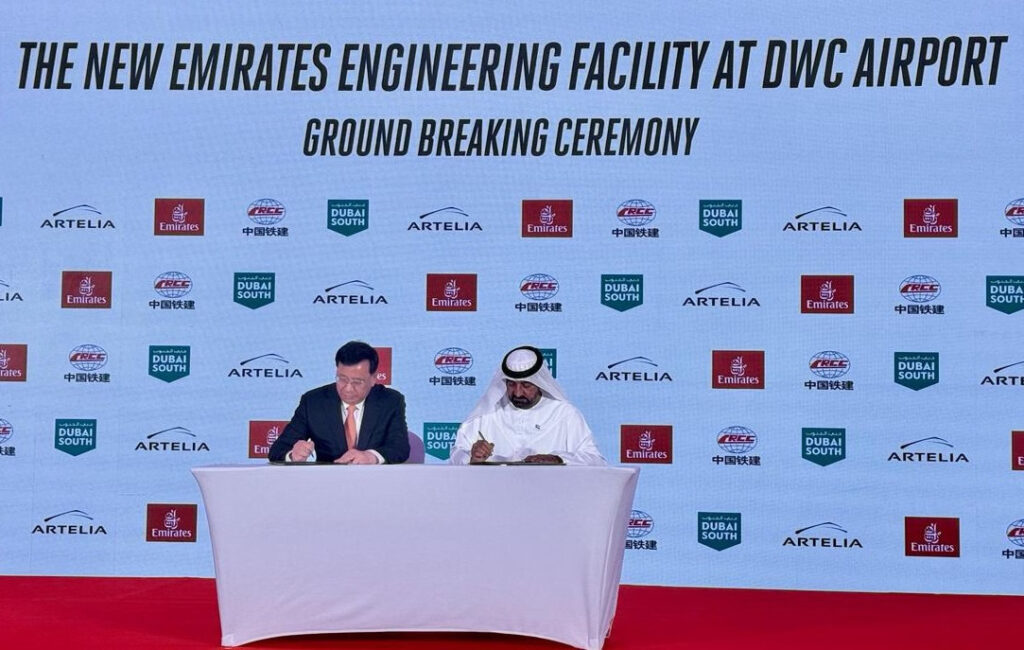
The groundbreaking ceremony, held on Monday at Dubai South (DWC Airport), was attended by Sheikh Ahmed bin Saeed Al Maktoum, Chairman and Chief Executive of Emirates Airline and Group; Sir Tim Clark, President of Emirates Airline; Khalifa Al Zaffin, Executive Chairman of Dubai Aviation City Corporation and Dubai South; and Dai Hegen, Chairman of China Railway Construction Corporation (CRRC), which will deliver the project alongside Artelia, the appointed project consultants.
Sheikh Ahmed and Dai Hegen also signed the project agreements.
Sheikh Ahmed called the investment a defining milestone, stating that the US$5.1 billion engineering facility represents a strategic step in advancing Dubai’s long-term aviation ambitions.
He added that the new complex will enhance Emirates Engineering’s vertical integration strategy by consolidating skills, infrastructure, parts production, and specialist capabilities under one roof, positioning the airline as a key engineering partner for future regional and global aviation needs.
Beyond routine maintenance, Al Redha noted that the facility will go far beyond a traditional MRO hub, enabling a wider range of engineering capabilities for both the airline and the broader aviation sector.
“This lays the foundation for Emirates’ future engineering capabilities—enabling expansion, readiness, and not only supporting the airline’s maintenance needs but also providing services to other operators in the region,” he said.
He added that the facility goes far beyond standard aircraft maintenance, expanding capabilities to include passenger-to-freighter conversions, multiple cabin modifications, and aircraft painting. “We know there is currently a shortage of aircraft painting facilities, and this will give us that capability.”
The complex represents a significant advancement in aviation capability, allowing the airline to rapidly adapt aircraft to shifting global demand—whether increasing premium seating configurations or converting passenger cabins for cargo use.
It will also support large-scale retrofits, cabin redesigns, and structural modifications in-house, helping to reduce turnaround times and improve operational flexibility at a time when airlines are facing global aircraft delivery delays and supply chain constraints.
The development reflects a wider industry trend, where airlines are increasingly investing in engineering capabilities rather than relying only on new aircraft purchases, enabling existing fleets to be continuously modified to meet evolving commercial demands.
What will be inside the facility
The complex will feature two state-of-the-art paint hangars designed to service Emirates’ wide-body fleet, with additional capacity to handle narrow-body aircraft as well—an important development amid a global shortage of aircraft painting facilities.
It will also include 77,000 sq metres of dedicated workshops for repairs and maintenance, 380,000 sq metres for storage and logistics, a 50,000 sq metre administrative building for Emirates Engineering, and 15,000 sq metres of training facilities.
All facilities in the project are designed to target a LEED Platinum sustainability rating, with rooftop solar panels integrated as part of its broader environmental strategy.
Dubai’s aviation ambition
The project supports Dubai’s Economic Agenda D33 and strengthens the emirate’s position as a global aviation hub.
Khalifa Al Zaffin said the facility is a key milestone in Dubai South’s long-term vision, noting that it advances aviation infrastructure around Al Maktoum International Airport, which is planned to become the world’s largest upon completion. He added that the project will enhance Dubai’s ability to meet rising demand for advanced aviation maintenance and engineering services.
Initially, the hangar complex will focus on heavy maintenance work and handle overflow operations from Emirates Engineering Centre at Dubai International Airport, before gradually scaling up to full operational capacity.
The project further reinforces Dubai’s status as one of the world’s leading aviation engineering and maintenance hubs, with the capability to support complex aircraft transformations at a global scale.

