

Dubai’s everyday Arabic: Why expats embrace words like habibi, yaani and inshallah.
Dubai: In Dubai, people don’t just say hello — they say marhaba.
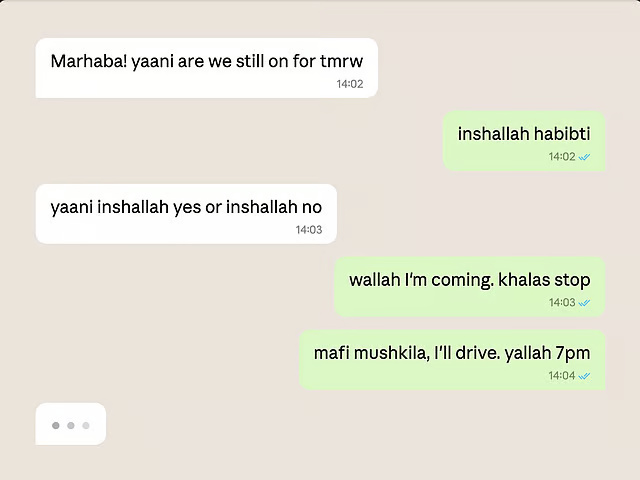
A social media trend that went viral on Instagram, built around the phrase “In my city, we don’t say…”, highlighted the unique expressions associated with different places. While many versions played on local stereotypes, Dubai’s stood out because the words and phrases featured are genuinely part of everyday conversations among residents.
From greetings to casual expressions, these Arabic words have become familiar to locals and expats alike.
In a city where more than 200 nationalities live side by side, residents have developed a shared everyday vocabulary that blends Arabic, English, Hindi, Urdu and even elements of Tagalog. These expressions have become widely understood, even among people who may not speak the languages they originate from.
Here are some of the Arabic words and phrases you’ll hear regularly in Dubai, what they mean, and why they have become part of everyday conversations among residents.
Marhaba
A simple “hello” — but with a warmer, more welcoming feel than the usual greeting.
The word comes from a root associated with spaciousness — the idea of making room for someone and welcoming them in. Ahlan wa sahlan carries a similar meaning and is another common way to say “welcome”. If you learn just one word from this list, marhaba is the one you are most likely to hear returned in everyday conversations.
Yaani
The Arabic word that almost every non-Arabic speaker in Dubai picks up, often without ever looking up its meaning.
Literally translated, yaani means “it means”. In everyday use, however, it works like “like”, “you know” or “sort of” — a conversational filler used while explaining a thought or searching for the right words. It is one of the most widely adopted expressions in the region and easily finds its way into English conversations.
Habibi and habibti
Meaning “my love” or “my dear”, habibi and habibti are among the most recognisable Arabic expressions in Dubai’s everyday speech.
Habibi is used when speaking to a man, while habibti is used for a woman. Depending on the tone and situation, the words can express genuine affection, friendly warmth between colleagues, or even a playful way of disagreeing with someone. In Dubai, context and tone often say as much as the word itself — “Habibi, no” can communicate an entire message on its own.
Inshallah
Meaning “God willing”, inshallah is one of the most widely used Arabic expressions — and the subject of countless jokes among expats.
Used sincerely, it reflects the idea that the outcome of a plan is not entirely within a person’s control. In everyday conversations, especially in workplaces, its meaning can vary depending on the speaker and tone. It may suggest “yes”, “hopefully”, “we’ll see”, “ask me later”, or sometimes a polite way of avoiding a firm commitment.
Social media trends often jokingly translate inshallah as “I promise”, which is part of the humour — because in many situations, it means the opposite: a reminder that plans can change.
Wallah
Meaning “I swear to God”, wallah is technically an oath but is often used as a conversational emphasis.
It adds sincerity or intensity to a statement, much like saying “really” or “honestly” in English. A phrase like “Enti so cute wallah” — which appeared frequently in social media trend examples — captures how naturally languages blend in Dubai: an Arabic pronoun, English words and an Arabic expression of emphasis coming together in a single sentence.
Yallah
Meaning “let’s go”, yallah can also mean “come on”, “hurry up” or “we’re leaving”.
It is arguably one of the most widely understood Arabic words in the UAE, used regularly even by people who do not speak Arabic. The phrase “yallah bye” has become a familiar Dubai-style farewell in its own right.
Khalas
Meaning “enough”, “done”, “finished” or “stop”, khalas is one of the most useful everyday Arabic words in Dubai.
It can bring an argument to an end, signal the close of a meeting, or settle a child’s negotiations over extra screen time. Direct but not necessarily rude, it delivers a firm message in a way that is often harder to capture in a single English word.
Bikam
Meaning “how much?”, bikam is one of the first Arabic words many newcomers learn — especially when shopping, bargaining or asking about prices in everyday situations.
Some versions of the social media trend used haza kam, which is closer to formal Arabic. In everyday conversations, especially in places like a souk, bikam is the phrase you are more likely to hear. It is a useful one to know before visiting the Gold Souk — rather than learning it afterwards.
Kayf halik
Meaning “How are you?”, kayf halak is used when speaking to a man, while kayf halik is used when speaking to a woman.
A common response is alhamdulillah, meaning “praise be to God”. In everyday use, it works much like “fine, thanks” in English, while also carrying a deeper sense of gratitude and contentment.
In Dubai, we don’t say… we say…
So, marhaba to anyone who has just moved here and is quietly trying to find their feet. Yaani, you’ll pick up these words faster than you think. Habibi, nobody is judging your pronunciation.
And when someone tells you your delivery will arrive at 6pm… inshallah.
Khalas.
Yallah bye.

