

A rare celestial event: Saudi Arabia prepares to witness one of the century’s longest total solar eclipses.
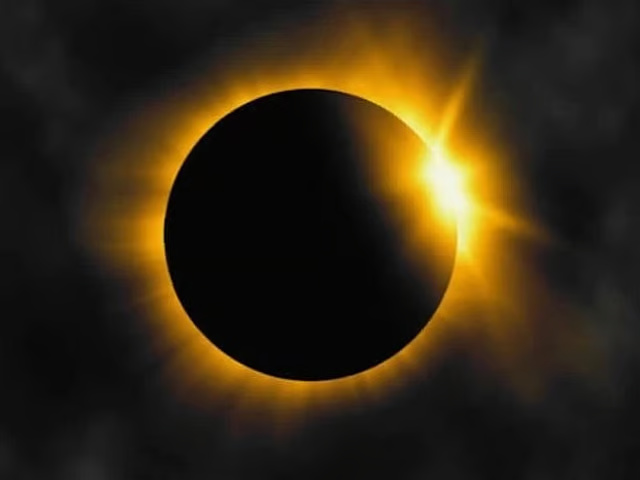
On the afternoon of August 2, 2027, Saudi Arabia will witness a rare celestial spectacle. For several minutes, daylight will briefly fade into darkness as the Moon passes directly in front of the Sun, creating a total solar eclipse.
Temperatures will drop, stars may become visible in the daytime sky, and the Sun’s outer atmosphere — the glowing corona — will emerge around the silhouette of the Moon, creating a breathtaking sight for observers.
This will be far from an ordinary eclipse. The event is expected to rank among the longest total solar eclipses of the 21st century and will mark the first time in more than 75 years that such an eclipse has crossed Saudi Arabia. The Saudi Space Agency has described it as one of the most significant astronomical events of the century.
Why Saudi Arabia will experience the eclipse
A total solar eclipse occurs when the Sun, Moon and Earth align perfectly, with the Moon positioned between the Earth and the Sun. A remarkable coincidence allows this to happen: although the Moon is around 400 times smaller than the Sun, it is also approximately 400 times closer to Earth, making both appear almost identical in size from our viewpoint.
When the alignment is exact, the Moon completely covers the Sun and its shadow falls across the Earth, briefly turning daytime into darkness along the eclipse path.
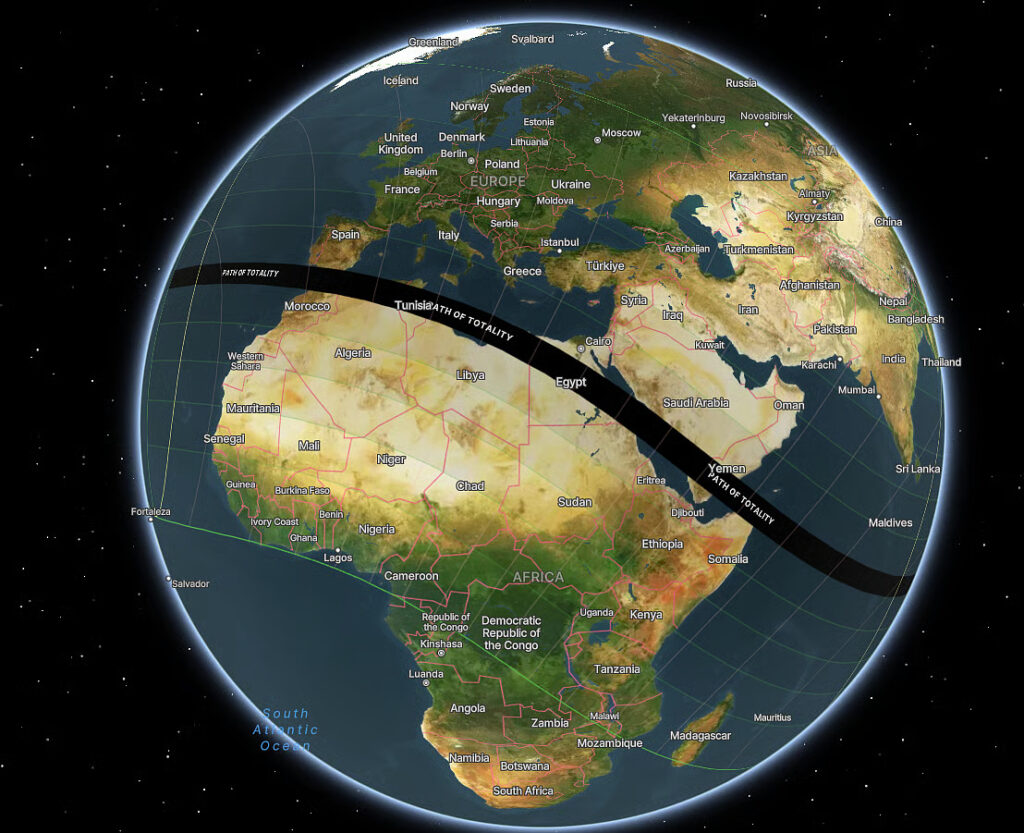
The Moon’s shadow is tiny compared with the size of Earth. It travels across the planet along a narrow corridor, typically only a few hundred kilometres wide, known as the path of totality. People located within this path experience a complete solar eclipse, while those outside it see only a partial eclipse.
This limited viewing area is what makes total solar eclipses such rare experiences. Although a total eclipse occurs somewhere on Earth roughly every 18 months, any particular location may wait centuries before it falls directly under the Moon’s shadow.
In 2027, that rare path will cross Saudi Arabia. The Moon’s shadow will begin over the Atlantic Ocean, move across North Africa and Egypt, cross the Red Sea and pass over western and southern Saudi Arabia before continuing towards the Indian Ocean.
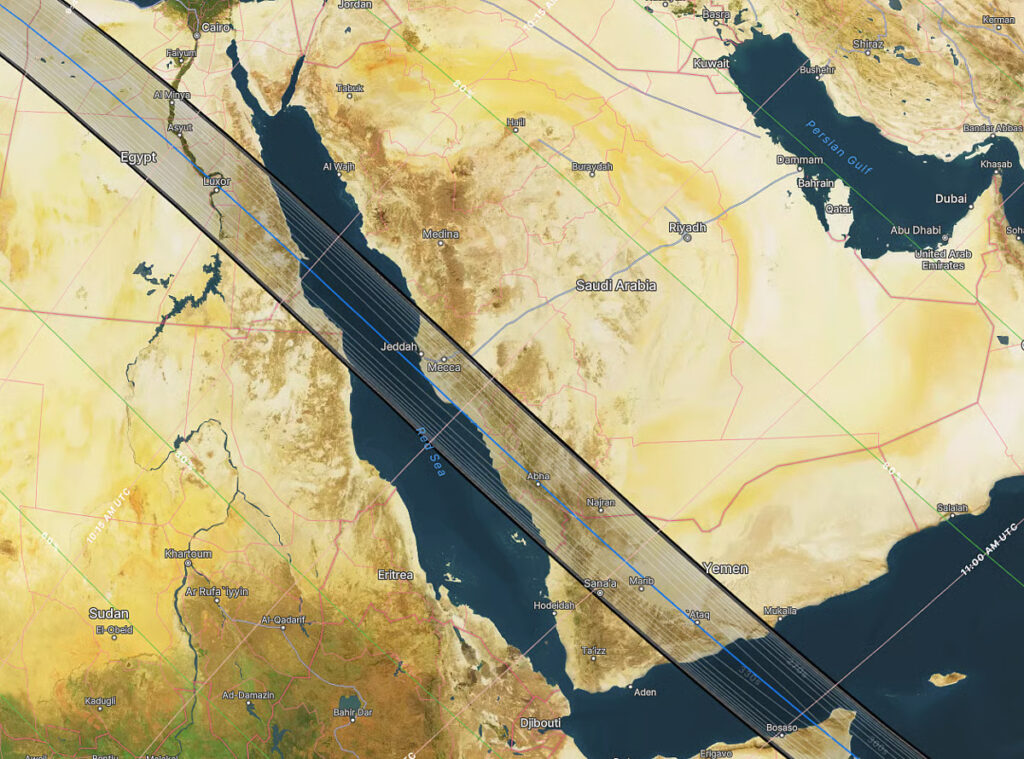
The Kingdom will be positioned directly beneath the eclipse path at the precise moment of alignment — an event that has not occurred there for more than 75 years.
Why this eclipse will last so long
The timing of the 2027 eclipse is what makes it particularly remarkable. In early August, Earth will be close to its farthest point from the Sun, making the Sun appear slightly smaller in the sky. At the same time, the Moon will be near its closest point to Earth, causing it to appear slightly larger.
This combination — a larger-looking Moon covering a smaller-looking Sun — allows the period of total darkness to continue for longer than during many other eclipses.
The longest duration of totality will occur in neighbouring Egypt, where darkness will last just over six minutes. Saudi Arabia, however, will be close enough to experience a similarly rare spectacle.
According to the Saudi Space Agency, total darkness is expected to last around six minutes in southern areas such as Abha, and approximately five minutes and 50 seconds in Jeddah and parts of the western coast. The extended duration will provide researchers and astronomy enthusiasts with a valuable opportunity to study the Sun’s corona.
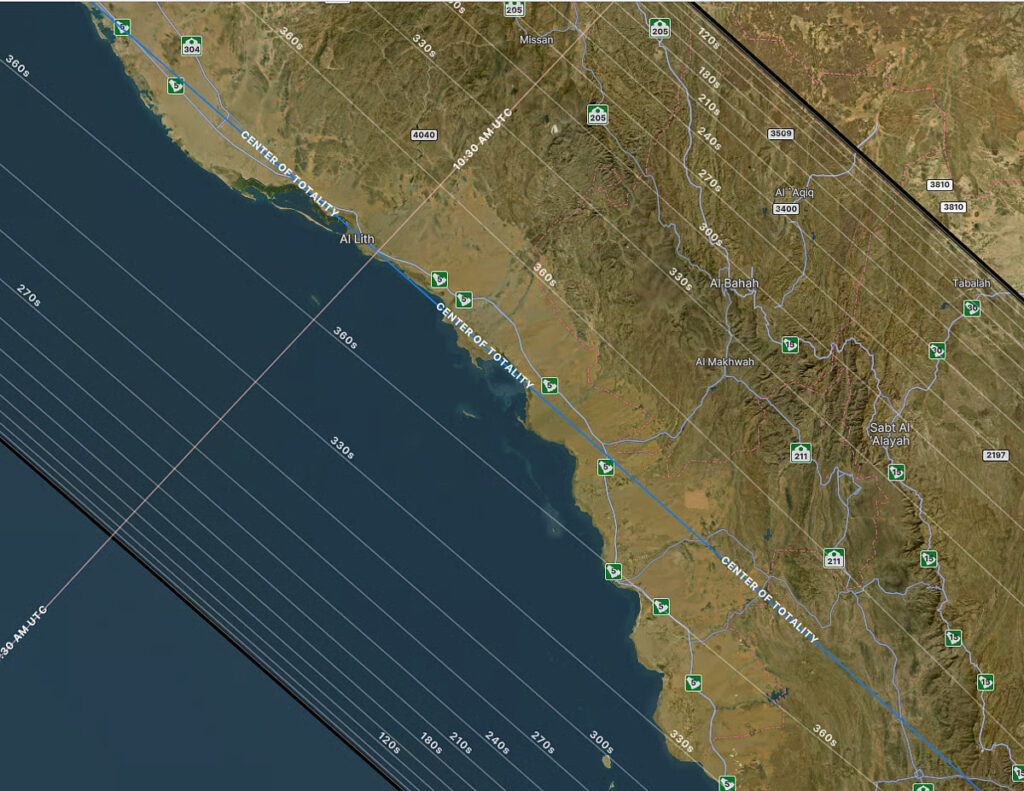
For comparison, many total solar eclipses last only around two minutes, making this event a particularly sought-after experience for eclipse chasers around the world.
Where the eclipse path will pass
According to Engineer Majed Abu Zahra, President of the Jeddah Astronomy Society, the Moon’s shadow will cross several major Saudi cities during the total solar eclipse. Mecca, Jeddah, Taif, Al Baha, Khamis Mushait, Jizan and Najran will all fall within the path of totality, where observers will experience complete darkness.
The eclipse will also pass over numerous smaller towns, including Tuwal, Dahban, Asfan, Khulais, Jumum, Bahrah, Al Hada, Al Shafa, Al Leith, Al Mandaq, Baljurashi, Majardah, Al Qunfudhah, Sabt Al Alaya, Al Namas, Tanuma, Bariq, Ahad Rafidah, Baish, Sabya, Dhahran Al Janoub and Sarat Abidah.
Other parts of the Kingdom will still witness the event. Central, eastern and northern regions — including Riyadh and the Eastern Province — will experience a partial solar eclipse, with the Sun obscured by up to 80 per cent in some locations. The exact level of coverage and timing will depend on the observer’s location.
When to look up
The eclipse will unfold over more than three hours. The first partial phase will begin at around 11:41am Arabia Standard Time, with the event ending at approximately 3pm. The period of total darkness will sweep across Saudi Arabia between about 1:21pm and 1:44pm.
City timings:
- Jeddah: Partial eclipse begins at 12:00pm. Totality starts at 1:25pm. The eclipse ends at 2:43pm.
- Mecca: Partial eclipse begins at 12:01pm. Totality starts at 1:26pm. The eclipse ends at 2:44pm.
- Taif: Partial eclipse begins at 12:03pm. Totality starts at 1:28pm. The eclipse ends at 2:45pm.
- Khamis Mushait: Partial eclipse begins at 12:13pm. Totality starts at 1:37pm. The eclipse ends at 2:54pm.
What the eclipse will feel like
In the moments before totality, daylight will gradually take on a silvery appearance and shadows will become sharper. Then, as the Moon completely covers the Sun, darkness will arrive suddenly.
A twilight glow will spread along the horizon, temperatures will drop and bright stars and planets may become visible in the daytime sky — creating a rare experience unlike any ordinary day.
At the height of totality, the eclipsed Sun appears as a dark circle suspended in the sky, surrounded by the glowing white halo of the corona. This outer atmosphere of the Sun is usually invisible because of the brightness of daylight, revealing itself only during the brief moments of a total eclipse.
That is why a six-minute eclipse is so valuable to scientists and astronomy enthusiasts. The longer period of darkness provides more time to observe and study the Sun’s corona.
The viewing location is crucial. Even with 99 per cent of the Sun covered, the sky only becomes dim — the true spectacle of totality does not occur. Observers must be within the path of totality to experience the complete eclipse.
Where to watch
The best strategy is to position yourself inside the path of totality and as close as possible to its centre line — the imaginary line running through the middle of the eclipse corridor.
Because the Moon’s shadow is roughly circular as it moves across Earth, locations near the centre line remain under the full shadow for the longest duration. Areas near the edges of the path experience only a brief period of totality, sometimes lasting just seconds.
Fortunately, the 2027 eclipse centre line will pass close to major Saudi destinations including Jeddah, Mecca and the southern highlands, giving observers several prime locations to witness the event.
Best places to watch in Saudi Arabia
Jeddah and the Red Sea coast:
The most convenient option for many visitors, with a major international airport, a wide choice of hotels and nearly six minutes of total darkness. The coastline also offers open spaces and unobstructed views of the sky.
The highlands around Abha and Khamis Mushait:
These areas will experience the longest totality in Saudi Arabia, lasting approximately six minutes. Their higher elevation can provide clearer skies, although visitors should keep an eye on forecasts as August afternoons can bring cloud formation over mountain areas.
Taif and Al Baha:
With cooler mountain temperatures and locations well within the path of totality, these destinations offer a comfortable alternative for those looking to avoid the intense summer heat.
Open desert areas within the eclipse path:
Ideal for photographers, remote desert locations provide wide horizons with minimal light pollution and buildings, creating dramatic views of the Moon’s shadow crossing the landscape.
Local astronomy organisations, including the Jeddah Astronomy Society, are expected to arrange public viewing events featuring telescopes and approved solar observation equipment. These gatherings can be especially useful for families and first-time eclipse viewers.
For those unable to travel, major space agencies and observatories typically provide live online broadcasts of total solar eclipses. While a livestream cannot replace seeing the event in person, it remains the next best option.
Will the UAE see the eclipse?
Yes, but only as a partial solar eclipse. The path of totality will pass several hundred miles west and southwest of the UAE, meaning the Emirates will not experience complete darkness.
Dubai is expected to see the Moon cover around 53 per cent of the Sun, with the partial eclipse lasting from approximately 1:33pm to 3:48pm local time. Areas farther west and south in the UAE may see slightly greater coverage, reaching around 61 per cent.
The Sun will appear as a large crescent, and the afternoon light will gradually soften. However, there will be no complete darkness, no glowing corona and no daytime stars — those extraordinary sights are reserved only for locations within the path of totality.
How to watch safely
The Saudi Space Agency has highlighted the most important safety rule: never look directly at the Sun without proper eye protection. Even during an eclipse, direct viewing can cause permanent eye damage, and no phase of a partial eclipse is safe to watch with the naked eye.
Key safety guidelines:
- Use only certified solar eclipse glasses. Ordinary sunglasses, regardless of how dark they appear, do not provide adequate protection.
- Inspect eclipse glasses before use and discard them if they are scratched, damaged or worn out.
- Never aim binoculars, telescopes or cameras at the Sun without a suitable solar filter. Concentrated sunlight can damage equipment and eyesight within seconds.
- Keep solar glasses on throughout all partial phases of the eclipse. The only time it is safe to view the eclipse without them is during totality, when the Sun is completely covered by the Moon. As soon as sunlight begins to return, the glasses must be worn again.
For one afternoon in August 2027, a narrow stretch of Saudi Arabia will become one of the world’s prime locations to witness a rare celestial spectacle. Whether standing beneath the Moon’s full shadow in Jeddah or watching a crescent Sun from Dubai, it will be a memorable moment for skywatchers across the region.

