

From achieving a perfect score of 100 in waste management to deploying AI-powered drones to seed mangroves along remote coastlines, the UAE has risen to the top of the region’s environmental rankings.
The UAE has ranked first among Arab countries in the 2026 Environmental Performance Index (EPI), the global sustainability scorecard published by Yale University, which evaluates 177 countries across 47 indicators covering environmental health, ecosystem vitality and climate change.
The country achieved a perfect score of 100 in waste management, ranking first globally in the category, and also received a score of 100 in the bottom trawling fisheries indicator, reflecting the absence of marine life caught through bottom trawling in UAE maritime zones. It further recorded a wastewater treatment score of 94.99 per cent, placing 19th worldwide.
The Emirates’ strong performance reflects its continued focus on sustainable development, environmental protection and innovative conservation initiatives, including advanced technologies and nature-based solutions aimed at preserving ecosystems for future generations.
The Emirates emerged as the regional leader in protecting marine Key Biodiversity Areas, ranking ninth worldwide, and placed second in the region for marine habitat protection.
Dr Amna bint Abdullah Al Dahak, Minister of Climate Change and Environment, said the UAE’s ranking reflects longstanding national values rather than a recent change in direction. She noted that environmental stewardship has long been embedded in the country’s identity, drawing on the legacy of the late Sheikh Zayed bin Sultan Al Nahyan, whose early vision highlighted the importance of conserving natural resources.

She described the achievement as the outcome of a comprehensive national effort, with government bodies, local communities and private sector organisations working together to advance the UAE’s environmental goals. “Our journey does not end here. We will continue to set global benchmarks, demonstrating that economic growth and environmental sustainability are not only compatible but essential partners,” she added.
Solar expansion and water security
The UAE Energy Strategy 2050 aims to triple the share of renewable energy in the country’s energy mix, supported by investments of Dh150 billion to Dh200 billion by 2030. The nation’s installed renewable energy capacity increased by 117 per cent between 2022 and 2025, driven by major projects including Noor Abu Dhabi and the Mohammed bin Rashid Al Maktoum Solar Park.
The renewable energy drive is set to gain further momentum with a newly announced $6 billion project near Abu Dhabi, developed by Masdar and EWEC. The facility will combine 5.2GW of solar photovoltaic capacity with a 19GWh battery storage system, making it the world’s largest continuous solar-plus-storage project upon completion and enabling round-the-clock delivery of clean power.
Water security remains a key national priority, with facilities such as Al Taweelah — one of the world’s largest reverse osmosis desalination plants — helping to reduce the environmental impact of desalination while enhancing long-term resilience against climate challenges.
AI-powered mangrove restoration
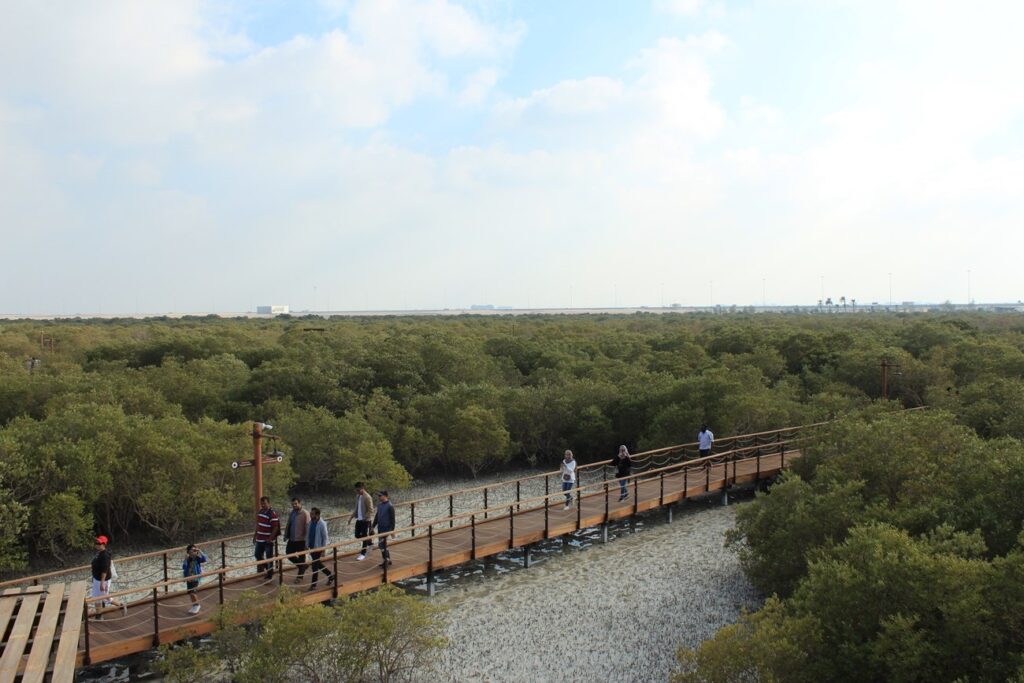
The UAE’s biodiversity conservation efforts are supported by a target to plant 100 million mangrove trees by 2030. More than 50 million mangroves have already been planted across the seven emirates, while protected terrestrial and marine areas now account for more than 19 per cent of the country’s total territory.
Technology is playing an increasingly important role in accelerating restoration efforts. UAE-developed AI-enabled heavy-lift drones are being used to distribute specially designed mangrove seeds across hard-to-reach coastal areas, while machine learning tools and satellite monitoring systems track blue carbon storage, seedling development and air quality trends in real time.
The 2026 Environmental Performance Index highlights that although wealth and environmental performance are often linked globally, effective governance is a defining factor separating leading performers from others. The UAE says its policies — including the National Air Quality Agenda 2031 and Circular Economy Policy 2031 — are designed to demonstrate how strategic planning can drive sustainable progress.

