

Group reports record revenue and cash levels despite airspace disruptions in the latter part of the year.
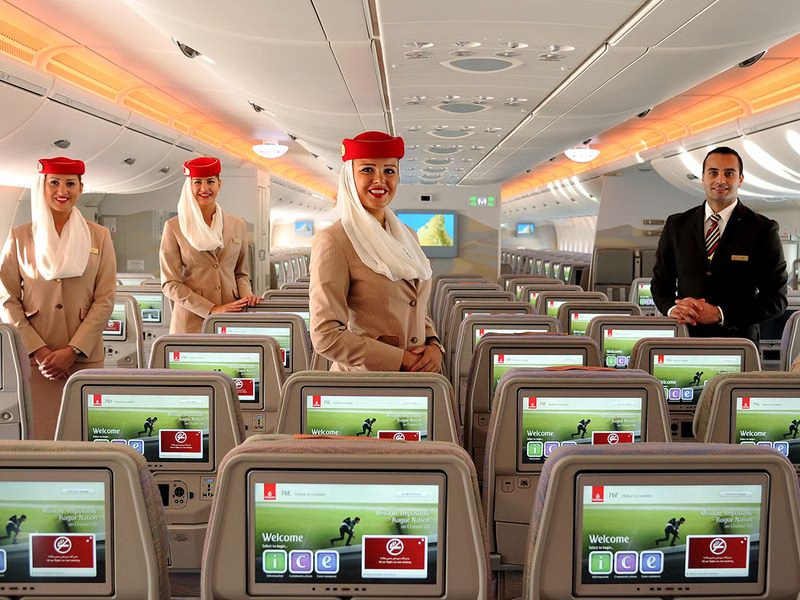
Dubai: Emirates Group has retained its position as the world’s most profitable airline group, reporting record financial results for 2025–26 despite operational disruptions in the final month of its financial year.
Emirates Group follows an April-to-March financial year, with the latest results covering the 12 months to March 31, 2026.
The group, which includes Emirates Airline and dnata—its aviation services arm—as well as subsidiaries spanning cargo, catering, travel, and retail, reported a record profit before tax of Dh 24.4 billion, up 7% year-on-year. Revenue rose to Dh150.5 billion, up 3%, while cash assets increased 12% to Dh59.6 billion.
The group recorded EBITDA of Dh41.1 billion, reflecting strong operating profitability.
The results come despite what the airline described as a “disruptive and challenging” final month of the financial year. Regional aviation, which had been enjoying a strong post-COVID growth phase, was hit by significant disruption after the US–Israel–Iran conflict escalated in late February.
The market is now gradually stabilising, with airlines beginning to restore schedules and rebuild capacity following recent operational interruptions.
Operations restored
Sheikh Ahmed bin Saeed Al Maktoum, Chairman and Chief Executive of Emirates Airline and Emirates Group, said in a statement:
“These outstanding results, despite significant challenges in the last month of our financial year, reaffirm the strength and resilience of the Emirates Group’s business model…”
He added that the first 11 months of 2025–26 showed strong performance. “Month after month, we were surpassing our targets,” he said. However, operations were impacted towards the end of the financial year.
“On February 28, military activity massively disrupted global commercial air traffic in the Gulf region, including in the UAE,” he said.
Sheikh Ahmed added: “We are fortunate to be based in Dubai, where years of infrastructure investments and a cohesive aviation ecosystem have enabled the government to quickly secure safe corridors for commercial flights.”
Emirates Airline and dnata have since gradually restored operations at Dubai International Airport.
“Although we are still operating at a lower passenger capacity than pre-disruption, cargo operations have ramped up to support the movement of essential goods into and through the UAE,” he added.
Emirates airline performance
Emirates Airline reported record profit and revenue, maintaining its position as the world’s most profitable airline.
The carrier posted a profit before tax of Dh22.8 billion, up 7% year-on-year. Revenues rose to Dh130.9 billion, a 2% increase compared to the previous year.
The airline also recorded its highest-ever cash assets of Dh54.9 billion, up 10% compared to March 31, 2025.
Revenue rose as Emirates expanded capacity to capture demand across multiple markets, supported by a growing network and partnerships reaching over 1,700 cities beyond its own routes.
The airline transported 53.2 million passengers and maintained a passenger seat load factor of 78.4 per cent. Passenger yields also improved, indicating sustained strong demand.
Fuel and staff costs remained the largest expense categories. Although overall operating costs increased due to higher flying activity, lower fuel prices helped partially offset the rise.
Total operating costs were up 2 per cent compared to the previous financial year. However, fuel expenses declined in share, accounting for 29 per cent of operating costs versus 31 per cent in 2024–25.
The airline’s fuel bill fell slightly to Dh31.2 billion, compared to Dh32.6 billion a year earlier, as a 7 per cent drop in average fuel prices offset a 1 per cent increase in consumption driven by higher flying activity.
The airline was ranked the UAE’s third strongest brand, with its brand value increasing 27 per cent year-on-year to $10.6 billion. It also achieved a Brand Strength Index (BSI) score of 85.3 out of 100, driven by strong global visibility, sustained demand for travel, and one of the aviation sector’s largest sports sponsorship portfolios.
According to Brand Finance, Emirates announced nine major sports partnerships and renewals in 2025, reinforcing its position as one of the most prominent global sports sponsors through the 2030s.
Fleet expansion remained a major priority for the airline over the year.
Emirates received 15 new Airbus A350 aircraft, increasing its A350 fleet to 19, which now serves 21 destinations. The overall fleet size reached 277 aircraft, with an average fleet age of 10.8 years.
The airline also progressed its $5 billion cabin retrofit programme, having upgraded 91 aircraft so far out of a planned 215, as part of its broader effort to enhance in-flight product and consistency across the fleet.
At the Dubai Airshow, Emirates placed additional aircraft orders valued at $41.4 billion at list prices, taking its total order backlog to 367 aircraft and extending planned deliveries through 2038.
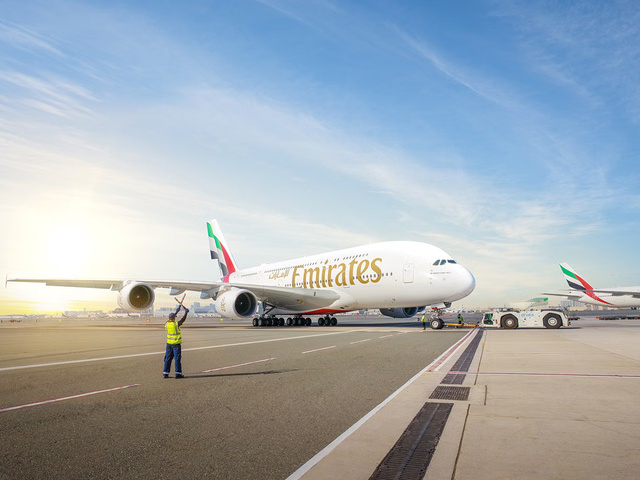
Future outlook
Looking ahead, the Emirates Group said it will continue investing across aircraft, infrastructure, and technology to support long-term growth.
“The Emirates Group has navigated crises and disruptions before… each time, we have bounced back stronger,” said Sheikh Ahmed.
The group added that its business model remains solid, and Dubai’s position as a global aviation hub is unchanged as it enters the new financial year.
Sheikh Ahmed bin Saeed Al Maktoum expressed confidence in the group’s resilience, saying:
“The Emirates Group has navigated crises and disruptions before. Each time, we focused on our customers and our people, and each time, we have bounced back stronger.”
He added that employees remain central to the organisation’s success, highlighting their ability to respond with agility in a fast-changing operating environment.
“Our people are a big part of our success, enabling us to respond with agility in a dynamic operating environment. I would like to thank all our employees — they have truly exemplified the qualities that set the Emirates Group apart during testing times.”
The Group’s workforce expanded by 8 per cent, reaching 130,919 employees, driven by continued hiring across both Emirates Group and dnata.
In the previous year, the group shortlisted 390,000 candidates from a total of 3.5 million applications and onboarded more than 9,700 employees in the UAE, reflecting strong global interest in roles across its businesses.
The Group’s UAE national workforce surpassed 4,000 employees, reflecting steady progress in national talent development programmes.

Fuel and cost management
Fuel remained one of the largest operating expenses. The airline reported a slight reduction in its fuel bill compared to the previous year, driven by lower average fuel prices, even as flying activity increased.
The Emirates Group also continued using hedging strategies to manage fuel price exposure and foreign currency risks, helping to stabilise cash flows.
Sheikh Ahmed noted that the airline remains well protected against fuel volatility:
“From a fuel perspective, Emirates is well-hedged until 2028–29; and we have worked with our suppliers to secure the volumes required to support our current operations and our scaling up to pre-disruption levels.”
dnata and other business units
dnata delivered record performance, supported by strong growth in global passenger travel and cargo demand.
Revenue increased to Dh 23.6 billion, up 12 per cent year-on-year, with international operations accounting for a substantial portion of earnings. Profit before tax rose 2 per cent to Dh1.6 billion in 2025–26.
International businesses now contribute 77 per cent of dnata’s total revenue, an increase of 2 percentage points compared to the previous year, highlighting its growing global footprint.
The business also reported strong operating cash flow, along with increased investment in infrastructure such as cargo and catering facilities.
Emirates SkyCargo
The cargo division transported xx million tonnes, supported by expanded freighter capacity and a wider network now covering 44 destinations.
Emirates Flight Catering
Emirates Flight Catering recorded revenue growth driven by external contracts. It now serves more than 100 airline customers and also supports large-scale global events.
MMI / Emirates Leisure Retail
The business posted revenue of Dh2.9 billion, a 5 per cent decline, affected by softer market conditions and the rollback of the UAE municipality tax waiver.
During the year, ELR acquired the remaining 25 per cent stake in Air Ventures LLC, gaining full ownership of the company that operates airport retail and food and beverage outlets in the United States.

