

UAE’s heaviest March rainfall in 80 years attributed to natural weather, not cloud seeding, says NCM.
Dubai: Following one of the UAE’s heaviest rainfalls in decades, questions quickly emerged on social media and in public forums about whether the storms were enhanced by cloud seeding or were completely natural.
From March 21 to March 28, the country saw intense rainfall caused by unstable weather associated with a low-pressure system, which triggered widespread convective clouds and heavy downpours across several areas.
Meteorological records show that this rainfall episode ranks among the heaviest in the UAE since systematic weather documentation began over 80 years ago.
Jebel Yanas in Ras Al Khaimah recorded the highest accumulation at 244 mm, followed by Al Manama in Ajman with 234.7 mm and Al Hayer in Al Ain at 234.1 mm. Other significant readings included 229.7 mm at Jebel Mebrah in Ras Al Khaimah and 226.6 mm in Khatm Al Shakla, Al Ain.
The fact that the heavy storms occurred in March, rather than during the usual peak winter period, sparked speculation that weather modification methods like cloud seeding might have contributed to the rainfall.
In remarks to Gulf News, the National Centre of Meteorology (NCM) confirmed that the recent heavy rainfall was caused by natural atmospheric conditions associated with a low-pressure system, and not by cloud-seeding activities. The centre stated that no cloud-seeding missions took place during the storms, and none are scheduled in the near future.
What is cloud seeding?
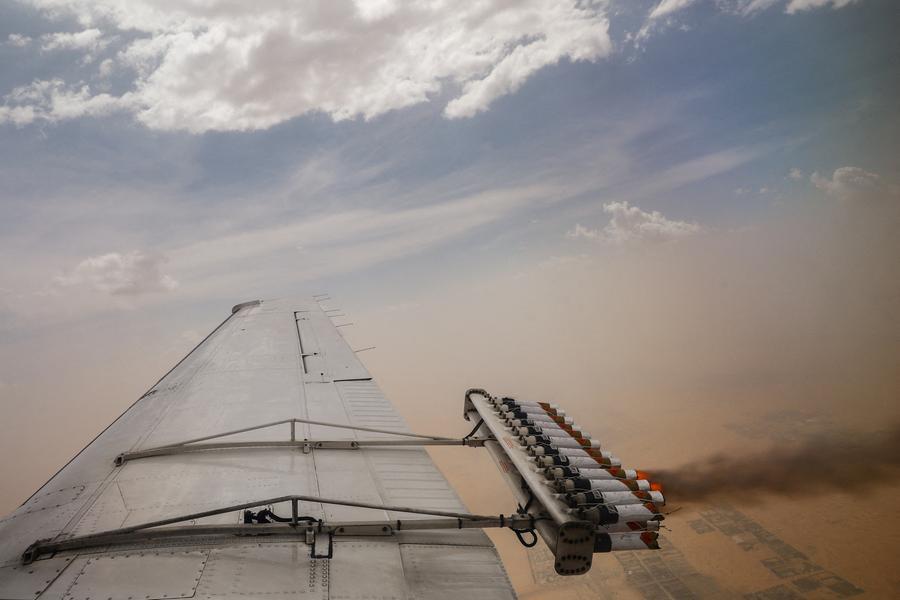
Cloud seeding is a weather-modification method aimed at increasing rainfall by adding specific particles to clouds to stimulate the formation of raindrops.
This is usually done using aircraft or ground-based generators, which release substances like silver iodide, sodium chloride (table salt), or potassium iodide into the clouds. These particles act as “seeds,” providing a surface around which moisture can condense, potentially leading to precipitation under the right atmospheric conditions.
These particles serve as condensation nuclei—tiny surfaces that allow water vapour to gather. As moisture collects around them, the droplets gradually grow until they become heavy enough to fall as rain.
Countries use cloud seeding mainly in arid and semi-arid regions to support water security. The technique can help increase rainfall, alleviate drought, boost agricultural output, and sometimes reduce hail damage.
In the UAE, cloud-seeding research has been part of a long-term water sustainability strategy. However, meteorologists emphasize that such operations require specific atmospheric conditions and cannot generate storms on their own.
Despite the heavy rainfall, the recent storms in the UAE caused no reported fatalities, with damage mostly confined to property and temporary disruptions.
Emergency teams nationwide worked tirelessly to pump out floodwaters, clear roads, and maintain traffic flow. The weather system affected much of the country, producing intense rainfall and rapid runoff, with some locations recording over 244mm of rain.

