

UAE Residents Urged to Rely on Official Channels and Avoid Rumours Following Drone Incident.
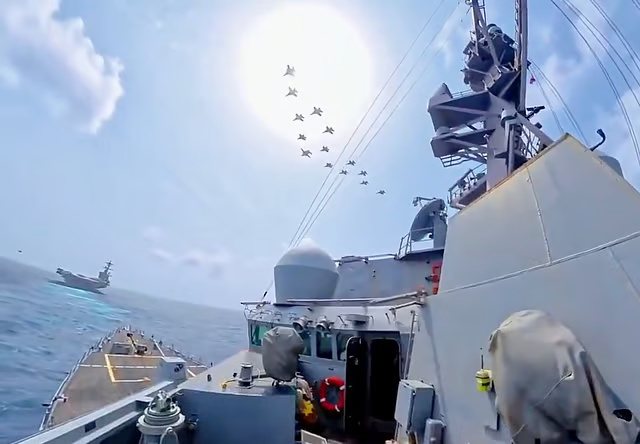
The UAE said its air force responded on Monday, August 31, to a drone approaching from Iran over the country’s territorial waters, as hostilities between the US and Iran intensified again near the Strait of Hormuz.
Authorities said the UAE’s air-defence systems remain on high alert and urged residents to rely on official sources for information and avoid spreading unverified reports or rumours.
The incident came after the US struck two Iranian launchers on Larak Island, near the Strait of Hormuz. Iran has also claimed that it targeted US bases in the region.
The UAE Ministry of Defence said its air force had successfully dealt with an unmanned aerial vehicle approaching from Iran.
Public Guidance
The UAE Ministry of Defence said the armed forces remain prepared to respond to any potential threats, while air-defence systems continue to monitor the country’s airspace around the clock.
The UAE’s core public guidance is for residents to rely exclusively on official sources and avoid sharing unverified videos, claims, location details or emergency alerts.
For residents, this means:
- Follow updates from the UAE Ministry of Defence, the National Emergency Crisis and Disaster Management Authority, police authorities and official state news channels.
- Do not forward social-media posts alleging attacks, explosions, airspace closures or emergency measures unless they have been confirmed by UAE authorities.
- Before travelling to the airport, check the status of your specific flight directly with the airline.
- Keep personal travel, school and work contingency plans up to date, but do not assume a cancellation, closure or safety threat unless an official notice has been issued.
Flights Remain Fluid
Aviation disruption remains one of the most immediate practical concerns for residents and visitors.
Several flights to and from the UAE continue to operate, but airlines are adjusting schedules, cancelling selected services and rerouting aircraft as regional airspace restrictions and security assessments evolve.
Passengers should check their flight status before leaving for Dubai, Abu Dhabi or Sharjah airports, as airline schedules remain subject to rapid changes.
Several international airlines have extended suspensions or reduced services to and from the UAE:
- Air Canada: Dubai services suspended until mid-January 2027.
- Finnair: Dubai and Doha services suspended until March 27, 2027.
- KLM: Dubai services suspended until October 24.
- Wizz Air: Dubai and Abu Dhabi services suspended until October 24.
- Singapore Airlines: Dubai suspension extended until October 24.
- Philippine Airlines: Manila-Dubai flights suspended until October 2.
- British Airways: Dubai services suspended until October 25.
- Lufthansa and SWISS: Dubai flights suspended until September 13.
- Cathay Pacific: Dubai flights suspended until October 25.
These schedules can change quickly. Passengers should therefore verify the status of their specific flight directly with the airline or booking provider rather than relying on route-wide suspension information.
UAE-based carriers continue to operate some regional services, although selected routes remain affected. Emirates, Etihad Airways, flydubai and Air Arabia have issued rolling updates to their schedules, particularly for services across the Gulf region.
Schools, Work and Daily Life
More than 1.277 million students across the UAE are returning to classrooms today, August 31, marking the start of the 2026–27 academic year.
The UAE Ministry of Education has confirmed that schools will reopen for in-person learning. A phased return with reduced hours will run from August 31 to September 3, with normal school schedules expected to resume on September 4.
Schools also have contingency plans in place should circumstances change.
The broader message for residents is one of continuity with vigilance. UAE air-defence systems remain active, while schools, public services and much of commercial life continue to operate unless authorities issue different instructions.
Why Hormuz Matters
Larak Island lies near the Strait of Hormuz, a narrow but strategically vital waterway connecting the Persian Gulf with the Gulf of Oman.
The strait is critical to global energy markets and the export of oil and gas from Gulf producers, including the UAE. Any disruption to shipping through the waterway could therefore have wider implications for global energy supplies and prices.
Oil prices rose sharply at the start of Asian trading following the strike on Larak Island, with Brent crude briefly climbing above $90 a barrel as traders assessed the increased risks to Middle East energy supplies and shipping.
For UAE residents, the advice remains straightforward: stay alert, follow official UAE channels for verified updates and check flight information directly with airlines.
The wider risk will depend largely on whether the latest US-Iran confrontation escalates further around the Strait of Hormuz.

