

Why UAE residents should plan their airport journeys well in advance.
The US-Iran war entered its sixth month on Friday as American diplomats began returning to US embassies in the Gulf, marking the first easing of wartime staffing restrictions since the conflict began.
However, there were no signs of a broader breakthrough. Iran said it would consider returning to negotiations if Washington ends its pressure campaign, while Hezbollah’s leader rejected the agreement between Israel and Lebanon. Meanwhile, US Central Command said the number of commercial vessels turned away under its blockade of Iran had risen to 82.
Here is the latest situation as of Saturday, August 29, 2026.
American diplomats begin returning
US embassies across the Middle East have started welcoming staff back, with some employees also returning with their families. The move reverses an evacuation order issued during the early weeks of the war and signals a limited easing of US wartime restrictions.
The return of US diplomatic staff remains partial. Embassies are not yet operating at full strength, with the State Department easing restrictions selectively rather than lifting them across the region.
Qatar, Kuwait and Bahrain announced on Friday that diplomats’ families would be allowed to return. However, Bahrain and Kuwait have limited the move to family members aged 18 and above.
Tehran leaves the door open — but on its terms
As the war reached the six-month mark, Iran reiterated that a negotiated settlement remains possible, but said Washington must first abandon its pressure campaign before talks can resume.
Foreign Minister Abbas Araghchi reiterated the position on X, saying a return to diplomacy remains possible and emphasizing Tehran’s belief that pressure will not achieve results.
The events of the past six months provide arguments for both sides. Pakistan and Qatar have been involved in mediation efforts for months. A ceasefire remained in place from April, while a memorandum of understanding aimed at paving the way for a final settlement was signed in June. However, neither initiative resulted in a lasting agreement, and Washington has since intensified its economic pressure on Tehran.
Araghchi also had a busy diplomatic week. On Thursday, he hosted Qatar’s foreign minister in Tehran for discussions focused on the Strait of Hormuz, which Iran closed at the beginning of the war. The meeting followed a period of increased diplomatic engagement between Iran, Oman and Pakistan.
Kuwait steps up diplomatic contacts
Kuwait’s Foreign Minister Sheikh Jarrah Jaber Al-Ahmad Al-Sabah held a series of phone calls on Saturday, speaking separately with Oman’s Foreign Minister Sayyid Badr Hamad Al Busaidi and Qatar’s Prime Minister and Foreign Minister Sheikh Mohammed bin Abdulrahman bin Jassim Al-Thani.
According to a statement issued by Kuwait’s Foreign Ministry through KUNA, the calls focused on regional developments and ongoing diplomatic efforts to strengthen security and stability. The discussions also placed particular emphasis on maintaining safe and uninterrupted navigation through the Strait of Hormuz.
Blockade tally reaches 82 vessels
US Central Command said its running tally had reached 82 commercial vessels turned away as of August 28 as part of efforts to enforce the blockade on Iran. Three vessels were disabled and two were boarded during the operations.
Hezbollah rejects Lebanon agreement
Hezbollah leader Naim Qassem returned to the airwaves on Friday, firmly rejecting the agreement between Israel and Lebanon and saying the group would not surrender after nearly six months of fighting.
Speaking on Hezbollah’s Al-Manar channel, Qassem said the group opposed the agreement and called for it to be scrapped, describing it as unlawful, humiliating and damaging to Lebanese sovereignty.
The agreement emerged from direct talks brokered by the United States after Hezbollah brought Lebanon into the war on March 2 by launching an attack on Israel. Israel responded with sustained airstrikes and a ground offensive that have killed more than 4,300 people, according to the Lebanese government.
Signed in late June, the framework calls for Hezbollah to disarm, outlines a phased Israeli withdrawal from southern Lebanon and requires the Lebanese army to take control of areas vacated by Israeli forces, starting with designated pilot zones.
Qassem’s remarks leave Lebanon’s most heavily armed group openly opposed to an agreement that has been endorsed by the Lebanese state.
Rare Israeli airstrike hits West Bank
The Israeli military said it killed three militants in an airstrike in the occupied West Bank on Friday. The use of air power is relatively uncommon in the territory, where tensions have continued to rise.
Settler violence in the West Bank has risen sharply, but the territory has largely avoided the extensive aerial campaign that has devastated much of Gaza since the Hamas attacks on October 7, 2023. Israeli ground raids on Palestinian towns remain common, while airstrikes have been relatively rare since early 2025.
Flying from the UAE
Emirates, Etihad, Air Arabia and flydubai continue to operate flights, although individual services on Gulf routes may still be cancelled, delayed or rescheduled at short notice as airlines respond to changing security conditions.
Some restrictions have eased, with carriers gradually restoring parts of their normal networks. However, several airlines continue to have flight suspensions in place extending into the autumn.
UAE carriers today
Emirates is operating flights from Dubai, although some services continue to face disruption. EK837 to Bahrain has been cancelled, while EK839 on the same route remains scheduled. EK857 to Kuwait is also scheduled to operate, while EK719 to Nairobi has been delayed.
Etihad is largely operating normally on its Bahrain and Kuwait routes from Abu Dhabi. EY647 arrived late, while EY641, EY643 and EY645 are scheduled to operate. EY653 to Kuwait has already departed.
Air Arabia has cancelled several Gulf flights, including G9068 and G9124 from Sharjah to Kuwait, G9107 from Sharjah to Bahrain, and 3L020 from Abu Dhabi to Kuwait.
flydubai is also reporting delays on several services, including FZ739 to Ashgabat. The airline is advising passengers departing from Dubai to arrive at the airport four hours before their scheduled departure and complete online check-in in advance where possible.
Other Dubai departures
Several other flights from Dubai are also facing delays or cancellations. These include SpiceJet services to Pune, New Delhi, Mumbai, Jaipur, Kozhikode, Kochi and Amritsar, as well as Air India Express flights to Jaipur and Kannur. Kenya Airways KQ311 to Nairobi, Oman Air WY604 to Muscat and PIA PK284 to Peshawar are also affected.
International carriers with suspensions still in place
- Lufthansa Group: Lufthansa, SWISS, Austrian, Brussels Airlines and ITA Airways have suspended services to multiple Middle East destinations through October 24.
- British Airways: Flights to Dubai, Tel Aviv, Bahrain and Amman remain suspended until October 25, with services expected to resume at reduced frequencies.
- Singapore Airlines: Dubai services remain suspended until October 24.
- Cathay Pacific: Flights to Dubai are suspended until October 25, while Riyadh services are suspended until October 26.
- Wizz Air: Services from mainland Europe to Dubai and Abu Dhabi are suspended until October 24, while Amman flights remain suspended until September 21.
- KLM: Services to Dubai, Riyadh and Dammam remain suspended until October 24. Flights to Tel Aviv resumed on August 25.
- Air France: Services to Dubai and Riyadh have resumed, while flights to Beirut remain suspended until September 1.
- Air Canada: Dubai and Tel Aviv services have been cancelled until mid-January 2027.
- Finnair: Flights to Dubai remain suspended until March 27, 2027.
DXB is getting busier again
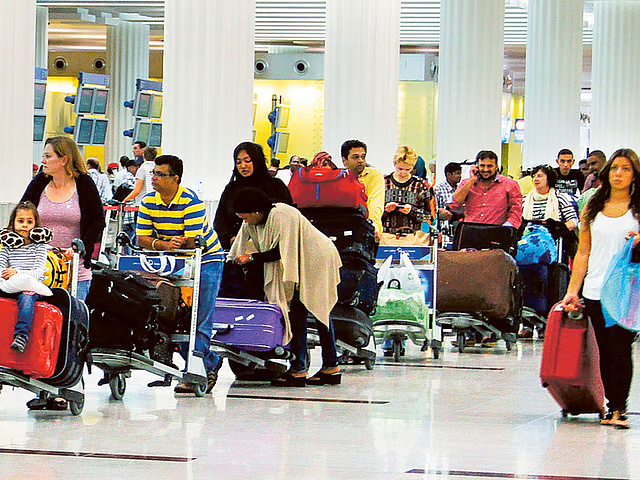
There is another reason travellers should consider leaving for the airport earlier this weekend. Dubai’s post-summer travel rush is gathering pace, with residents and visitors returning from holidays and airports experiencing heavier passenger traffic. Airport authorities have increased preparations across terminals and checkpoints to manage the surge.
For travellers, this means queues could become a bigger source of delays than the conflict itself. Allow enough time for the journey to the airport, check-in, security screening and passport control rather than planning only around the scheduled flight time.
Before heading to the airport
- Check your flight status on the day of travel, even if it was confirmed earlier in the week.
- Allow at least three hours before departure, or longer if your airline recommends it.
- Complete online check-in whenever available.
- Factor in additional time for traffic, check-in, security and immigration.
- Ensure your airline has your latest phone number and email address so you can receive disruption alerts.

