

Mohammed Al Shehhi’s AI System Identifies 14 Types of Cyberattacks with 97.45% Accuracy on Small Devices.
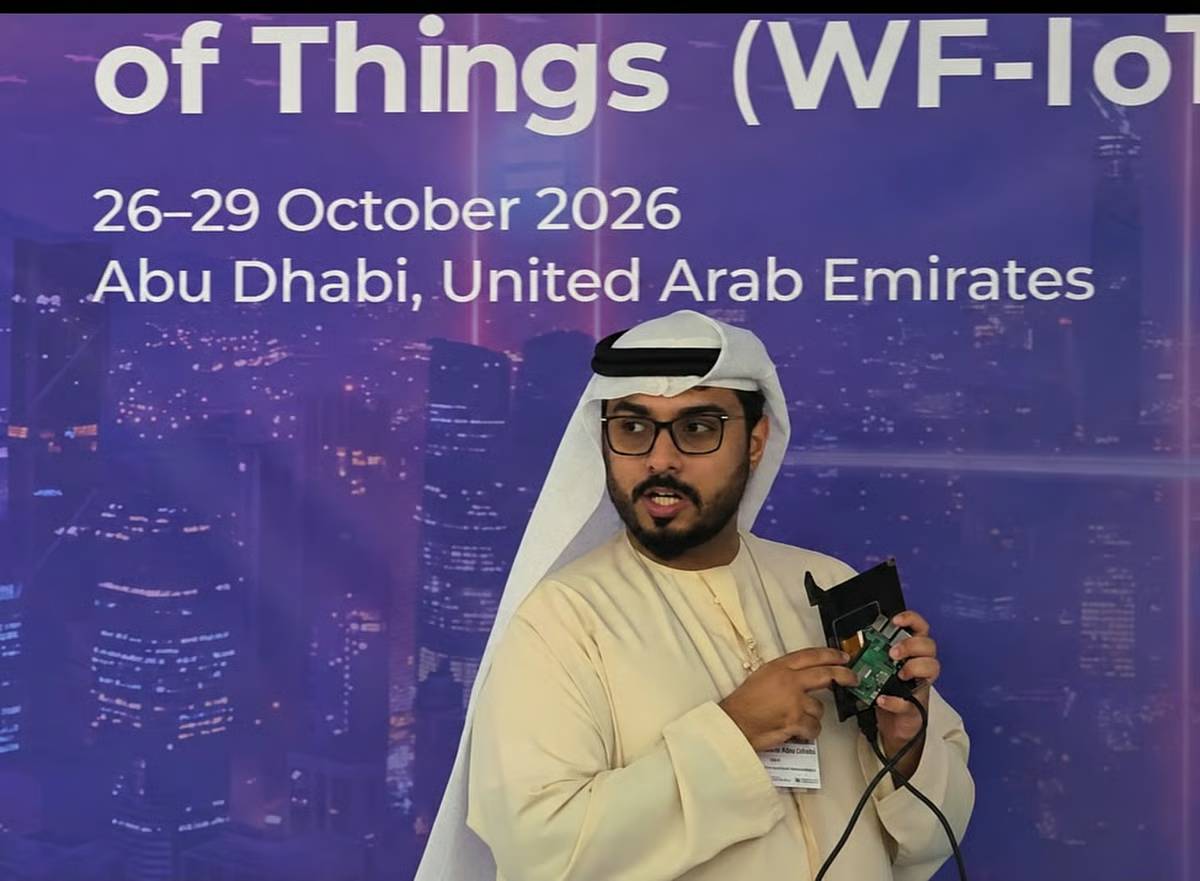
Abu Dhabi: An Emirati engineer has developed an artificial intelligence (AI) system that detects cyberattacks with 97.45 per cent accuracy, identifying 14 types of threats in just 0.87 milliseconds. This is around 31 times faster than an earlier international research benchmark tested on the same device.
Mohammed Al Shehhi, a data scientist and lecturer at the Higher Colleges of Technology, developed the system to help secure internet-connected devices, including home surveillance cameras, smart appliances, sensors and industrial equipment. By lowering the computing power and memory needed to identify threats, the technology could support more efficient cybersecurity solutions for devices with limited processing capabilities.
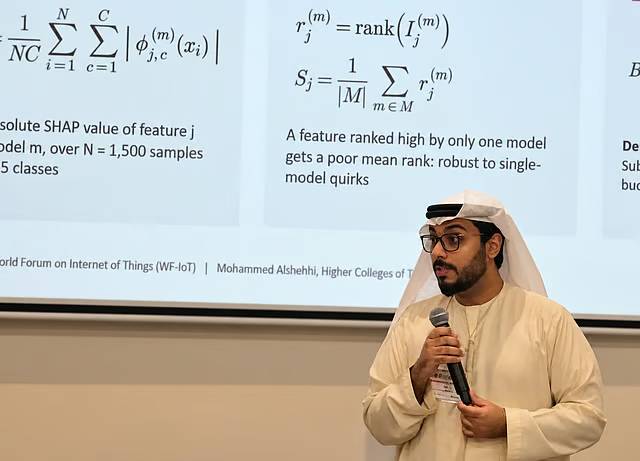
Al Shehhi is presenting his findings today at the 12th World Internet of Things (IoT) Congress, being held at Khalifa University in Abu Dhabi from October 26 to 29. The UAE is hosting the international conference for the first time, bringing together researchers and specialists from academia, industry and government to discuss artificial intelligence, cybersecurity and smart cities.
Smaller models, faster detection
In an exclusive statement to Gulf News, Al Shehhi explained that the research uses explainable artificial intelligence to identify the network indicators most relevant to detecting malicious activity, rather than analysing every available feature.
This approach reduced the number of features used by one model from 47 to 20, a reduction of approximately 57 per cent, while simplifying the detection process.
The main model was also scaled down to around 301 kilobytes, compared with 5,213 kilobytes for the full model used as the study’s starting point.
Researchers also developed a more compact version measuring approximately 152 kilobytes, with a prediction time of around 0.61 milliseconds, while maintaining strong performance during testing.
These reductions could make AI-powered cybersecurity more practical for connected devices with limited memory and processing capacity.
Tested on real hardware
The research was evaluated using established benchmark datasets widely used in Internet of Things (IoT) security studies. Al Shehhi also tested the model on a physical, low-power computing device to assess how it performed under real-world hardware constraints.
A multi-round evaluation found that the model outperformed the strongest comparable published study included in the assessment on one performance metric, achieving a score of 0.969 against 0.947 — an improvement of 2.2 percentage points.
The findings highlight the potential of the approach in terms of detection accuracy, prediction speed and model size.
However, the technology remains in the research and development phase and has not yet been commercially deployed in homes or industrial facilities. The results are based on scientific testing using benchmark datasets and physical hardware, and further development will be needed before commercial adoption.
Potential applications in homes and industry
As the number of connected devices increases, so does the demand for cybersecurity solutions that can operate within limited hardware resources. Devices such as surveillance cameras, smart refrigerators, washing machines, sensors and industrial equipment often lack the memory and processing power needed to run conventional security software.
Al Shehhi’s research could help advance lightweight intrusion detection systems for smart homes, factories, industrial facilities and smart cities. Such systems could allow connected devices to identify suspicious network activity while consuming fewer computing resources.
Emirati research on the international stage
Al Shehhi’s presentation at the 12th World Internet of Things Congress brought UAE-developed research to an international audience, highlighting the contributions of Emirati researchers to advances in artificial intelligence and cybersecurity.
The study also highlights the role of UAE higher education institutions in nurturing research talent and translating academic knowledge into practical applications. By addressing real-world cybersecurity challenges, the research illustrates how expertise developed in the UAE could contribute to emerging technologies.

