

Engineers who worked on the UAE’s Mars mission are now programme managers and team leaders on MBR Explorer, as the country focuses on developing the space technologies it needs to master at home.
Six years ago, some of the Emirati engineers working on the Hope Probe were still learning how to build and operate the UAE’s first interplanetary mission. Today, several of them are leading a spacecraft that will travel almost 10 times farther.
Engineers who worked on the Emirates Mars Mission have returned as programme managers, team leaders and technical specialists on MBR Explorer, the spacecraft being developed for a five-billion-kilometre journey through the asteroid belt, Salem Butti Al Qubaisi, Director-General of the UAE Space Agency, said.
“There is something called institutional knowledge,” Al Qubaisi said. “The young Emirati engineers who took part in the Emirates Mars Mission and worked on the Hope Probe are now continuing in leadership roles — as programme managers and team leaders — on the new MBR Explorer programme.”
For Al Qubaisi, that progression is one of the clearest signs of what the Hope mission left behind. He likened it to tending a palm tree — watering and nurturing it year after year before finally seeing it bear fruit.
“That’s the gratification that I see and I feel,” he said, describing engineers progressing from junior roles on one mission into leadership positions on the next.
That progression matters because building national expertise was part of the purpose of Hope long before the spacecraft reached Mars. An independent assessment by University College London, conducted before the Emirates Mars Mission launched, identified a broad range of capabilities emerging from the programme, including spacecraft project management, risk management, software quality assurance, manufacturing expertise, scientific capacity and infrastructure.
The researchers also found that the programme had strengthened the UAE’s readiness for future space missions while creating a mechanism for transferring knowledge from international partners into the country. Six years later, MBR Explorer is beginning to demonstrate what it means to put that knowledge to work again.
A much harder mission
The Emirates Mission to the Asteroid Belt is considerably more complex than the journey Hope began in July 2020.
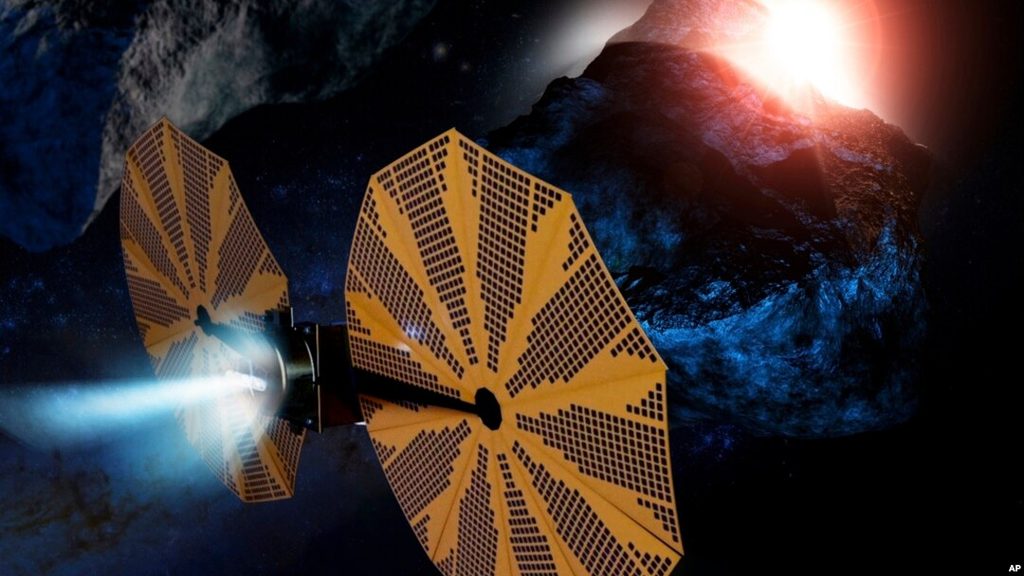
MBR Explorer is scheduled to launch in March 2028 and travel roughly five billion kilometres over a seven-year mission. The UAE Space Agency says the spacecraft will be about twice the length of Hope and around 1,000 kilograms heavier.
MBR Explorer will use gravity-assist manoeuvres around Venus, Earth and Mars to alter its speed and trajectory before beginning a series of encounters with asteroids in the main belt between Mars and Jupiter.
Its first asteroid encounter is expected in February 2030. By 2034, the spacecraft is expected to reach its seventh and final target, Justitia, where it will deploy a lander to study the asteroid’s surface.
The mission will investigate the origins and evolution of water-rich asteroids, their composition and geological history, and whether such bodies could eventually provide resources for future space exploration.
MBR Explorer has already passed its critical design review and entered assembly, integration and testing — the stage at which its different systems are brought together and tested under conditions designed to replicate the environment they will encounter in space.
Al Qubaisi said the team has been able to build on spacecraft design and operational experience gained through Hope, rather than having to approach deep-space exploration from the ground up.
There is another sign of that continuity: some of the engineers who once received training through the Hope mission are now helping lead the next one.
“Young engineers back in the Hope Probe now are in a position to be leadership in this new programme,” he said.
The agency has also opened parts of the asteroid mission to engineers from UAE private-sector companies, allowing them to work alongside the mission team and take that experience back into industry.
That feeds into a larger question facing a relatively young space economy: which capabilities should the UAE develop and retain at home?
What does the UAE need to own?
Al Qubaisi was clear that the answer is not everything.
“Trying to say that you can do everything is actually not being honest to yourself,” he said.
The UAE, he said, still does not have domestic launch-vehicle providers or the spaceports needed to send a mission such as MBR Explorer into deep space.
The spacecraft will once again rely on Japan for its launch. Mitsubishi Heavy Industries, which launched Hope in 2020, has been contracted to launch MBR Explorer aboard Japan’s H3 rocket.
The asteroid mission also remains part of a broad international network of scientific and technical partners, including the Italian Space Agency and universities in the United States.
For Al Qubaisi, building national capability means making strategic choices rather than trying to eliminate international dependence.
“It’s not about having everything,” he said. “It’s how you are able to do specific things, important things, sovereign things that are really meaningful, that have great strategic value but also great commercial value.”
One example is the spacecraft’s lander.
The Technology Innovation Institute in Abu Dhabi is leading the design, development and testing of the lander that will eventually separate from MBR Explorer and attempt to reach Justitia.
The project also creates opportunities for UAE startups to participate, while half of the wider asteroid mission’s work has been allocated to UAE-based companies.
It is a more tangible form of capability-building than simply placing a national flag on a spacecraft. Engineers and institutions inside the country have to learn how to design, build and operate hardware capable of functioning millions of kilometres from immediate human support.
The same philosophy is visible much closer to Earth.
Choosing which technologies to bring home
The UAE’s Sirb programme is developing a constellation of synthetic-aperture radar satellites, which use radar rather than conventional optical cameras to produce images of the Earth’s surface.
Its objectives go beyond simply acquiring the satellites. The UAE Space Agency says the programme is designed to transfer synthetic-aperture radar payload and mission-development expertise into the country, secure intellectual property that could later be commercialised, establish facilities capable of supporting payload development domestically and build a local supply chain.
Al Qubaisi said the approach begins by identifying gaps in the UAE’s space supply chain and then deciding which are important enough to justify investment and technology transfer.
That calculation is becoming increasingly important as the government looks to the space sector to deliver economic returns alongside scientific advances.
Under the National Space Strategy 2031, the UAE aims to double space-economy revenues and the number of national space companies, increase the sector’s economic value added by 60 per cent and rank among the world’s top 10 space economies.
Al Qubaisi described this as a shift in how progress itself is measured.
The next phase, he said, is moving “from measuring success through how many missions we have to measuring the wider contribution of space to the national economy”.
That means missions such as Hope and MBR Explorer carry two sets of expectations.
The first is scientific. Hope has produced data on the Martian atmosphere for researchers around the world, while MBR Explorer is designed to expand scientists’ understanding of some of the Solar System’s oldest bodies.
The second is what remains in the UAE after the spacecraft is gone.
Engineers, software, intellectual property, companies, facilities and the ability to take responsibility for increasingly complex parts of a mission are now part of that calculation.
International partnerships remain central to the model. Al Qubaisi’s argument is that cooperation should not be confused with standing still. The UAE can continue relying on a Japanese rocket while taking greater responsibility for other layers of a mission that once required more extensive outside support.
MBR Explorer still has nearly two years of assembly and testing ahead before its planned launch window. Then comes a journey lasting years before it reaches its final asteroid.
The spacecraft will provide one measure of whether the mission succeeds. For the experienced space chief, the people building it provide another.
Six years after Hope left Earth, some of the Emirati engineers who were learning to execute the country’s first interplanetary mission are now responsible for delivering its most ambitious one yet.

