

Crude futures decline in late Asian trading as markets price in easing geopolitical risks.

Oil futures fell broadly in late Asian trading on Thursday as markets priced in easing geopolitical risks and the potential reopening of key shipping routes, while physical crude benchmarks showed sharp and uneven movements.
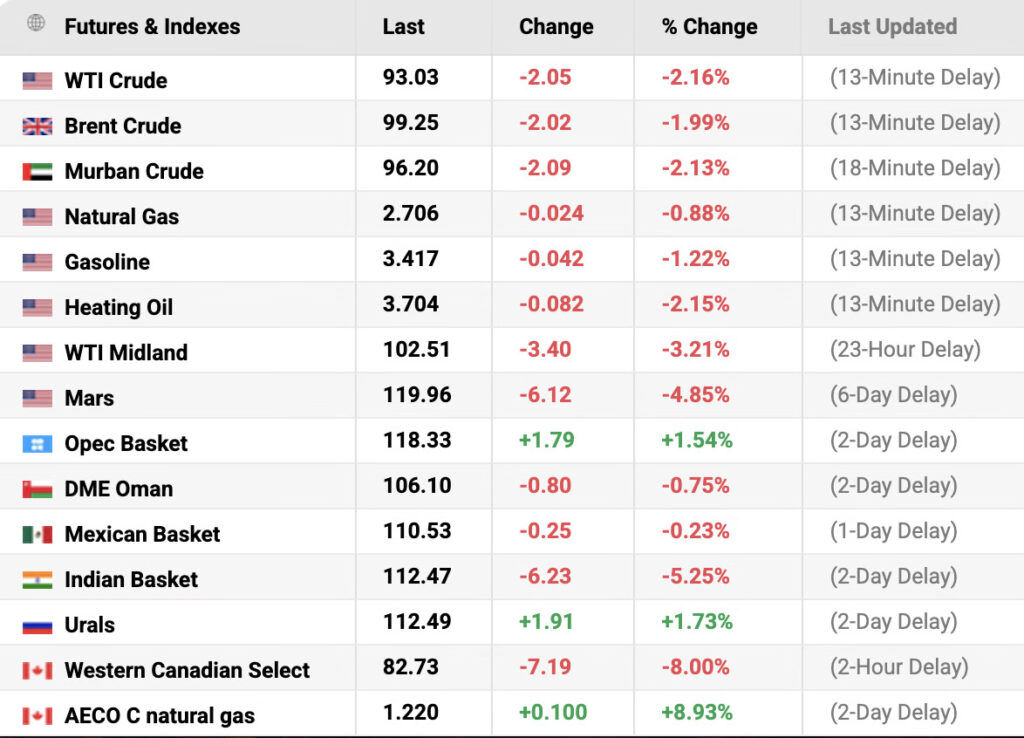
As of 4:19 am Beijing time, West Texas Intermediate crude traded at $93.03, down 2.16%, while Brent crude stood at $99.25, off 1.99%.
Middle East benchmark Murban crude declined 2.13% to $96.20. In refined products, U.S. gasoline fell 1.22%, heating oil dropped 2.15%, and U.S. natural gas eased 0.88%.
The decline in futures came despite volatile trading in physical crude grades, highlighting ongoing divergence in different parts of the oil market.
The OPEC basket rose 1.54% to $118.33, while Russia’s Urals crude climbed 1.73% to $112.49.
By comparison, Canada’s heavy Western Canadian Select dropped 8.00% to $82.73, marking one of the sharpest declines of the session and widening discounts on heavier, high-sulfur crude grades.
Other crude benchmarks also declined, with Mexico’s basket slipping 0.23% and India’s basket falling 5.25%.
Divergence
Oman’s DME crude contract edged lower by 0.75%, reflecting uneven price movements across global oil benchmarks.
Analysts said the divergence reflects the fact that futures are reacting rapidly to macroeconomic headlines, while physical crude grades are being re-priced based on refinery demand, freight costs, and quality differentials.
Heavy crude grades, which require more complex refining processes, were among the hardest hit as margins for producing diesel and fuel oil tightened.
Market participants are closely monitoring whether diplomatic developments will lead to sustained shipping activity through the Gulf and more stable refinery operations across Asia.
For now, benchmark prices are easing from recent highs even as some export blends move in the opposite direction, underscoring a market still adjusting after weeks of volatility and disruption.

