

India passport power declines: Rank drops to 81 with fewer visa-free travel options.
India’s passport ranking has shifted over the past two decades, reflecting changes in global travel patterns, visa policies, and diplomatic relationships. According to the latest Henley Passport Index 2026, India is ranked 81st worldwide, with Indian passport holders able to access 55 destinations through visa-free or visa-on-arrival arrangements.
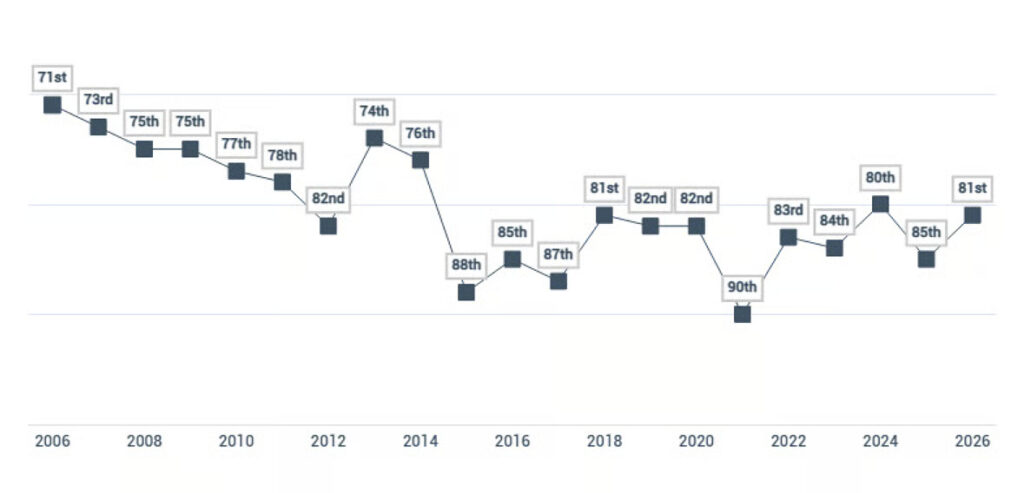
When the index was first introduced in 2006, India held the 71st position. Over the following 20 years, the ranking experienced several fluctuations, reaching its lowest point at 90th in 2021. It later improved to 80th in 2024, fell to 85th in 2025, and rose again to 81st in 2026.
India’s passport journey over two decades: From rank 71 to 81.
From 71st to 81st rank: India’s 20-year passport journey
India’s passport journey over the past two decades has been marked by periods of decline, recovery, and fluctuations, reflecting changes in global mobility trends, visa policies, and international relations.
The ranking gradually declined from 71st place in 2006 to 82nd in 2012, before showing a temporary improvement to 74th in 2013. The sharpest drop came in 2015, when India slipped to 88th position, followed by its lowest-ever ranking of 90th in 2021.
Since then, India’s passport ranking has shown signs of recovery, rising to 83rd in 2022, 84th in 2023, and 80th in 2024. After a decline in 2025, the ranking improved slightly to 81st in 2026.
Over the past two decades, India has fallen 10 places from its 2006 position, reflecting the challenges of strengthening passport power amid changing global visa policies and increasing competition for international travel access.
India’s passport ranking over two decades: Key milestones
| Period | Year | Rank | Trend/Notes |
|---|---|---|---|
| 2006–2012: Gradual decline | 2006 | 71st | India began its journey in the Henley Passport Index |
| 2007 | 73rd | Ranking declined | |
| 2008 | 75th | Ranking declined | |
| 2009 | 75th | Ranking remained unchanged | |
| 2010 | 77th | Ranking declined | |
| 2011 | 78th | Ranking declined | |
| 2012 | 82nd | Lowest point during this phase | |
| 2013–2018: Recovery followed by volatility | 2013 | 74th | Significant improvement recorded |
| 2014 | 76th | Ranking slipped slightly | |
| 2015 | 88th | Major decline | |
| 2016 | 85th | Partial recovery | |
| 2017 | 87th | Ranking declined | |
| 2018 | 81st | Improvement recorded | |
| 2019–2021: Lowest point | 2019 | 82nd | Ranking remained stable |
| 2020 | 82nd | Ranking remained stable | |
| 2021 | 90th | Lowest ranking in India’s 20-year history | |
| 2022–2026: Recovery phase | 2022 | 83rd | Recovery began after the 2021 low |
| 2023 | 84th | Ranking remained largely stable | |
| 2024 | 80th | Strongest position in recent years | |
| 2025 | 85th | Ranking declined | |
| 2026 | 81st | Partial recovery, but still below the 2006 position |
India’s visa-free access declines to 55 destinations
Indian passport holders can currently travel to 55 destinations without obtaining a traditional visa before departure. This marks a decline from 56 destinations earlier in 2026, following the removal of visa-on-arrival access for the Cape Verde Islands.
The 55 accessible destinations include various forms of simplified entry arrangements, such as:
- Visa-free entry
- Visa on arrival
- Electronic Travel Authorisation (ETA)
- Visitor permits
Most of the destinations offering easier access to Indian travellers are located in Asia, Africa, and island nations. However, advance visas are still required for major travel destinations, including the United States, the United Kingdom, and most European countries.
Global passport power doubles over 20 years
The 20th anniversary edition of the Henley Passport Index highlights a significant increase in global travel freedom over the past two decades.
The average passport now provides access to 108 destinations worldwide, compared with just 58 destinations in 2006.
However, the divide between the world’s most and least powerful passports has grown wider. In 2006, the gap between the highest- and lowest-ranked passports stood at 118 destinations. Today, that difference has reached a record 170 destinations.
Singapore leads as US passport strength declines
Global passport rankings have undergone major shifts since 2006, with several countries gaining or losing ground in terms of international travel access.
The United States, which shared the top passport ranking with Denmark and Finland in 2006, has dropped to 10th place in 2026, despite increasing its travel access from 130 to 180 destinations.
The United Kingdom has also slipped in the rankings, moving from third place in 2006 to sixth place in 2026, while Canada currently ranks seventh.
Singapore now holds the world’s most powerful passport, providing access to 192 destinations.
UAE emerges as a passport success story
The UAE has recorded one of the most significant improvements in passport strength over the past two decades, making it one of the biggest success stories in global passport rankings.
From a middle-ranking position in 2006, the UAE has climbed to second place globally in 2026, sharing the position with Japan and South Korea, with access to 188 destinations.
Over the past two decades, the UAE has added 153 visa-free destinations, demonstrating how diplomatic efforts, international cooperation, and economic partnerships can significantly strengthen global mobility.
What two decades of passport rankings reveal
The Henley Passport Index shows that passport strength is shaped by more than just visa policies. Factors such as diplomatic relations, economic influence, international partnerships, and geopolitical standing also play a crucial role.
India’s 20-year passport journey reflects the challenges faced by emerging economies as they seek to expand their global influence while navigating an increasingly connected yet unequal travel landscape. Although worldwide travel access has improved, the divide between the most and least powerful passports continues to widen.
Where can Indians travel without a traditional visa?
Indian passport holders currently have access to a range of destinations through visa-free entry or visa-on-arrival arrangements.
Visa-free destinations include:
Angola, Barbados, Bhutan, British Virgin Islands, Cook Islands, Dominica, Fiji, Grenada, Haiti, Jamaica, Kazakhstan, Kiribati, Macao (SAR China), Malaysia, Mauritius, Micronesia, Montserrat, Nepal, Philippines, Rwanda, Senegal, Sri Lanka, St Kitts and Nevis, St Vincent and the Grenadines, Thailand, The Gambia, Trinidad and Tobago, Vanuatu, and others.
Visa-on-arrival destinations include:
Burundi, Cambodia, Comoros, Djibouti, Ethiopia, Guinea-Bissau, Indonesia, Jordan, Laos, Madagascar, Maldives, Marshall Islands, Mongolia, Mozambique, Myanmar, Niue, Palau, Qatar, Samoa, Sierra Leone, Tanzania, Timor-Leste, Tuvalu, Zimbabwe, and others.
These arrangements allow Indian travellers to visit these destinations without securing a traditional visa before departure, although entry requirements and permitted stay periods may vary by country.
Planning a trip? Explore 55 destinations Indians can visit without a traditional visa
Indian passport holders can currently travel to 55 destinations without obtaining a traditional visa before departure, according to the latest Henley Passport Index 2026.
The number has decreased from 56 earlier this month following the removal of Cape Verde Islands’ visa-on-arrival (VOA) access from the list.
The available destinations include countries and territories offering visa-free entry, visa-on-arrival facilities, and other simplified travel arrangements.
55 destinations Indians can visit without a traditional visa
Indian passport holders can currently access 55 destinations through visa-free entry, visa-on-arrival facilities, or electronic travel authorisation (ETA) arrangements.
| Destination | Access type |
|---|---|
| Angola | Visa-Free |
| Barbados | Visa-Free |
| Bhutan | Visa-Free |
| British Virgin Islands | Visa-Free |
| Burundi | Visa on Arrival |
| Cambodia | Visa on Arrival |
| Comoro Islands | Visa on Arrival |
| Cook Islands | Visa-Free |
| Djibouti | Visa on Arrival |
| Dominica | Visa-Free |
| Ethiopia | Visa on Arrival |
| Fiji | Visa-Free |
| Grenada | Visa-Free |
| Guinea-Bissau | Visa on Arrival |
| Haiti | Visa-Free |
| Indonesia | Visa on Arrival |
| Jamaica | Visa-Free |
| Jordan | Visa on Arrival |
| Kazakhstan | Visa-Free |
| Kenya | ETA |
| Kiribati | Visa-Free |
| Laos | Visa on Arrival |
| Macao (SAR China) | Visa-Free |
| Madagascar | Visa on Arrival |
| Malaysia | Visa-Free |
| Maldives | Visa on Arrival |
| Marshall Islands | Visa on Arrival |
| Mauritius | Visa-Free |
| Micronesia | Visa-Free |
| Mongolia | Visa on Arrival |
| Montserrat | Visa-Free |
| Mozambique | Visa on Arrival |
| Myanmar | Visa on Arrival |
| Nepal | Visa-Free |
| Niue | Visa on Arrival |
| Palau Islands | Visa on Arrival |
| Philippines | Visa-Free |
| Qatar | Visa on Arrival |
| Rwanda | Visa-Free |
| Samoa | Visa on Arrival |
| Senegal | Visa-Free |
| Seychelles | Visa-Free (ETA) |
| Sierra Leone | Visa on Arrival |
| Sri Lanka | Visa on Arrival |
| St. Kitts and Nevis | Visa-Free (ETA) |
| St. Lucia | Visa on Arrival |
| St. Vincent and the Grenadines | Visa-Free |
| Tanzania | Visa on Arrival |
| Thailand | Visa-Free |
| The Gambia | Visa-Free |
| Timor-Leste | Visa on Arrival |
| Trinidad and Tobago | Visa-Free |
| Tuvalu | Visa on Arrival |
| Vanuatu | Visa-Free |
| Zimbabwe | Visa on Arrival |

