

Abu Dhabi reaches a new milestone as it advances its Dh240 billion future vision.
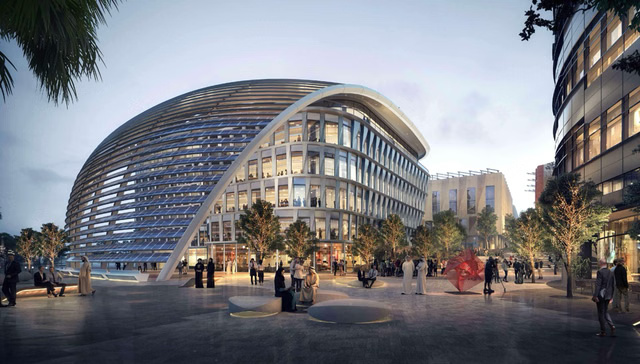
Masdar City has achieved a UAE-first milestone with its M19 A&B Office Buildings becoming the first commercial office development in the country to receive a 5 Pearl Estidama rating, the highest level of sustainable building certification in Abu Dhabi.
The announcement was made at the second edition of the Abu Dhabi Infrastructure Summit (ADIS), underscoring progress under Abu Dhabi’s Vision 2030.
It comes as the emirate continues to advance major infrastructure investments, including Dh42 billion allocated to infrastructure and community projects in 2025, and a further Dh240 billion planned over the next decade.
Spoke with Dr. Mohamed Al Breiki, Executive Director of Masdar City, to explore what nearly two decades of developing a sustainable city looks like in practice and what lies ahead.
The following is the full interview with Dr Al Breiki:
Nearly two decades on, Masdar City has been described as a place to live, learn, work, and play. What does this look like in practice?
Masdar City is currently home to more than 15,000 people living and working across the development, with over 2,000 companies from more than 90 countries operating within its free zone. Tenants include organisations such as IRENA, the UAE Space Agency, Siemens Energy, the Advanced Technology Research Council (ATRC), and the Mohamed bin Zayed University of Artificial Intelligence (MBZUAI).
What distinguishes it from a conventional office park is how these elements are integrated. The Masdar City Podium runs around 10 degrees cooler than downtown Abu Dhabi due to the city’s orientation and design, which channels north-west prevailing winds through shaded walkways and between buildings positioned to reduce direct sun exposure. Across the city, buildings consume around 40% less energy than the Abu Dhabi average, driven by passive design strategies.
In 2024, the city saved nearly 31,000 cubic metres of water and diverted 56% of waste through recycling.
Beyond the data, the lived experience is more difficult to quantify—it is, simply, a more comfortable and functional environment for a working day.
Abu Dhabi has committed Dh42 billion to infrastructure and community projects in 2025, with a further Dh240 billion planned over the next decade. In this broader vision, Masdar City positions itself as a working model of what that investment is meant to achieve.
Its role, the city explains, is to demonstrate and test sustainable urban solutions at real scale in the region’s climate, refined over nearly two decades of development.
Masdar City currently produces 17,500 MWh of clean electricity annually from on-site solar infrastructure. It has also achieved LEED Communities Platinum certification, the highest-scoring and largest certified LEED Platinum community in the UAE. More recently, its M19 A&B development became the first commercial project in the country to receive the Estidama 5 Pearl rating, the highest level under Abu Dhabi’s sustainability certification system.
Alongside this, Masdar City now has three completed net-zero energy buildings, reinforcing that net-zero is not a future ambition but a present reality.
As Abu Dhabi advances its Economic Vision 2030, the focus shifts from whether sustainability and commercial viability can coexist to how effectively they can be integrated—an equation Masdar City says it has already addressed.
Making the healthy choice easier
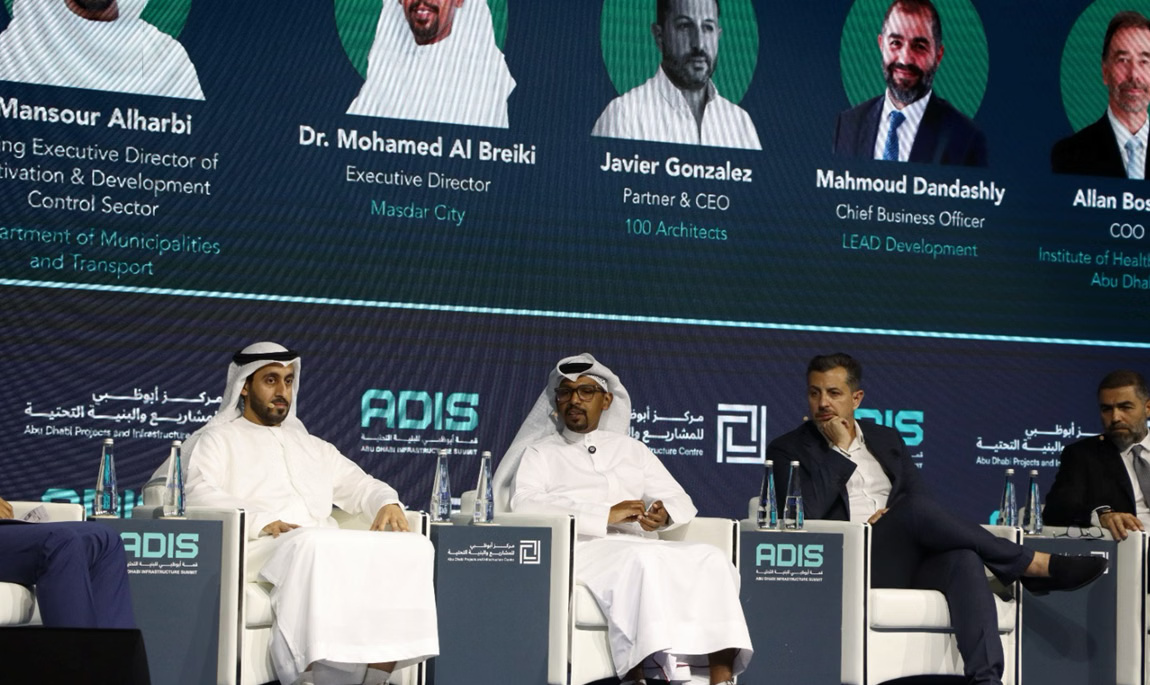
Speaking at ADIS on “Humanising Cities and Infrastructure for Health and Wellbeing,” the discussion turned to how Masdar City embeds preventive health into its urban design.
“The principle is simple: the built environment should make the healthy choice easier,” the statement noted.
At Masdar City, this is reflected in design choices that encourage movement through shaded walkways, cycling connections, and active ground floors, ensuring physical activity becomes part of daily routines rather than a separate effort.
The approach also prioritises indoor air quality, natural light, and thermal comfort, aiming to create environments that are restorative rather than purely functional.
The city currently manages more than 206,147 square metres of parks and open spaces. Connect Park and Falaj Plaza have both achieved Exemplar status under the Estidama Public Realm Rating System—the highest possible designation—making Masdar City home to the first and highest number of Exemplar-rated public parks in Abu Dhabi.
The WELL Gold certification targeted by M19 A&B reflects this philosophy that health is not an added feature, but the result of every design decision—from building orientation and material selection to how people move through spaces.
The highest level of Estidama certification
Until recently, no commercial office development in the UAE had achieved the highest level of Estidama certification. Achieving it required pushing performance across all systems from the earliest stages of design.
M19 A&B delivered 91.8% energy savings beyond ASHRAE 90.1-2010 baselines through passive design strategies and solar photovoltaic integration. Indoor water consumption was reduced by 45% through high-efficiency systems and smart controls. Heat gain was cut by 56%, while cooling loads were reduced by 63%.
These are not marginal gains; they represent a step change in building performance compared to conventional commercial developments.
The achievement also demonstrates that the Estidama framework, when applied rigorously, can produce buildings operating at a fundamentally higher level of efficiency. Importantly, the 5 Pearl rating also shows that this level of sustainability is commercially viable.
M19 A&B is also targeting LEED Platinum, reflecting a broader shift in which sustainable buildings are increasingly what occupiers demand, investors value, and regulators are moving towards requiring.
What this means for tenants and residents
In practical terms, this translates into working in buildings that are significantly cooler and better ventilated without higher energy costs, while also using far less water. It also means direct access to Masdar City’s wider mobility and infrastructure network, including cycling routes, shaded pedestrian walkways, and EV charging facilities.
Across Masdar City, buildings already consume around 40% less energy than the Abu Dhabi average, with M19 A&B exceeding that benchmark by a considerable margin.
Beyond the physical environment, companies based in Masdar City benefit from access to a free zone that hosts research institutions and a growing clean-tech ecosystem, including The Catalyst, a start-up platform backed by Masdar City and BP. However, the experience is not defined by technical systems alone.
“There is a distinct quality to these spaces — from the light and airflow to the way buildings connect with the street and the people inside them — that reflects the level of care invested during the design stage,” he said.
“Tenants tell us it positively affects how they feel at work. That is not accidental; it is the result of deliberate design choices aimed at improving the experience of everyone who lives and works here.”
Making cities healthier and happier
Asked about the most exciting opportunity ahead for creating healthier and happier cities, he pointed to the growing convergence of data and urban design.
“For the first time, we have the tools to understand in real time how a city is performing — not only in terms of energy use or carbon emissions, but also in terms of how people feel, how they move, and how healthy they are,” he said.
With 70% of the world’s population expected to live in cities by 2050, and global infrastructure investment needs estimated at $106 trillion through 2040, he added that the decisions being made today will shape quality of life for future generations.
At Masdar City, that vision is already being put into practice through a fully integrated live-work-play environment, where world-class research institutions, residential communities, parks, schools, sports facilities, and dining spaces coexist within a single urban ecosystem designed around how people actually live.
Here, sustainability and quality of life are not seen as competing priorities; they are delivered together every day.
Operating within Abu Dhabi and the wider UAE, where both the ambition and resources exist to implement such ideas at scale, Masdar City continues to serve as a testing ground for sustainable urban living solutions before they are expanded more broadly.
“The opportunity ahead is to accelerate that process — to apply what we have learned here in shaping the next generation of cities, not only in Abu Dhabi, but across the region,” he said.

