

Gold rates in Dubai remained largely unchanged on Monday, coinciding with the start of Navratri, the nine-day Indian festival that began on Sunday and is traditionally regarded as an auspicious occasion for purchasing gold.
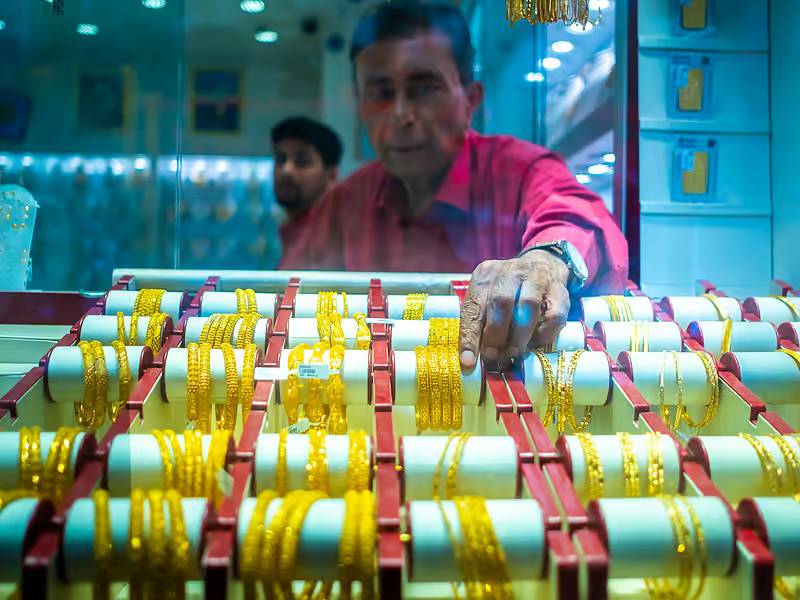
Gold prices in Dubai remained largely unchanged at the beginning of the week, coinciding with the start of Navratri, an important Indian festival traditionally associated with buying precious metals.
According to figures released by the Dubai Jewellery Group, 24-karat gold was priced at Dh505.50 per gram on Monday, while 22K gold was trading at Dh468 per gram.
Meanwhile, 21K and 18K gold were available at Dh448.75 and Dh384.75 per gram, respectively.
The more affordable 14K variety was priced at Dh300 per gram during Monday morning trading.
Navratri, a nine-day Hindu festival that began on Sunday, is widely regarded as a favourable occasion for purchasing gold.
During the celebrations, many families traditionally invest in gold jewellery, coins and bars, associating these purchases with prosperity, financial security and good fortune.
Jewellery retailers often experience increased customer interest during the festive period as shoppers purchase ornaments and make investments in precious metals.
In international markets, spot gold declined slightly by 0.16 per cent to $4,188 per ounce, while silver edged down 0.14 per cent to $223.55 per ounce.
Gold Prices Approach Key $4,200 Level
Simon-Peter Massabni, Head of Business Development at XS.com, said the precious metal was entering an important trading phase as prices hovered around $4,185 per ounce.
He explained that gold was attempting to regain the psychologically significant $4,200 mark, with movements in the US dollar and Treasury yields expected to influence its near-term direction.
According to Massabni, a weakening US dollar and declining US Treasury yields are among the primary factors currently supporting gold prices.
A softer dollar makes gold relatively less expensive for investors using other currencies, potentially encouraging additional demand.
At the same time, falling Treasury yields reduce the opportunity cost of investing in gold, which does not provide regular interest or dividend payments.
However, Massabni cautioned that these favourable conditions may continue only if Treasury yields maintain their downward trend.
He warned that a recovery in the US dollar, accompanied by rising bond yields, could weaken gold’s recent upward momentum and place renewed pressure on prices.
US Inflation Report Could Determine Gold’s Next Direction
Massabni identified the upcoming US Consumer Price Index (CPI) report as one of the most significant developments likely to influence gold prices this week.
He explained that investors are closely watching inflation figures because of their potential impact on expectations surrounding the US Federal Reserve’s future interest rate decisions.
If the inflation report shows that consumer prices are rising more slowly than anticipated, expectations of tighter monetary policy could weaken.
Such an outcome may lead to lower Treasury yields and create a more supportive environment for gold prices to rise further.
On the other hand, stronger-than-expected inflation could revive concerns about additional interest rate increases.
This could strengthen the US dollar and push Treasury yields higher, making gold comparatively less attractive to investors and potentially triggering fresh selling pressure.
Massabni also expects market volatility to increase ahead of the inflation report’s publication.
He suggested that investors’ response to any unexpected inflation figures could have a greater influence on gold’s short-term performance than its current trading levels.
As a result, market participants are likely to remain focused on upcoming US economic data and Federal Reserve policy expectations for clearer indications of where gold prices may move next.

