

Oil benchmarks surge as traders price in tighter supply and rising geopolitical risks.

Brent crude climbed back above the psychologically important $100-a-barrel mark early on Thursday (April 23), highlighting renewed strength across global oil benchmarks as energy markets responded to tighter supply expectations and rising geopolitical risks.
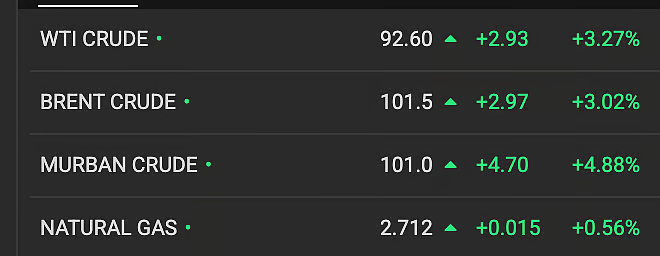
A market snapshot taken at 5:21am Tokyo time on Thursday (12:21am GST, April 23, 2026) showed Brent crude at $101.5, up $2.97, or 3.02%, on the session.
The move pushed the international benchmark back into triple-digit territory after weeks of volatile trading below that level.
US benchmark WTI crude also moved higher, trading at $92.60, up $2.93 or 3.27%.
Meanwhile, Murban crude — a key Middle Eastern benchmark closely watched by Asian buyers — posted the strongest gain among the major grades, rising $4.70, or 4.88%, to $101.
The synchronized rally across Brent, WTI and Murban points to broad-based buying rather than a localised market move — often a sign that traders are pricing in wider supply constraints or heightened geopolitical tension affecting multiple export routes.
Natural gas prices were also modestly higher, with futures at 2.712, up 0.56%, indicating a parallel rise across the broader energy complex.
Brent’s return above $100 is significant for both producers and consumers. For oil-exporting countries, it restores a revenue cushion not seen consistently since earlier market disruptions.
Inflationary pressure
For importing nations, particularly in Asia and Europe, it signals renewed inflationary pressure linked to transport, electricity generation and industrial costs.
Murban’s outsized gain is especially notable because the grade is closely tied to Middle East supply flows and Asian refining demand. Its sharp rise often reflects trader sensitivity to risks affecting Gulf shipping routes and regional stability.
The latest price action suggests markets are once again assigning a premium to uncertainty — whether from shipping disruptions, sanctions dynamics or production concerns — after a period when prices had softened on expectations of stabilising output and demand.
With Brent back in triple digits, energy markets appear to be re-entering a phase where geopolitical developments, rather than purely economic fundamentals, are driving price direction.

