

A medal is undoubtedly a proud achievement — but the journey began with something much simpler: curiosity.
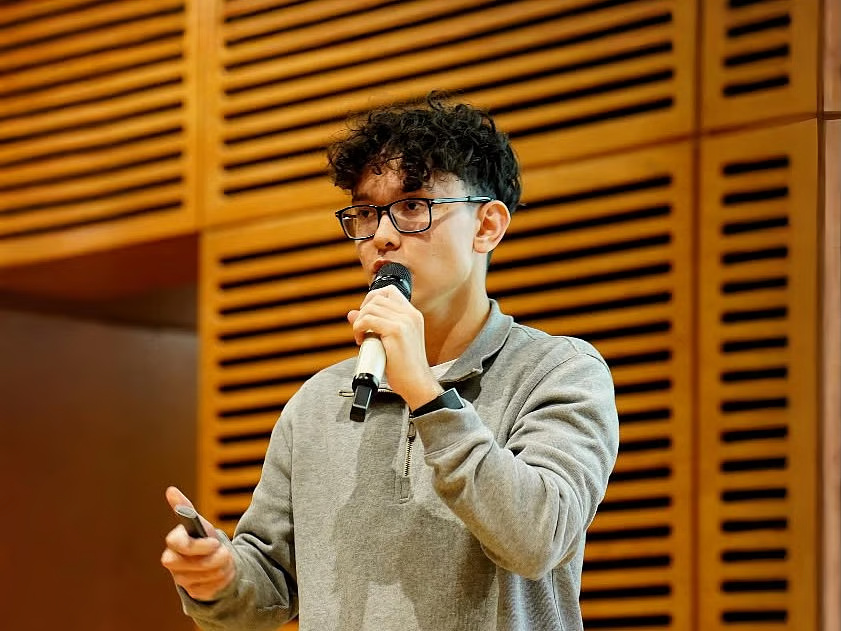
He is bright and beaming, just as one would expect after achieving a gold medal victory.
Ali-Mansur Valiyev recounts his journey to the International Economics Olympiad with a cheerful yet grounded perspective. He celebrates the achievement without exaggeration, describing the path to success in a straightforward manner — from following current affairs and analysing economic concepts to attending intensive training camps.
That journey eventually led him to Shenzhen, China, where he discovered he had won gold at one of the world’s premier competitions for high school students in economics, finance, and business. Standing beside him at that defining moment was his mother, who shared in the celebration.
Reflecting on the achievement, Ali-Mansur said, “It was quite a surreal experience. A few years ago, I never really expected to win gold or even participate in the Olympiad. But when I finally won, I was there with my mum, and it was a really exciting moment.”
The 2026 International Economics Olympiad (IEO) featured national teams from six continents, with Valiyev selected as one of five students to represent the UAE after a rigorous selection process involving participants from 56 countries.
While the gold medal marked a remarkable achievement, the journey began with something far simpler — curiosity.
From Kazakhstan to the UAE
Valiyev’s journey in the UAE began years before economics became a part of his life. Born in Kazakhstan, he spent his early childhood there before moving to the UAE at the age of four. He explains that the move was influenced by health concerns during his childhood.
“When I was young, I had laryngitis, and the conditions in my hometown in Kazakhstan weren’t ideal for me because I was falling sick quite often due to the dust and other factors,” he said.
The family eventually relocated to the UAE, where the coastal environment proved beneficial. Thirteen years later, the country has become home for Valiyev.
His interest in economics began at Dubai College, where he was introduced to the subject in Year 10. That first exposure would go on to shape his academic journey and future ambitions.
“I began learning economics formally when I was in Year 10, and I think the teachers I had there were incredible at guiding me,” he said.
The classroom provided him with the foundation, but curiosity was what drove him further.
When economics became more than a school subject
The IEO challenges students on much more than their ability to recall economic theories. For Valiyev, economics evolved into a tool for understanding the world around him.
Soon, he began exploring topics beyond the boundaries of his classroom lessons and curriculum, driven by a genuine interest in discovering more about the subject.
“I really enjoyed taking what I learned and going beyond school lessons and the curriculum, exploring areas that I found interesting. I think my curiosity about the subject was what really pushed me forward,” he said.
That constant curiosity became the driving force behind his Olympiad preparation. After entering the UAE qualifiers, Valiyev spent nearly two years attending training camps and progressing through selection rounds before securing his place among the five students chosen to represent the UAE.
However, his preparation was not limited to memorising formulas or spending countless hours with textbooks. Instead, it involved independent learning, keeping up with global developments, and applying economic concepts to real-world situations. While UAE training sessions lasted around two hours, students were encouraged to continue expanding their knowledge beyond the classroom.
“I would wake up in the morning, spend some time studying, and instead of only preparing for the IEO, I would explore economics more broadly — reading about different concepts, following the news, and building my understanding of the world through economics,” he said.
Two years of preparation — and a few missed social events
The journey also required careful balance. Alongside his Olympiad preparation, Valiyev remained a student, managing academic projects and research while continuing to pursue interests outside the classroom.
Despite the demanding schedule, he continued to maintain an active lifestyle, making time for activities such as swimming and going to the gym.
“Of course, I had to miss a few social events because of the training, but that’s just part of the journey,” he said.
As the Olympiad drew closer, finding the right balance became increasingly challenging. However, years of managing schoolwork, research, and personal projects had already helped him develop a crucial skill: knowing how to prioritise.
“Over the past few years, being at a school like DC, taking on different projects, and conducting research taught me not only time management but also how to prioritise and use my time effectively,” he said.
Most importantly, he never viewed the preparation as a challenge he simply had to endure in pursuit of a medal.
The secret to his success: A genuine love for learning
So, what kept him motivated throughout two years of preparation?
Passion — a genuine enthusiasm for the subject he was studying.
“I think, for me, I’m just really happy that I’m doing a subject I’m genuinely passionate about, and that’s probably the greatest thing,” he said.
For Valiyev, economics goes far beyond graphs and the complexities of national income accounting. It is a lens through which he understands and interprets the world around him.
“When I read global news, for instance, I can apply economic thinking to almost any topic. It helps me understand not only what is happening within a specific industry but also how it links to the wider world, different countries, and broader global trends,” he said.
That ability to draw connections between seemingly unrelated events is what continues to make economics fascinating for him.
“I think economics is a really important subject because it helps me understand how the world functions — from the global economy to individual companies,” he added.
For Valiyev, the medal was never the main motivation. It was his curiosity and passion for the subject that kept him moving forward.
“It was really the curiosity I had for the subject that allowed me to keep going,” he said.
The moment he realised: ‘I could actually win this’
The IEO consisted of three rounds, each designed to assess a different aspect of economic ability. The first focused on core economic knowledge, while the second challenged students with essay-based problems requiring them to apply economic reasoning to areas such as artificial intelligence, data centres, and current affairs. The final round featured a business case challenge, where participants took on the role of consultants and developed solutions to real-world business problems.
With competitors from around the world arriving after successfully navigating their own national selection processes, Valiyev had every reason to feel the pressure. Yet, he entered the competition without fixed expectations.
“I didn’t really have any specific expectations going into it,” he said.
His approach was simple: focus on his own preparation rather than the competition around him.
“The main thing that helped me throughout the entire process was focusing on my own path and my own journey. I didn’t spend too much time thinking about the competitors or who I was up against. I focused on myself and building my own knowledge,” he said.
The first round marked a turning point, as his preparation began translating into confidence.
“In the first round, especially the economic knowledge section, I felt really good because I was able to showcase what I had learned,” he said.
For the first time, the possibility of winning a medal felt realistic.
“Once I finished that first round, I realised that I actually had a strong chance of performing well in the competition,” he said.
Learning to think, not just memorise
One of the biggest challenges of the Olympiad was also what made it most rewarding: the unpredictability of the questions.
“They can apply to any situation, or they can be completely new. You won’t find them in previous Olympiads or past papers. They are always different and require you to adapt to new scenarios,” he said.
As a result, preparation had to go beyond memorising theories and formulas. Valiyev needed a deep understanding of economic concepts that would allow him to apply them, analyse problems, and develop solutions in unfamiliar situations.
“For me, the most important thing was building a strong foundation of understanding so I could apply economics to different scenarios, reason through problems, and think about how economic principles work in the real world,” he said.
The people behind the medal
The Olympiad was not simply a measure of his knowledge — it was a test of his ability to analyse, adapt, and think critically.
While Valiyev’s own curiosity and determination played a central role in his success, he is quick to acknowledge the support of those who guided him throughout the journey.
He credits his teachers at Dubai College for providing the foundation that helped spark and develop his interest in economics. Mentors also played an important role, offering valuable perspectives and discussions around economic developments and global events. This support system allowed him to move beyond simply studying economics to questioning ideas, applying concepts, and engaging in deeper conversations about the subject.
What comes after gold?
For now, the gold medal stands as a significant achievement. However, Valiyev believes success should not be driven only by the pursuit of accolades, but by following genuine interests and remaining open to new opportunities.
“Just do what you’re passionate about,” he advises.
His other piece of advice is equally straightforward: embrace opportunities and explore new experiences, even when the outcome is uncertain.
“Make sure you take up every opportunity you can if it’s something that interests you, even if you feel it may not lead anywhere,” he said.
Not every project or idea Valiyev pursued before the Olympiad turned into a major accomplishment, but he believes each experience played a valuable role in shaping him.
“Before the Olympiad, and before these projects and research efforts came together, I was trying different things that perhaps didn’t lead to anything significant at the time, but they gave me great experiences and taught me things I truly value today,” he said.
For someone who entered a global competition without expecting to win, the gold medal ultimately became the result of years spent exploring his interests, building knowledge, and following his curiosity.

