

To achieve the feat, he climbed up to the 49th floor 59 times. After each climb, he took the lift back down to the ground level, pausing between attempts to hydrate and refuel with water and dried fruits.
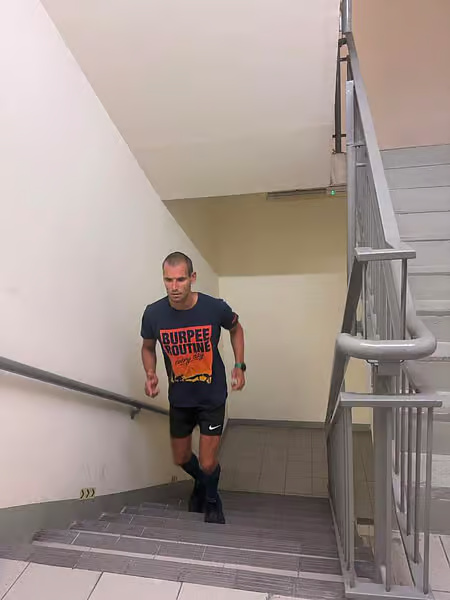
For nearly 16 hours, the surroundings remained unchanged. The walls, doors, staircase and routine stayed exactly the same as Abu Dhabi-based physical training coach Veljko Vukićević repeated the climb over and over.
Without leaving the capital, he completed a total vertical ascent of 8,848 metres — matching the height of Mount Everest — by tackling the same stairwell repeatedly.
Why did he do it? Because he wanted to demonstrate that extraordinary achievements do not always require extraordinary locations. Rather than travelling to a mountain, the Serbian coach turned an ordinary staircase on Reem Island into his personal Everest, aiming to prove that the greatest barriers are often psychological and that anyone can take the first step towards a challenging goal.
To complete the challenge, Vukićević climbed to the 49th floor 59 times, completing around 54,000 stairs and burning an estimated 7,000 calories during nearly 16 hours of continuous effort. He averaged roughly four climbs every hour.
After each ascent, he returned to the ground floor by lift, keeping rest periods short and limited to quick breaks for water, dates, bananas, almonds and walnuts before beginning the next climb.
“I wasn’t looking for beautiful scenery to distract me,” he told Khaleej Times. “I wanted an environment where I had to rely entirely on my mental strength.”
Unlike traditional Everesting challenges, which are usually completed outdoors through GPS-tracked cycling, running or hiking routes, Vukićević’s attempt was carried out entirely indoors. Inspired by the Everesting concept, he said he did not pursue official recognition because indoor stair-climbing attempts are currently not eligible for verification due to GPS tracking limitations.
The challenge took almost a year of preparation. Although he did not follow a training plan created specifically for the attempt, he built his endurance through rucking, cycling, uphill walking, VO₂ max training, bodyweight exercises and weekend stair-climbing sessions, alongside his role as a physical training coach at Abu Dhabi Police College.
Rather than focusing on speed, Vukićević prioritised maintaining a consistent rhythm. He completed around four climbs per hour for almost the entire challenge, using each elevator ride back to the ground floor as a short recovery period before beginning again.
“My greatest strength wasn’t climbing fast,” he said. “It was recovering quickly enough to begin each ascent at almost the same intensity as the previous one.”
However, he said the challenge was as much a mental test as a physical one.
“The body is capable of far more than we often believe,” he said. “The greatest obstacle wasn’t the number of floors or the fatigue in my legs, but the voice in my head telling me I had done enough.”
As the hours passed, the repetition became increasingly demanding.
“Towards the end, I wasn’t counting floors anymore; I was counting steps,” he recalled. “At one point, I stopped on a landing, looked up and thought, ‘Do I really have to do this again?’ I smiled at myself, took a deep breath and carried on.”
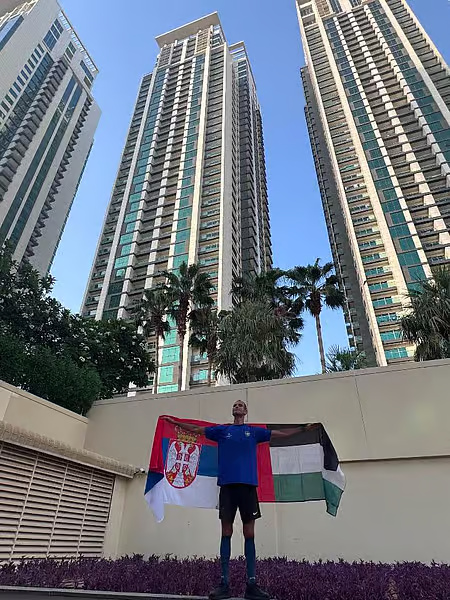
That moment, he said, was when the challenge shifted from a physical battle to a mental one.
“I realised I was no longer battling the stairs but my own thoughts.”
Throughout the climb, he chose not to listen to music or podcasts, preferring to remain completely focused on the task.
“I broke the day into small goals, one ascent at a time. Entertainment wasn’t what would get me to the finish line; discipline and complete focus would.”
The repetitive surroundings added another layer of difficulty.
“The view never changed: the same walls, the same staircase and the same hallways over and over again,” he said. “That was actually part of the point.”
His only support throughout the challenge was colleague Srđan Ostojić, who managed logistics, monitored his heart rate, recorded each ascent, prepared food and water, arranged the elevator returns and helped keep him focused.
The unusual activity also attracted attention from people passing by.
“I could sense people looking at me strangely, but honestly, I was just focused on the next climb,” he said with a laugh. “If I had started telling someone what I was doing, I don’t think they would have believed me. They probably would have thought I was crazy or joking.”
Despite the intensity of the challenge, Vukićević said his body recovered within a few days, with only the expected muscle soreness in his calves, quadriceps and glutes.
He hopes the achievement leaves people with a simple but powerful message.
“Everyone has their own Everest,” he said. “Not everyone chooses the same path, but everyone chooses their own hard.”
For Vukićević, the challenge was never about reaching a mountain peak.
“If this inspires even one person to believe they are capable of more than they think and to take the first step outside their comfort zone,” he said, “then it has accomplished far more than a sporting result.”

