

More empty tankers, more sanctioned ships: The new reality in Hormuz.

Hormuz vessel traffic is holding “steady” — a headline count that may mask an undesirable reality: a weaker flow of oil through the chokepoint.
MarineTraffic’s latest weekly snapshot, posted August 24, 2026, shows vessel crossings through two critical Middle East chokepoints — the Strait of Hormuz and Bab el-Mandeb — remaining broadly “stable”, or slightly higher week over week.
But headline traffic numbers mask a clear shift in what is moving through the strait — and how.
The data
Strait of Hormuz — the world’s most important oil chokepoint, normally handling around 20% of global petroleum liquids:
- 121 crossings, up 2.5% from 118 the previous week.
- Laden, or cargo-carrying, crossings plunged 27% to just 35.
- Ballast, or empty, movements rose to 61.
- Sanctioned crossings increased from 9 to 16.
- Iran’s unilateral routing scheme accounted for 46.3% of all crossings.
Bab al-Mandab — the southern gateway to the Red Sea and Suez route:
- 269 crossings, up 3.1% week over week and roughly 2.2 times Hormuz volumes.
- Laden transits rose to 131.
- Dark, or AIS-off, transits fell from 23 to 15.
Raw ship counts vs. risk
MarineTraffic’s point is straightforward: raw vessel transit counts can appear reassuring even as the commercial and security risk profile deteriorates.
That risk was underscored by Saudi Arabia’s national shipping company, Bahri, which reported that its vessel AMZAN was involved in a security-related incident in the Red Sea on Monday, August 24, 2026. Bahri said all crew members were safe and that there were no injuries.
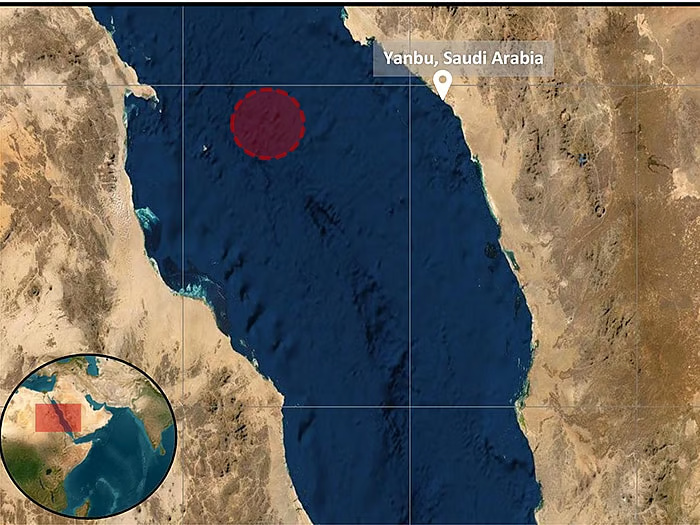
Yemen’s Houthi rebels claimed responsibility, saying they had struck the Saudi oil tanker with a ballistic missile as part of what they described as a maritime blockade of Saudi Arabia. The claim followed a report by the UK Maritime Trade Operations agency that a tanker had been hit by an unknown projectile off Yanbu.
The Houthis said the strike was “accurate and direct,” claiming it caused a fire aboard the vessel and prompted other ships in the area to flee. They described the attack as part of their decision to ban maritime navigation by what they called the “Saudi enemy.”
Bahri, however, confirmed only that AMZAN was involved in a maritime incident and that all crew members were safe, without confirming the Houthis’ account of the attack or its cause.
Hormuz crossing dynamics
The Strait of Hormuz functions as a critical export chokepoint for Gulf energy producers. Under normal trading conditions, tanker traffic follows a familiar pattern:
- Inbound traffic is typically dominated by tankers sailing in ballast — without cargo — to Gulf terminals, where they load crude, refined products, LNG or LPG.
- Outbound traffic is dominated by those same vessels sailing laden, carrying energy cargoes from Gulf producers to overseas markets.
- The result is a textbook “empty in, full out” cycle: vessels enter the Gulf to load and leave carrying cargo.
The distinction matters because a rise in total vessel crossings does not necessarily mean a recovery in energy flows. If more vessels are entering empty while fewer are leaving laden, headline transit numbers can remain stable even as the volume of oil and gas actually moving through the chokepoint weakens.
That is particularly important for Hormuz, where roughly 20 million barrels per day of crude and petroleum products moved through the strait in 2025, according to the IEA.
As the MarineTraffic data shows, a corridor crowded with empty tankers, sanctioned vessels and ships being routed along Iran’s preferred northern corridor does not necessarily indicate a return to “normal” trade.
There is, of course, always some two-way mixed traffic — including container ships, general cargo vessels, dry bulk carriers and naval vessels. But energy tankers remain the key driver of both traffic volumes and the overall risk picture.
Iran’s unilateral routing scheme
This comes against the backdrop of a prolonged US-Iran conflict that began in late February 2026.
Iran has sought to assert greater control over vessel movements through Hormuz through what it calls a “unilateral scheme,” directing traffic closer to its own coast. Reuters has reported that the proposed arrangement would give Iran greater control over transit, including routing one direction of traffic through Iranian waters.
The traditional UN-approved Traffic Separation Scheme, which establishes routing lanes through Iranian and Omani waters, and the southern routes closer to Oman have seen limited use amid the security situation. Reuters has also reported that vessels have faced Iranian transit conditions and restrictions.
Other shipping trackers have recorded far lower daily commodity-vessel counts, often in the single digits. Reuters reported nine commodity-vessel transits through Hormuz on August 20, underscoring the gap between broader vessel-count data and the much thinner flow of commercial energy traffic.
This distinction is important: a relatively stable headline vessel count does not necessarily mean that normal commercial traffic has returned to Hormuz.
At Bab el-Mandeb, Houthi-related threats and renewed blockade warnings have kept the security environment elevated, even as overall vessel crossings have held up better than at Hormuz. Recent MarineTraffic data also shows that sanctioned and shadow-fleet vessels, along with dark or AIS-off movements, remain a recurring feature of traffic through the chokepoint.
The takeaway is similar to Hormuz: a relatively resilient transit count does not necessarily translate into normalised or low-risk commercial shipping.
The “empty-in, full-out” pattern helps explain why a relatively stable headline transit count can be misleading. Under normal conditions, tankers enter the Gulf in ballast to load cargo and then exit laden with crude, petroleum products or gas.
In the latest data, however, ballast movements are rising while laden crossings have fallen sharply. That suggests the number of ships moving through the chokepoint does not necessarily translate into an equivalent flow of energy cargo.
In other words, 121 crossings do not mean 121 cargo-laden shipments are moving through Hormuz. The composition of those crossings matters. The latest figures show 61 ballast movements against just 35 laden crossings, a marked departure from the normal commercial cycle.
That distinction is reinforced by other tracking data: Reuters reported that fewer than 20 commodity vessels crossed Hormuz over the August 22–23 weekend, with traffic roughly 90% below pre-conflict levels.
The takeaway: a chokepoint can look busy on a vessel-count basis while carrying significantly less energy cargo — making what ships are carrying, rather than simply how many are crossing, the more meaningful measure of whether trade has normalised.
The latest weekly figures show a notable divergence in the composition of Hormuz traffic: total crossings rose to 121, but laden crossings fell 27% to 35, while ballast movements increased to 61. MarineTraffic’s data therefore points to a corridor carrying a larger share of empty vessels even as the overall transit count appears stable.
That matters because, under the usual Gulf trading pattern, tankers enter the Gulf in ballast to load cargo and then exit laden. A higher ballast-to-laden ratio is therefore consistent with fewer vessels completing that normal commercial cycle.
Put simply, more ships crossing does not necessarily mean more oil or gas leaving the Gulf. Empty tonnage may still be entering or circulating within the region, while fewer vessels are emerging laden with cargo.
The pattern is also consistent with other recent tracking data showing severely depressed commercial traffic through Hormuz. Kpler data cited by Reuters found fewer than 20 commodity-vessel transits over the August 22–23 weekend, while weekly traffic remained about 90% below pre-conflict levels.
The key distinction, then, is between vessel activity and cargo flow: Hormuz may look relatively busy on a raw ship-count basis, while the actual movement of energy exports remains significantly constrained.
In a disrupted environment — with Iran’s unilateral routing scheme accounting for nearly half of Hormuz traffic, elevated security risks and a rising share of sanctioned or shadow-fleet activity — this imbalance is a useful signal.
In simple terms, ballast ships typically enter the Gulf to load, while laden ships leave carrying cargo. When ballast movements rise as laden crossings fall, it points to more empty-ship positioning and less cargo moving out, rather than a return to normal export flows.
That makes the composition of vessel traffic more informative than the headline crossing count. Laden versus ballast status, sanctioned-vessel exposure, routing choices and AIS behaviour can reveal changes in commercial activity and risk that aggregate transit numbers obscure.
So while Hormuz vessel traffic may appear to be “holding steady,” that can coexist with weaker commercial flows, greater reliance on higher-risk or sanctioned tonnage, and a greater degree of de facto Iranian control over how vessels transit the strait. Iran has, in fact, threatened dozens of vessels with fines, detention or cargo confiscation for allegedly violating its transit protocols, underscoring the extent to which routing and access have become part of the geopolitical contest.
The key takeaway is that “stable traffic” does not necessarily mean normal trade. The details of which ships are moving, whether they are laden, what route they take and whether they remain visible on AIS matter at least as much as the raw number of crossings.
Raw ship-transit counts may appear relatively “stable,” but that can mask a weaker level of commercial energy and trade throughput than the headline numbers suggest.

