

The final image combines 724 exposures captured over nine days, totalling more than 36 hours of imaging.
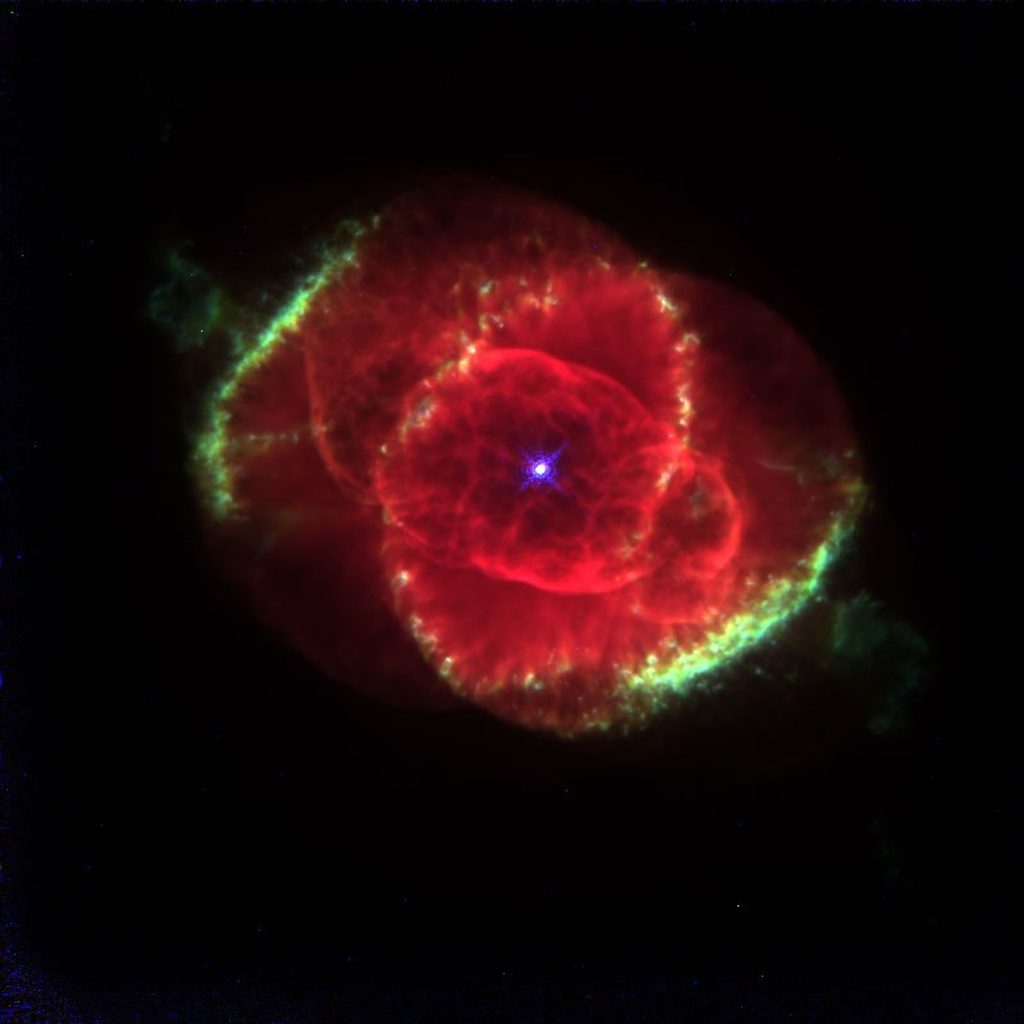
Abu Dhabi: An observatory in Abu Dhabi has captured a detailed image of the Cat’s Eye Nebula, one of the best-known and most structurally complex planetary nebulae, following nine days of observations and more than 36 hours of combined exposure.
The image was produced by Al Khatim Astronomical Observatory, part of the International Astronomy Centre, using 724 individual exposures across four filters. It shows the nebula’s bright central “eye” surrounded by a much larger, fainter and irregular shell of gas.
Officially known as NGC 6543, the Cat’s Eye Nebula is located in the constellation Draco, around 3,000 light-years from Earth. Despite its name, a planetary nebula has no connection to planets; it forms during one of the final stages in the life of a star with a mass broadly similar to that of the Sun.
As a star of this type runs out of nuclear fuel, it expands into a red giant before gradually shedding its outer layers into space. The remaining core eventually becomes a hot, dense white dwarf, whose intense radiation causes the expelled gas to glow.
The Abu Dhabi image was captured over nine days using the observatory’s main 14-inch reflecting telescope, fitted with a monochrome camera. Three narrow-band filters recorded emissions from hydrogen, oxygen and sulphur, while a fourth filter captured infrared light.
The final image has a total exposure time of 36 hours and 12 minutes, combining 724 individual images across four filters. These include 183 hydrogen-filter exposures totalling nine hours and nine minutes, 187 oxygen exposures amounting to nine hours and 21 minutes, 178 sulphur exposures totalling eight hours and 54 minutes, and 176 infrared exposures adding up to eight hours and 48 minutes. Each exposure lasted three minutes.
At the centre lies the feature that gives the nebula its name — a small but intensely bright region of overlapping shells, bubbles and arcs of gas surrounding the dying star.
Observations by the Hubble Space Telescope have revealed the inner Cat’s Eye as one of the most intricate structures found in a planetary nebula, featuring multiple gas shells, high-speed jets and knots of material, some of which were created by shock waves.
Astronomers believe powerful stellar winds from the hot central white dwarf helped shape these structures by colliding with gas expelled during earlier stages of the star’s evolution.
X-ray observations by NASA’s Chandra Observatory have also revealed that the nebula’s core is surrounded by gas heated to millions of degrees. Some of the material expelled by the star is travelling at speeds of nearly six million kilometres per hour.
The exact cause of the Cat’s Eye Nebula’s unusually complex shape remains under investigation. One theory suggests that the white dwarf may have interacted with a companion star, with their gravitational relationship helping to channel the expelled material into irregular patterns rather than a simple spherical shell.
Beyond the bright inner “eye” is another prominent feature captured in the Abu Dhabi image — a vast, faint outer halo made up of filaments, edges and scattered clouds of gas.
This outer material was expelled during an earlier stage of the star’s evolution, providing a record of its past. Recent observations combining data from the Hubble and Euclid space telescopes have helped astronomers distinguish these older emissions from the younger, brighter structures closer to the nebula’s centre.
Hubble observations have identified at least 11 concentric shells or rings surrounding the Cat’s Eye Nebula. These features are believed to be the projected edges of nearly spherical bubbles of gas, suggesting that the star went through repeated episodes of mass loss, separated by roughly 1,500 years, rather than shedding its outer layers in a single event.
The stark contrast in brightness between the nebula’s inner region and its outer halo makes the latter particularly challenging to capture. Long exposures and advanced image processing are needed to reveal the extremely faint gas spread across the much wider area.
The Cat’s Eye also provides a glimpse into the distant future of the Sun. In several billion years, the Sun is expected to shed its outer layers and leave behind a white dwarf. However, the nebula it creates may look very different from the Cat’s Eye, as its shape would depend on factors such as stellar winds, the pattern of mass loss and possibly the presence of a companion star.

