

UAE-bound Filipino travellers advise carrying both OFW Pass and OEC to avoid airport delays.
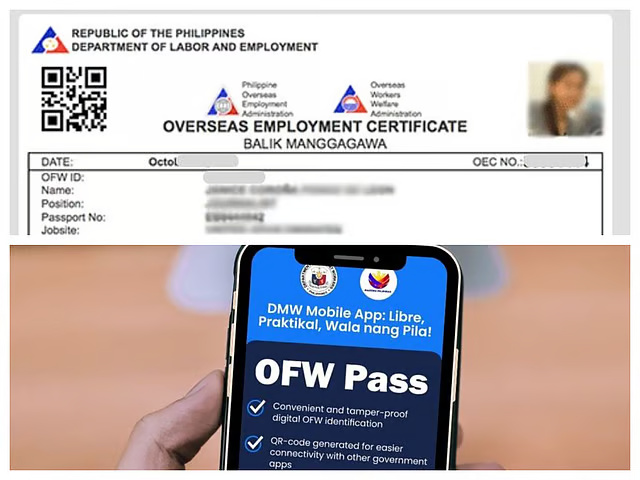
Dubai: For many overseas Filipino workers (OFWs), returning to the UAE after a holiday in the Philippines should be as straightforward as checking in, clearing immigration and boarding their flight.
For some, however, having the right document can make the difference between a smooth journey and multiple trips across the airport.
Although the Philippine Department of Migrant Workers (DMW) introduced the OFW Pass in 2023 as a digital alternative to the Overseas Employment Certificate (OEC), UAE-based Filipino workers have told Gulf News that they are still sometimes asked to present a printed OEC during airport processing.
Their experiences also suggest that procedures can vary between airports — and even from one counter to another.
Digital alternative
The DMW introduced the OFW Pass as a digital alternative to the OEC, aimed at making the travel process more convenient and streamlined for overseas Filipino workers.
Unlike the OEC, which is obtained through DMW processing and is valid for 60 days for a single use, the OFW Pass can be accessed through the DMW mobile app or the eGovPH app and remains valid until the worker’s employment contract expires.
Both the OFW Pass and the OEC serve as exit clearances for overseas Filipino workers.
‘I had to go back and forth’
For Jeane Adriano, a health and safety manager who returned to the UAE in August through Clark International Airport in Pampanga, what should have been a straightforward departure turned into a lengthy process.
“The immigration officers are still asking for the OEC. If you don’t have one, they will direct you to the DMW kiosk at the airport. The OFW Pass is still not being accepted. Even the details on eTravel are not accepted because the immigration system is not yet linked,” Adriano said.
She said she was flying with Emirates when the check-in staff asked whether she had a printed copy of her OEC.
“When I told her I didn’t have one, she said I needed to go to the DMW kiosk on the other side of the airport,” she recalled.

At the kiosk, Adriano was instructed to log in to the DMW online portal and apply for an OEC. She also noticed other OFWs struggling to access their accounts after forgetting their passwords or login details.
After the OEC was printed, she returned to the airline counter, where staff took a photo of the document instead of keeping the hard copy.
She then proceeded to immigration, expecting the process to be complete. Instead, she was asked to return to the DMW kiosk once again.
“The officer checked my documents and wrote something on a piece of paper. Then I was asked to go back to the DMW kiosk to get my OEC verified. They could have done this at the same time when they issued the OEC,” she said.
After obtaining the verification, Adriano had to pass through airport security again before rejoining the immigration queue.
“Only after seeing the verified OEC did the officer process my exit stamp,” Adriano recalled, describing the experience as “frustrating”.
OEC still needed for travel tax refund
For Ressie Pineda, a kids’ club coordinator who returned to the UAE in July through Ninoy Aquino International Airport (NAIA) in Manila, the OEC has also remained part of the departure process.
“An OEC is still needed when claiming a refund. Based on my experience, you need a hard copy of it,” Pineda said.
After claiming her refund, Pineda was directed to the dedicated OFW lane.
“After you get your refund, the staff will immediately direct you to the OFW lane. Once you are there, they will ask for your OEC and travel pass. After that, they will direct you to the smart gate,” she said.

‘Presenting the OEC worked without any issues’
Not every traveller has encountered delays. Paulo Lagunay Jr., a food and beverage supervisor who also returned to the UAE this month, said he continued to use the traditional OEC and experienced no issues during the journey.
“In my case, I still presented the OEC upon departure, as I haven’t tried using the OFW Pass yet,” Lagunay said.
“Presenting the OEC worked without any issues,” he added.

Both documents are valid
An immigration officer at NAIA, who spoke on condition of anonymity because they were not authorised to speak publicly, said both the OEC and OFW Pass are currently recognised by the system.
“At the moment, the OEC is still being used. Since OFWs are processed through the e-gates, they must have either a valid OEC or an OFW Pass before departure,” the officer told Gulf News.
The officer said that while many workers have yet to switch to the digital version, either document is currently accepted.
“Not everyone has shifted to using the OFW Pass yet, but having either document, as long as it is valid, is enough for the e-gate system to process their clearance.”
What this means for OFWs
The OFW Pass was introduced to simplify travel by replacing the paper-based process with a digital alternative. However, recent experiences shared by UAE-based Filipino workers suggest that the transition is still unfolding in practice.
For OFWs planning to return to the UAE after a holiday, the safest approach may be to ensure their DMW account is accessible and to keep all necessary documents — whether digital or printed — ready before heading to the airport.

