

Oil prices climb amid fresh Strait of Hormuz tensions, but will UAE drivers see higher petrol prices?
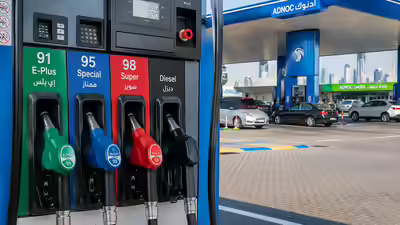
Dubai: UAE motorists may need to lower expectations of another significant drop in fuel prices after global oil prices climbed following reports of Iranian attacks on two UAE tankers in the Strait of Hormuz.
Brent crude prices climbed above $85 a barrel on Tuesday, while US benchmark West Texas Intermediate (WTI) rose past $80, pushing oil gains to around 12% since Friday as traders reacted to renewed geopolitical concerns.
The surge marks a sharp turnaround from the earlier market optimism that had pushed Brent prices down to the low $70s after a US-Iran ceasefire framework agreed in June eased concerns over the security of Gulf energy supplies.
For UAE motorists, the latest surge in oil prices raises a key question: could petrol prices begin climbing again after July’s first fuel price cut in four months?
Oil prices jump again
The latest rally was driven by reports of Iranian missile strikes on two UAE tankers travelling through the southern shipping route of the Strait of Hormuz.
The attacks reignited concerns over the security of one of the world’s most vital energy routes, through which around 20% of global seaborne oil supplies pass. Brent crude climbed above $85 a barrel, while US crude moved past $80 — levels not seen in roughly a month.
While prices remain significantly below the highs reached earlier this year, when Brent briefly surpassed $120 a barrel, the latest surge highlights how quickly geopolitical developments can influence global oil markets.
UAE fuel prices to fall?
The UAE reviews fuel prices on a monthly basis, using the average international oil prices from the previous month rather than day-to-day market movements.
This means a brief spike in crude prices over a few days is unlikely, on its own, to lead to higher petrol prices. The key factor will be whether Brent crude remains elevated in the weeks ahead.
If oil prices retreat towards the mid-$70 range, the impact on the next fuel price review is expected to be limited.
However, if Brent remains above $85 for a prolonged period, the higher monthly average could reduce the possibility of further fuel price cuts or potentially put upward pressure on future revisions.
Outlook still points lower
The recent rise in oil prices has added uncertainty to the near-term outlook, but most major forecasters have not yet revised their expectations for lower crude prices in the second half of 2026.
Those forecasts were based on expectations of improving supply conditions following the US-Iran ceasefire framework, a gradual reopening of the Strait of Hormuz and increased OPEC+ production. While the latest UAE tanker attacks have reintroduced a geopolitical risk premium into the market, analysts say it is still too early to determine whether the broader downward trend has been reversed.
Before the latest escalation, the US Energy Information Administration (EIA) had projected Brent crude would fall below $80 a barrel in the third quarter and move closer to $70 by the end of the year, supported by the recovery of Hormuz exports and slower global demand growth.
Goldman Sachs lowered its fourth-quarter Brent forecast to $80 a barrel from $90, while Morgan Stanley projected prices at $90 in the third quarter and $80 in the fourth. Citi remains among the more bearish forecasters, expecting Brent to average $75 in the third quarter and $70 in the final quarter.
Analysts stay cautious
The latest market reaction has reinforced warnings from several analysts that geopolitical risks remain a key factor for oil markets.
ING commodities strategists Warren Patterson and Ewa Manthey recently noted that markets appeared to be underestimating geopolitical risks.
“This complacency is unusual and clearly leaves significant upside risk if the recovery in supply is slower than expected — or if there is a major escalation in tensions,” they said.
Stephen Innes, Managing Partner at SPI Asset Management, also cautioned that while oil markets had moved past the initial panic, supply risks had not fully disappeared.
“Oil has moved beyond the first panic phase because the physical system has proved more resilient than feared,” he said.
He noted that markets have remained stable due to factors such as pipeline alternatives, inventory drawdowns and strategic reserve releases, rather than a complete recovery in Gulf energy flows.
“Hormuz does not need to operate at full capacity for the market to function. Around 70% traffic, combined with pipeline alternatives and inventory drawdowns, can keep the lights on,” Innes said.
What motorists watch
The direction of UAE fuel prices in the coming months will largely depend on four key factors:
- Whether Brent crude prices remain above $85 a barrel or fall back towards the $70-$75 range.
- The security situation in the Strait of Hormuz and surrounding Gulf shipping routes.
- Whether OPEC+ continues with its planned production increases.
- Progress in diplomatic efforts between the US and Iran.
Outlook
The recent surge in crude oil prices does not immediately change the outlook for UAE fuel prices, but it has introduced more uncertainty compared with just a few days ago.
Under the UAE’s market-linked pricing system, it is sustained movements in global oil prices — rather than short-term spikes — that ultimately influence petrol prices at the pump.
If tensions ease and Brent crude prices move back towards the mid-$70 range, UAE motorists could still see stable or slightly lower fuel prices in the months ahead.
However, if the current rally continues or the security situation in the Strait of Hormuz worsens, the pace of fuel price relief is likely to slow, increasing the possibility of future price rises.
For now, markets have shifted from expecting a steady decline in oil prices to closely monitoring whether the latest geopolitical shock is temporary or develops into another prolonged disruption to global energy supplies.

