

Blue Origin said on May 27 that it was preparing its New Glenn rocket to launch 48 Amazon LEO satellites into low-Earth orbit.

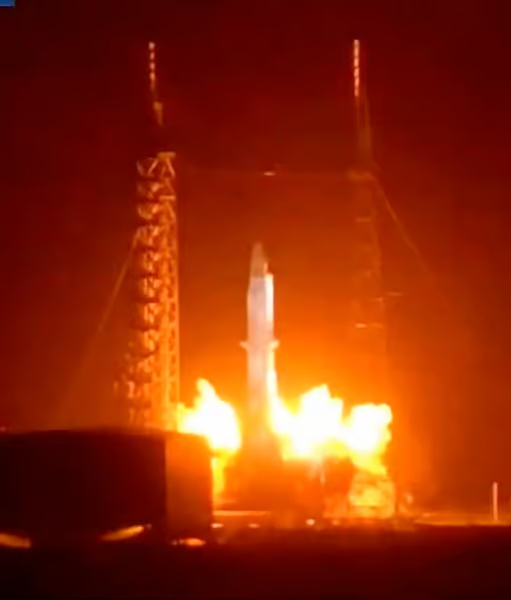
An uncrewed Blue Origin New Glenn rocket exploded on a launchpad in Florida during a test on Thursday, marking a major setback for Jeff Bezos’ space venture as it seeks to close the gap with SpaceX, founded by Elon Musk.
Video shared by NASASpaceflight, which livestreams launches from Florida, showed the towering New Glenn rocket igniting on the launchpad at about 9pm ET (1am GMT Friday) before erupting into a massive fireball. Thick flames and smoke billowed high into the sky following the explosion.
Blue Origin was preparing the rocket for its fourth launch, which was scheduled to deliver 48 Amazon Leo satellites into low-Earth orbit as part of efforts to build a broadband constellation aimed at competing with SpaceX’s Starlink network.
A source familiar with the matter said the Amazon Leo satellites were not onboard or integrated into the rocket at the time of the incident, adding that they could not be identified due to the sensitivity of the information.
The explosion marks the latest setback for Blue Origin’s long-delayed New Glenn rocket, which is expected to play a key role in delivering lunar landers and cargo for NASA’s Artemis lunar exploration missions.
The incident comes just two days after NASA awarded Blue Origin a $188 million contract to land rovers on the Moon, and less than a week after SpaceX conducted a largely successful test of its next-generation Starship rocket.
Blue Origin confirmed it experienced an “anomaly” during a hot-fire test, in which a rocket engine is ignited while the vehicle is secured on the ground.
“Very rough day, but we’ll rebuild whatever needs rebuilding and get back to flying. It’s worth it,” said Jeff Bezos in a post on X, adding that it was too early to determine the root cause.
Jared Isaacman said the agency would work with Blue Origin to support an investigation into the incident, noting that spaceflight development is highly complex and challenging. He added that NASA would assess any potential impacts on its Artemis and Moon Base programmes.
“Rockets are hard”
SpaceX and Blue Origin are intensifying their competition as both companies race to support future lunar missions ahead of a planned crewed landing by China in 2030. The two billionaire-led firms are developing lunar landers that will support NASA’s return to the Moon.
SpaceX, which recently announced plans for an IPO that could become one of the largest U.S. market debuts, has also faced its own setbacks. In June last year, its Starship spacecraft exploded during testing in Texas. More recently, it completed a largely successful 12th test flight, deploying mock satellites and achieving a controlled splashdown in the Indian Ocean, although the Super Heavy booster failed to land successfully and instead fell into the Gulf of Mexico.
Reacting to the latest Blue Origin incident, Elon Musk posted on X, saying: “Most unfortunate. Rockets are hard.”
Meanwhile, Blue Origin has invested billions over roughly a decade in developing New Glenn, a 29-storey reusable rocket designed to compete with SpaceX’s Falcon fleet and Starship programme.
The Federal Aviation Administration said it was aware of the incident but noted it fell outside its scope and did not affect air traffic in the region.

