

With two years of focused preparation, students can secure admission to government medical colleges in India.
Despite the tough competition in India’s engineering and medical entrance exams, students from the UAE are increasingly earning places in top institutions such as IITs, NITs, and government medical colleges—often at costs lower than monthly school fees in the UAE.
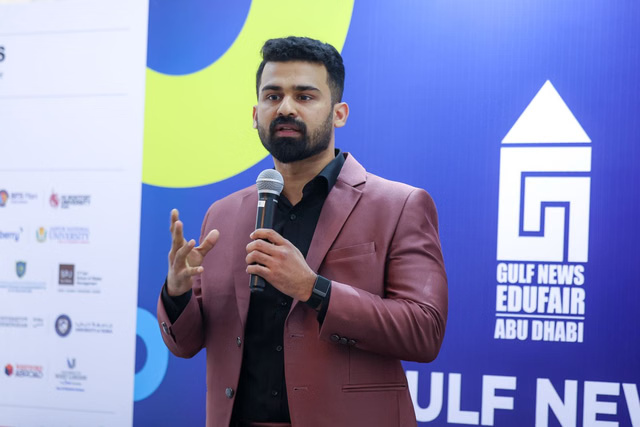
Speaking at a spotlight session at Gulf News Edufair in Abu Dhabi, A. Ameen, Head of Operations at Unique World Education, highlighted that early preparation, structured coaching, regular mock tests, and a clear understanding of admission routes are helping Gulf-based NRI students succeed in India’s highly competitive system.
“Students studying in the UAE can become IITians and doctors in India if they start preparing early and understand the admission pathways properly,” he said.
He added that some students have secured MBBS seats for as little as Rs18,000 (about Dh690) per year.
IIT pathway for UAE students
Ameen noted that opportunities are growing for Gulf students in IITs and IIITs, including the IIT Delhi Abu Dhabi campus.
Admissions to the Abu Dhabi campus are conducted through the Combined Admission Entrance Test (CAET) or JEE Advanced. Students must have a strong foundation in Physics, Chemistry, and Mathematics. “They can either appear for CAET or qualify through JEE Advanced,” he explained, adding that the campus currently offers around 60 to 70 seats.
He recommended that students begin preparation from Grade 11, as JEE questions are based on both Grade 11 and 12 syllabi. He also pointed out that nearly 1.4 million students take the JEE each year, making it one of the most competitive exams globally.
NIT admissions via DASA
For engineering aspirants, admissions to National Institutes of Technology (NITs) are available through the Direct Admission of Students Abroad (DASA) scheme, which has a separate quota for overseas students. Fees are around Rs85,000 per year across 32 NITs in India.
NEET and medical admissions
For medicine, government medical college admissions depend on the NEET exam, where competition is extremely high. In 2025, around 2.2 million students competed for about 100,000 MBBS seats.
“To secure a seat in a government medical college with fees of around Rs18,000–Rs20,000 per year, students typically need scores between 660 and 700,” he said.
Lower scores can significantly increase costs, with management quota seats ranging from Rs800,000 to Rs1.5 million per year for students scoring around 550.
He also cautioned that foreign medical degrees do not automatically allow practice in India unless candidates clear the required licensing process.

