

Tawazun Economic Council and Lockheed Martin have signed an agreement to develop local microelectronics manufacturing capabilities.
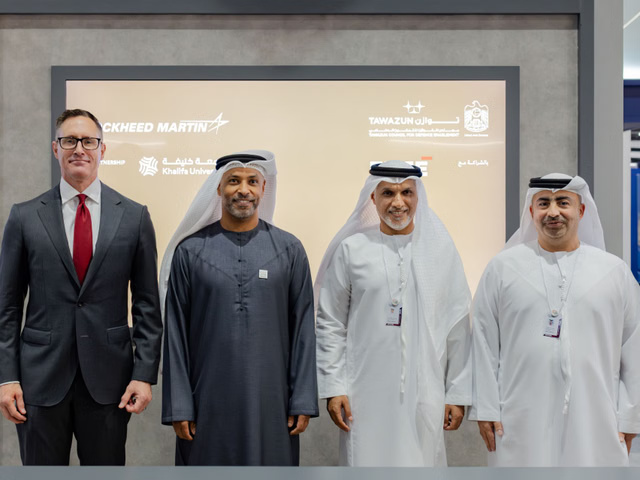
Dubai: The UAE will develop an advanced chiplet design and assembly facility through a strategic agreement between Tawazun Economic Council and Lockheed Martin, marking a major step in strengthening local capabilities in advanced microelectronics.
The agreement was signed on the sidelines of Make it in the Emirates 2026 and will be implemented in partnership with EDGE Group and Khalifa University of Science and Technology.
The initiative aims to enable the UAE to design and assemble advanced chiplet-based technologies, which are widely used across defence, aerospace, telecommunications, artificial intelligence, autonomous systems, and advanced manufacturing sectors.
HALCON, a subsidiary of EDGE Group, will integrate chiplet-based processors into its advanced targeting and guidance systems.
The new processors are expected to enhance onboard computing capabilities, improving target acquisition, tracking accuracy, and precision engagement in defence applications.
The agreement also includes the establishment of a dedicated research and development centre at Khalifa University of Science and Technology, focused on microelectronics design, talent development, and industry-led research.
Shareef Hashim Al Hashmi, General Director of the Industry Development Directorate at Tawazun Economic Council, said the council is working to bring together strategic partners, support capability development, and lay the foundations for a local chiplet ecosystem.
He added that chiplet technologies are becoming increasingly important across advanced sectors such as defence, aerospace, telecommunications, artificial intelligence, autonomous systems, and advanced manufacturing.
UAE-US technology partnership
The agreement also reinforces the UAE’s technology partnership with the United States by connecting local design, research, and assembly capabilities with Lockheed Martin expertise and its wider network of American partners.
Al Hashmi said the co-development model would help strengthen supply chain resilience and support the creation of high-value jobs and innovation opportunities in both countries.
“For more than 50 years, Lockheed Martin has partnered with the UAE to bring advanced capabilities from ambition to reality. This agreement moves further,” said Daniel Mouton, Chief Executive, Lockheed Martin Middle East. “It establishes the design and assembly capacity needed to place the Emirates inside the global microelectronics value chain. Chiplets are foundational to the next generation of aerospace, defence, AI and autonomous systems, and this initiative brings together UAE vision, Emirati talent and US technology partners to build capability that can serve both national priorities and wider industrial growth.”
Khalifa University to train UAE talent
The dedicated R&D centre will be hosted at Khalifa University of Science and Technology, where it will focus on training UAE nationals in chiplet design and advanced microelectronics.
The centre is also expected to bridge academic research with real-world industrial applications, strengthening the link between education, innovation, and the country’s growing advanced technology sector.
“Khalifa University is leading in the knowledge-based economy as a catalyst for economic development in the UAE,” said Prof. Ebrahim Al Hajri, President of Khalifa University of Science and Technology. “The dedicated R&D centre at the University, to be established with our partners, will train UAE nationals in chiplet design and advanced microelectronics and connect our research directly to industrial application. This is precisely the model the UAE needs to secure its position in the global technology value chain.”
The talent development component is central to the agreement, as advanced chip design and assembly require highly specialised engineering expertise. Building this capability locally is expected to strengthen the UAE’s long-term foundation in technology manufacturing and applied research.
EDGE to support local integration
EDGE Group will play a key role through HALCON, which plans to integrate chiplet-based processors into advanced defence systems. This will enable direct application of microelectronics capabilities in locally developed technologies.
Saif Al Dahbashi, President of Missiles & Weapons at EDGE, said the initiative supports the UAE’s sovereign microelectronics capability.

