

Dr Khalid Al Naqbi has spent 15 years observing the UAE’s efforts to develop sovereign control over infrastructure that most people rarely consider.
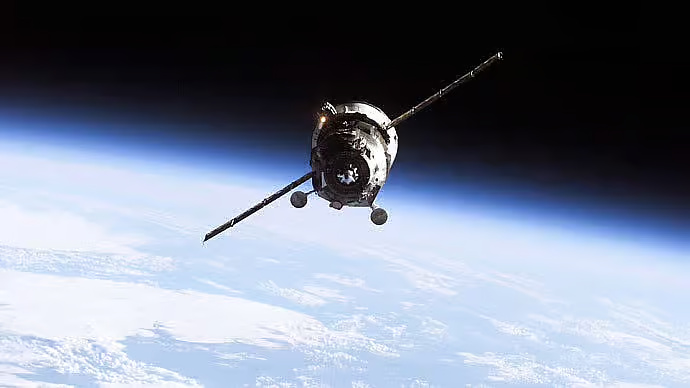
Every time a payment clears, a flight lands on schedule, or a flood warning reaches a city before the water arrives, a satellite has played a role. Most people never notice it. That invisibility, he says, is exactly what makes satellites easy to underestimate.
Dr Khalid Al Naqbi has spent 15 years working within the infrastructure that operates largely out of public view. As a National Expert on Satellite Technology and Vice President of Product and Engineering at Space42, he entered the field at a time when Emirati representation was limited, much of the technology was imported, and space remained a domain dominated by global superpowers.
Most people think of satellites as tools that power maps and weather forecasts, but their role extends much further. “We use satellites for communications, for positioning, navigation and timing, and for Earth observation,” Al Naqbi said. “Whether you use satellites for your car, your phone, or your communications, these applications all have dual use. You have the defence use and you have the commercial. And all of them are woven into the foundation of how countries operate every single day.”
The consequences of that dependence usually only become visible when something goes wrong. Global Navigation Satellite Systems (GNSS) underpin aviation routing, financial transaction timestamps, mobile network coordination, and logistics at a scale most people rarely consider. “The timestamp and the location services, financial systems, the mobility sector, aviation, communication networks — all of these systems need to know the location of users and the time to coordinate,” he told Khaleej Times. “Without the GNSS we are blind.”
Modern systems depend on satellites—but many countries rely on infrastructure they do not fully control.
AI-driven data
Artificial intelligence has reshaped satellite infrastructure by changing both what it can detect and how quickly it can respond. Synthetic Aperture Radar (SAR) satellites can capture high-resolution imagery in all weather conditions and at night, but interpreting that data once required significant human effort. That has changed.
“Today, with the applications we have and with artificial intelligence, we are able to bring radar images to optical images, an image you can take straight up with your mobile phone,” Al Naqbi said. “The computer takes the radar image and the artificial intelligence makes it as if it is an optical image, layering the information in a way that the normal human eye would understand.”
The practical uses are immediate. AI can analyse soil composition from orbit, monitor changes in waterways over time, and simulate urban flood paths before rainfall begins. “If it rains, we would actually, with AI, anticipate where the water would run in a city, which will help us in preventing damage, allowing for water access, and maybe utilising the water better. AI helped us study things that we cannot normally monitor with the naked eye, things that were simply not reachable before.”
Region’s first commercial SAR satellite manufacturer
Space42’s Foresight constellation now includes five SAR satellites in low Earth orbit, operating at 25-centimetre resolution and placing the UAE among a small group of countries with such capabilities. Abu Dhabi is also home to the region’s first commercial SAR satellite manufacturing facility, enabling the design, assembly, and testing of advanced Earth observation satellites domestically for the first time.
For the UAE, the goal was not just participation in the space sector, but ownership of key layers of it—data, infrastructure, manufacturing, expertise, and the systems that connect them.
“The ambition has always been to utilise space as a part that cannot be separated or excluded from the UAE’s infrastructure and foundation in technology, in providing services, in enhancing people’s lives, but the ambition that has been constant is not only growth in technology and business. They have always invested in the human capital, in people’s education and growth. And I am maybe one of the biggest people who benefited from this.”
That investment is now visible in a new generation. When Al Naqbi began, Emiratis in the sector were few. Today, he sees graduates entering space technology, AI, and cybersecurity with clear direction and purpose.
“I proudly see my younger brothers and sisters today graduating in those fields with huge eagerness to join,” he said. “It is something really to be proud of.”
For countries, the question has moved beyond whether to invest in space technology to whether they can build sovereign systems. The UAE, Al Naqbi says, made that decision early—the satellites in orbit, the facilities in Abu Dhabi, and the engineers behind them are the result of that choice.

