

Faithful across the UAE can use the expected dates to plan their observance of the major Islamic occasions next year.
The UAE’s Astronomy Centre has released likely dates for major Islamic occasions in 2027, corresponding to 1448 AH, giving residents an early guide for planning next year’s religious observances.
Because the Hijri calendar follows the lunar cycle, Islamic months can last 29 or 30 days, depending on crescent-moon visibility. The UAE’s official Moon-sighting Committee makes the final determination of key dates, meaning the dates currently projected by astronomical calculations may change.
From Ramadan to Eid Al Adha, here are the likely dates based on the Astronomy Centre’s calculations. These should be treated as expected dates rather than final official dates, pending the relevant moon sightings.
Ramadan 2027
Ramadan 1448 AH is expected to begin on Monday, February 8, 2027, according to astronomical calculations. The exact date will be confirmed by the UAE’s official Moon-sighting Committee based on the sighting of the crescent moon.
The holy month is expected to continue for either 29 or 30 days, meaning Eid Al Fitr could fall around March 9 or 10, 2027, depending on the official moon sighting.
The crescent marking the end of Shaaban is likely to be sighted on either Saturday, February 6, or Sunday, February 7, 2027.
According to the Astronomy Centre, the crescent will not be visible from several parts of the world, including the UAE, because the Moon will set before the Sun and/or the conjunction will occur after sunset. As a result, Shaaban is expected to complete 30 days, putting the likely start of Ramadan on Monday, February 8, 2027, in the UAE.
In 2026, Ramadan began on February 18. The holy month moves approximately 10 to 12 days earlier each year because the Islamic calendar follows the lunar cycle.
Eid Al Fitr 2027
Eid Al Fitr begins on the first day of Shawwal and is traditionally observed over the first three days of the month.
The date in 2027 will depend on the length of Ramadan. The Shawwal crescent is expected to be sighted in the UAE on either Monday, March 8, or Tuesday, March 9, 2027, according to the Astronomy Centre.
If the crescent is sighted on the evening of Ramadan 29, March 8, Eid Al Fitr would begin on Tuesday, March 9. If the crescent is not sighted and Ramadan completes 30 days, Eid would begin on Wednesday, March 10.
Eid Al Adha 2027
Eid Al Adha falls on the 10th day of Dhul Hijjah, the final month of the Islamic calendar. It follows the Day of Arafah on Dhul Hijjah 9, one of the most significant days in Islam.
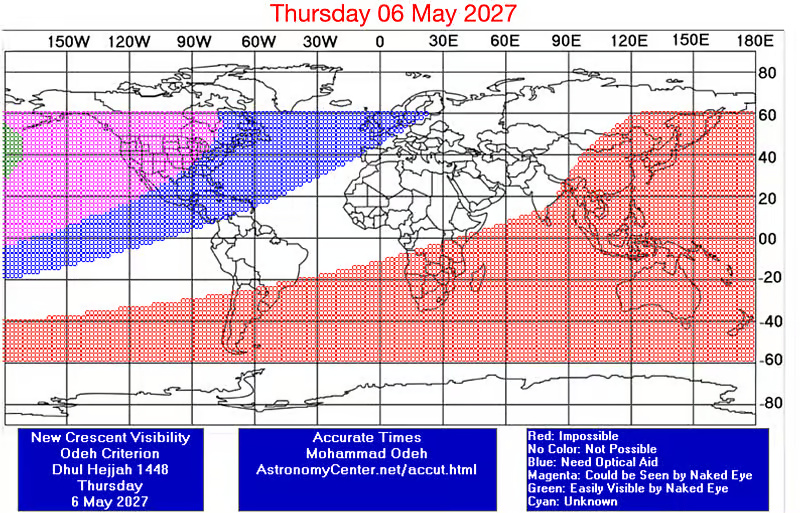
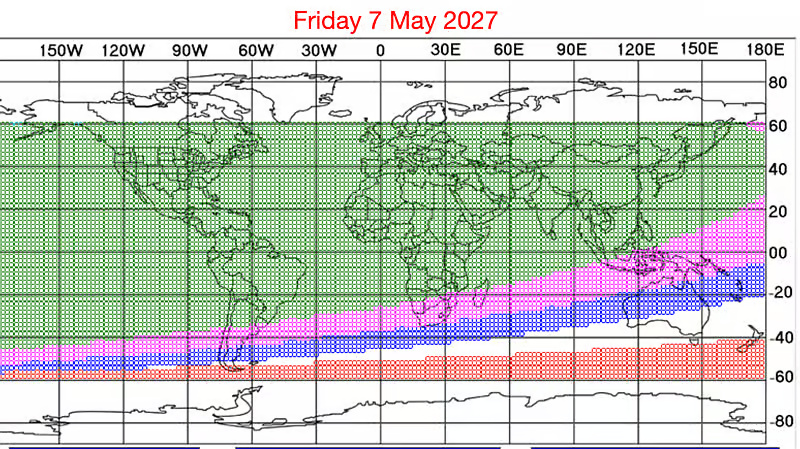
The Dhul Hijjah crescent is expected to be sighted in the UAE on either Thursday, May 6, or Friday, May 7, 2027, according to the Astronomy Centre. This would mean Dhul Hijjah could begin on May 7 or May 8, making Eid Al Adha likely on Sunday, May 16, or Monday, May 17, 2027.
The Astronomy Centre’s visibility calculations indicate that on May 6 and May 7, the crescent’s visibility will vary by location. In areas marked red, it is expected to be impossible to see because the Moon sets before sunset and/or the conjunction occurs after sunset. In blue areas, the crescent may be visible with optical aid, while in magenta areas it may be visible with optical assistance and potentially to the naked eye under favourable conditions and with an experienced observer.
All dates remain provisional. Final dates in the UAE will be determined through official moon-sighting procedures.
Day of Arafah 2027
The Day of Arafah is likely to fall on May 15 or May 16, 2027, depending on which date is confirmed as the ninth day of Dhul Hijjah.
Eid Al Adha is observed by Muslims worldwide to commemorate Prophet Ibrahim’s sacrifice. The occasion includes the sacrifice of livestock, with the meat traditionally distributed among family, friends and those in need. The nine days leading up to Eid are also considered a period for increased worship, remembrance and spiritual reflection.
On the Day of Arafah, most Muslims who are not performing Hajj observe a fast. Pilgrims performing Hajj do not fast on this day, as they take part in the central rites of the pilgrimage. Hajj generally takes place from the 8th to the 12th or 13th of Dhul Hijjah.
Muharram 2027
The Islamic New Year begins on the first day of Muharram, the first month of the Hijri calendar. Based on the Astronomy Centre’s projected moon-sighting dates for 2027, the first day of Muharram will depend on when Dhul Hijjah begins and whether the crescent is sighted.
If Dhul Hijjah begins on May 7, 2027, and lasts 29 days, Muharram would likely begin on Saturday, June 5. If the crescent is not sighted and Dhul Hijjah lasts 30 days, the new Islamic year would begin on Sunday, June 6.
If Dhul Hijjah begins on May 8, and lasts 29 days, Muharram would likely begin on Sunday, June 6. If it lasts 30 days, the first day of Muharram would fall on Monday, June 7, 2027.
These dates are astronomical projections and remain subject to official moon-sighting announcements in the UAE.

