

Toyota Building demolition puts Dubai tenants with illegal partitions under scrutiny.
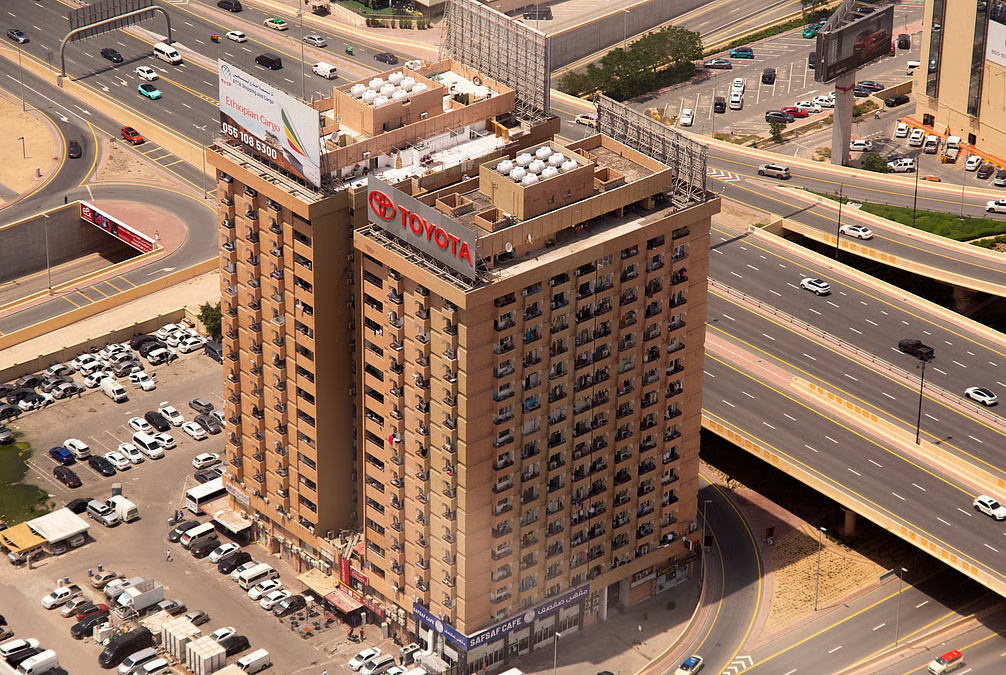
Dubai: Dubai’s iconic Toyota Building on Sheikh Zayed Road is set to be demolished in 2027, with nearly 70 per cent of its tenants already having moved out. The situation has also raised broader questions about tenant rights, illegal partitions and regulations governing shared accommodation in the emirate.
Gulf News spoke to the building’s management, which said tenants had not been forced to leave, although electricity to the building has been disconnected. Some residents reportedly still had valid tenancy contracts running until December 2026.
The management said it was unaware of the reason for the power disconnection and attributed the matter to Dubai Municipality. An agent, meanwhile, said the issue was linked to several partitioned apartments in the building, although this could not be independently verified.
Asked why any partitioned apartments had not been identified earlier, the building management said it was not authorised to enter rented units once they had been handed over to tenants.
The management said municipal regulations prevent it from inspecting the interiors of occupied apartments without the required authority.
The management did not disclose how many apartments were affected by the electricity disconnections.
While the circumstances at the Toyota Building are specific to the property, they highlight wider questions in Dubai’s rental market: what happens when apartments are divided into unauthorised rooms or bed spaces, who bears responsibility, and what protections apply to tenants when a building is scheduled for demolition?
Who can legally operate shared housing in Dubai?
Dubai Law No. (4) of 2026 establishes a regulatory framework for shared housing across the emirate, including private development zones and free zones.
Under the new rules, a property cannot be designated or operated as shared housing without a permit from Dubai Municipality. The law also sets requirements covering occupancy limits, space per resident, shared facilities and building and safety standards. Tenants are not permitted to sublease parts of a unit informally.
Only property owners, or companies authorised to manage or lease properties on an owner’s behalf, can legally operate shared accommodation. This may include an owner leasing a property directly, a property management company acting for the owner, or a company leasing a unit and subsequently subleasing it to residents.
Tenants, however, do not fall within this chain. A tenant cannot simply divide an apartment and rent out individual rooms or bed spaces without the required authorisation.
The law also empowers Dubai Municipality to set occupancy limits for each unit, determine the minimum space allocated to each resident, and specify the facilities and services that must be provided.
A permit is required for shared housing
“A real estate unit cannot be allocated for shared housing without obtaining a permit. This changes the conversation completely. It is no longer simply a question of whether the landlord agrees to subletting or whether several people can contractually agree to live together,” said Ahmed Elnaggar, CEO of Elnaggar and Partners.
“The property itself must enter the shared housing regulatory system,” Elnaggar said.
For example, an owner cannot simply divide an apartment among six people because it appears commercially viable. The property must first obtain the necessary permit to operate as shared accommodation.
Dubai Municipality will also establish standards governing where shared housing can operate, taking into account factors such as population density, infrastructure, sewage capacity, urban planning and the characteristics of surrounding residential neighbourhoods.
“A real estate unit cannot be allocated for shared housing without obtaining a permit. This changes the conversation completely. It is no longer simply a question of whether the landlord agrees to subletting or whether several people can contractually agree to live together. The property itself must enter the shared housing regulatory system.”
Ahmed Elnaggar, CEO of Elnaggar and Partners
Who is responsible for illegal partitions?
Responsibility can depend on who created, authorised or operated the unauthorised arrangement.
“The penalties may fall on the property owner or anyone operating the apartment as an unauthorised shared space,” said Awatif Al Khouri, lawyer and founder of Awatif Mohammad Shoqi Advocates and Legal Consultancy.
She said residents who simply rent partitioned spaces could face eviction, while fines are more likely to target landlords or main tenants who profit from dividing a property without permission. Property management companies could also face liability if they fail to monitor the building or disregard safety standards set by Dubai Municipality.
“The penalties may fall on the property owner or anyone operating the apartment as an unauthorised shared space. While residents who simply rent a partition may face eviction, fines are more likely to be issued to landlords or main tenants who profit from dividing the flat without permission. Property management companies may also be held liable if they fail to monitor the building or ignore safety standards set by Dubai Municipality.”
Awatif Al Khouri, lawyer and founder of Awatif Mohammad Shoqi Advocates and Legal Consultancy
Ahmed Odeh, Managing Partner at MIO & Partners, said that when a landlord discovers that a unit has been partitioned without authorisation, they can file an expert case before the Dubai Courts.
“The court-appointed expert attends the premises and documents the actual conditions, including the number of beds, occupants and their Emirates ID numbers. The resulting report can then serve as evidence for the landlord’s eviction case,” he said.
He added that a tenant who partitions a property without the landlord’s written consent could be in breach of tenancy regulations and face eviction, as well as liability for the cost of restoring the unit.
Where a management company authorised the partitioning work, its liability would depend on the capacity in which it acted — whether as the owner’s agent or as an operator acting in its own name, he said.
“A tenant who partitions without the landlord’s written consent breaches tenancy law and could face eviction as well as the cost of restoring the property. Where a management company authorised the works, its position depends on the capacity in which it acted, whether as the owner’s agent or as an operator in its own name.”
Ahmed Odeh, Managing Partner at MIO & Partners
Fines for illegal shared housing
The new law provides for fines ranging from Dh500 to Dh500,000. If the same violation is repeated within one year, the fine can be doubled, with the maximum penalty reaching Dh1 million.
Additional administrative measures may include suspending the activity for up to six months, revoking the shared-housing permit, coordinating the revocation of a commercial licence, suspending public services to a violating property, restricting transactions involving the property and refusing to register lease or management contracts until the violation is resolved.
In certain cases, a violating unit may also be ordered to be evacuated following a decision by the Execution Judge.
Property owners and operators running shared accommodation have one year to bring their properties into compliance with the new regulations.
What happens when a Dubai building is demolished?
The rules governing demolition are separate from those covering illegal partitions and unauthorised shared housing.
Under Article 25 of Dubai’s Rental Law, a landlord seeking to evict a tenant because a property is being demolished and reconstructed must provide 12 months’ notice, clearly stating the reason for the eviction. The notice must be served through a Notary Public or by registered post.
Dubai’s tenancy legislation also links demolition-related eviction to cases where the necessary permits have been obtained from the relevant authorities. This means a landlord cannot necessarily terminate a tenancy simply by stating an intention to demolish the building.
For tenants, this distinction is important. A building being earmarked for demolition does not automatically allow a landlord to terminate a tenancy immediately, particularly if the required notice and other legal conditions have not been fulfilled.
Tenants may also have protection once the work is completed. Under Article 29, a tenant has a right of first refusal to rent the property after it has been demolished and reconstructed, or renovated or refurbished by the landlord. The tenant must exercise this right within 30 days of receiving notification.

