

Nusseibeh takes leave from UAE government role to focus on UN chief bid.
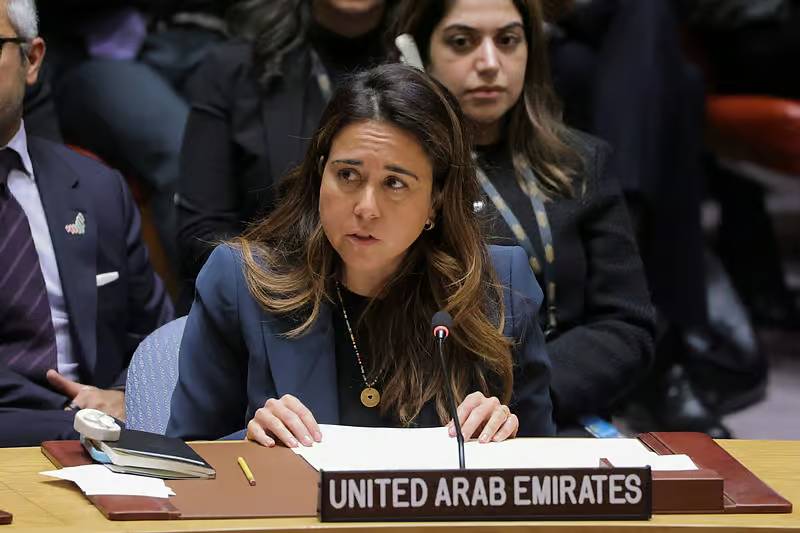
The United Nations should rely on “quiet diplomacy” to prevent conflicts from escalating and secure practical agreements that ease human suffering while laying the groundwork for broader political settlements, UAE diplomat Lana Nusseibeh has said as she announced her candidacy for the world body’s top job.
In her vision statement, Nusseibeh, the UAE’s former ambassador to the UN, calls for a focus on achievable “first agreements”, including securing humanitarian access, exchanging prisoners and negotiating local truces. Such agreements, she argues, should be pursued through sustained diplomatic efforts, backed by measures to verify that they are upheld.
She also advocates involving those closest to conflicts in peace efforts, including regional organisations and mediators trusted by the parties involved. The UN, she says, need not lead every negotiation but should be ready to work with those best placed to make progress.
Her approach focuses on bridging differences between countries to achieve tangible outcomes, rather than simply keeping dialogue open. These efforts should help reduce violence, enable humanitarian aid to reach those in need and create conditions for lasting peace.
Nusseibeh, the UAE’s Minister of State and Envoy to the UN and European Union, announced her candidacy on Wednesday, October 21, after being formally nominated by President Sheikh Mohamed bin Zayed Al Nahyan.
Sheikh Mohamed submitted her nomination in a letter addressed to the presidents of the UN General Assembly and Security Council. According to the Emirates News Agency (WAM), the UAE President highlighted her extensive experience at the UN, her judgement in addressing international challenges and her record of constructive engagement.
If elected, Nusseibeh would become the first woman to lead the United Nations since its establishment in 1945. She would also be the second Secretary-General from the Arab world, following Egypt’s Boutros Boutros-Ghali, who held the post from 1992 to 1996.
The veteran diplomat has taken a leave of absence from her UAE Government responsibilities to focus on her candidacy.
In her vision statement, she said the decision reflected the independence required of the Secretary-General under the UN Charter.
“I wish to offer myself to this office as I would serve it: speaking frankly with every government and answering to none. There will be no exemptions for friends and no grudges against critics.”
— Lana Nusseibeh
What determined diplomacy can achieve
Announcing her candidacy, Nusseibeh reflected on both the potential of diplomacy and the consequences when it falls short.
“I have spent much of my professional life working in and around the United Nations, and I have seen first-hand what determined diplomacy can achieve – countries with profound differences finding common ground, and agreement where people said agreement was impossible,” she said.
However, she warned that the widening gap between international commitments and tangible results was eroding confidence in the organisation.
“When the distance between what we promise and what we deliver grows, trust erodes, and so does our ability to act,” she said.
“I am standing to be Secretary-General because I believe this is a moment to act with greater urgency: to act earlier, bring people together across difference, and drive the work forward until it produces concrete results.”
More than a decade at the UN
Nusseibeh brings extensive diplomatic experience to the contest, having served as the UAE’s Permanent Representative to the United Nations from 2013 to 2024.
She led the UAE’s participation during its 2022-2023 term as an elected member of the UN Security Council, serving twice as its President.
Her tenure involved negotiations on some of the Council’s most divisive issues, including the humanitarian crisis in Gaza.
In December 2023, she led a visit by current and incoming Security Council members to the Rafah border crossing to highlight the worsening humanitarian situation. She also played a key role in securing the adoption of Resolution 2720, which aimed to facilitate humanitarian aid deliveries to Gaza.
Nusseibeh has also served as Vice-President of the UN General Assembly and President of the Executive Board of UN Women. Her work has included efforts to reform the Security Council and revitalise the General Assembly.
Beyond conflict resolution, her proposals for the UN include strengthening accountability, reducing duplication and focusing the organisation’s work on measurable results across peace and security, development and human rights.
A race without a consensus candidate
Nusseibeh enters the race at a critical stage, with the Security Council yet to agree on a successor to António Guterres, whose second five-year term ends on December 31, 2026.
According to Reuters, six rounds of informal Security Council polling have failed to produce a candidate acceptable to all five permanent members: the United States, Russia, China, Britain and France.
In the latest poll, held on October 16, former Costa Rican Vice-President Rebeca Grynspan narrowly led the field. However, all seven contenders received at least two opposing votes from permanent members, leaving the race without a clear frontrunner.
The deadlock has created an opening for additional candidates to enter the contest.
The next Secretary-General must be recommended by the 15-member Security Council and subsequently appointed by the General Assembly. A candidate needs at least nine votes in the Council and must avoid a veto from any of its five permanent members.
The post carries a five-year term, with the next Secretary-General due to take office on January 1, 2027.
The selection process comes amid longstanding calls for a woman to lead the UN for the first time, alongside an informal tradition of regional rotation that has fuelled expectations of a candidate from Latin America. Neither consideration is a formal requirement under the UN Charter.
For Nusseibeh, the race will mean seeking support from the same world powers whose divisions have often hindered international consensus.
Her vision statement outlines how she would approach the role if appointed: “I will judge my own work by the impact it produces, not by what it proclaims.”

