

UAE students return to classrooms for more than lessons, with focus on values and AI.
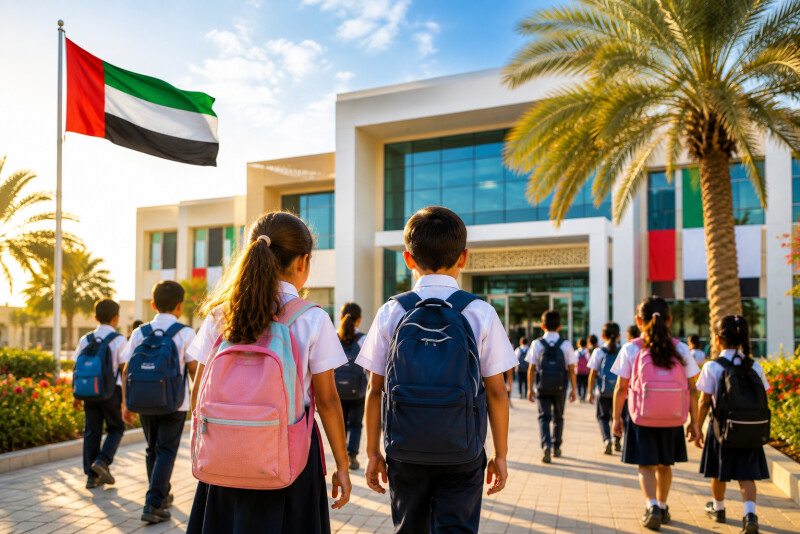
Students across the UAE’s public and private schools returned to classrooms yesterday as the 2026–27 academic year got underway, marking a fresh start for more than 1.277 million students enrolled across more than 1,180 public and private schools nationwide.
Among them are around 26,700 first-time students, with schools completing extensive preparations ahead of the new academic year. Welcome programmes combined orientation for the year ahead with educational and interactive activities designed to help students settle smoothly back into school life.
Public schools are following a phased return during the first week of the new academic year. The process begins today with new students, followed by other educational stages according to attendance schedules set by individual schools from Monday to Thursday.
School hours will be reduced during the transition period, with all students expected to be back by Friday, when schools will move towards the regular timetable.
The phased return allows schools to welcome students in stages and help them transition from the holiday routine to the structure of the school day, particularly those starting school for the first time. It also gives schools an opportunity to familiarise students with the school environment, organise entry and exit procedures and finalise arrangements for the start of the academic year.
11 new schools and educational complexes, 8 million textbooks
The new academic year follows extensive preparations, including the opening of 11 new schools and educational complexes, the distribution of around 8 million textbooks and the deployment of 5,810 school buses to transport students.
More than 24,000 education professionals also took part in specialised training programmes, with more than 80 programmes and workshops organised ahead of the new academic year.
Across schools nationwide, the return to classrooms has involved more than simply resuming lessons. The first days have been used for orientation, interaction and familiarisation with the themes and priorities that will shape students’ academic journey throughout the year.
Zayed Educational Complex – Al Mizhar
At Zayed Educational Complex – Al Mizhar in Dubai, local media representatives were introduced during a field visit to a series of initiatives bringing together learning, values, technology and awareness.
The students’ return followed extensive academic and operational preparations, including getting facilities and classrooms ready, filling staffing vacancies and establishing early communication with parents. Educational and administrative teams also began preparations well ahead of the students’ return to ensure the complex was ready for the new academic year.
Interactive activities
Speaking to the media, Bdoor Shaheen Ali, Head of the Academic Affairs Unit at Zayed Educational Complex – Al Mizhar, said the complex had sought to turn the National Charter for Education into an interactive experience that students could engage with in their daily school environment, rather than treating it simply as a set of theoretical concepts.
She explained that the complex’s team had designed a wide range of activities across corridors, classrooms and other school facilities, incorporating themes closely linked to students’ experiences, including artificial intelligence, national identity and Sanad.
Shaheen said preparations for the activities began before students returned, with administrative and teaching teams using the week leading up to the start of classes to decorate corridors, prepare classrooms and organise the wider school environment.
The aim, she said, was to ensure students encountered a fully prepared environment from the moment they arrived on their first day – one that welcomed them and encouraged them to reconnect with school life.
Partnership with families
Bdoor Shaheen emphasised that communication with parents was a key part of preparations for the new academic year.
The complex began engaging with families before students returned through its official communication channels and platforms, as well as by organising an orientation meeting between the school administration and parents.
She said the meeting and advance communication helped families understand the preparations and arrangements for the academic year, while establishing a direct line of communication between parents and the school from the outset. This was clearly reflected in the atmosphere surrounding students’ first day, she added.
Early preparation to introduce students to the National Charter for Education
Early preparation across academic, organisational and interactive areas, combined with engagement with families, was aimed at ensuring a smooth transition from the holiday period to the school environment. It also sought to establish a positive relationship from day one between students, teachers, the school and parents, laying the foundation for a stable start to the new academic year.
Amna Hilal, Principal of Zayed Educational Complex – Al Mizhar, told the media that early preparations for the 2026–27 academic year had helped ensure a smooth and stable start for students from the first day.
Preparations included ensuring staff, facilities and classrooms were ready, as well as developing an interactive programme to introduce students to the National Charter for Education, reinforce the values of national identity and Sanad, and promote the responsible use of artificial intelligence. The complex also established early communication channels with parents.
“Preparations for the academic year began before the students returned, with the aim of ensuring the readiness of the complex, its facilities and the services it provides,” Hilal said.
Bringing the charter into the classroom
Hilal noted that preparations for the academic year went beyond operational and academic arrangements, with equal focus placed on introducing students to the National Charter for Education and its objectives from the outset.
A compass for values and behaviour
At the Values Station, students encounter a “Values Compass” that brings together behaviours intended to become part of their daily school lives. These include respect, honesty, responsibility, cooperation, empathy, critical thinking and a strong sense of belonging.
Beyond simply displaying these values, the station encourages students to consider how they can put them into practice.
Through cards, activities and real-life scenarios, students explore the behaviours associated with each value, connecting the concepts to their everyday experiences in classrooms and corridors and their interactions with classmates and teachers.
The station also features activities focused on tolerance, with scenarios designed to encourage students to consider how they should respond to and interact with others. In this way, values move beyond words on a board and become choices and behaviours that students can practise every day.
Read… to Create
A few steps away, holders of the “Future Passport” move to the Reading and Creativity Station, under the slogan “Read… to Create”.
Here, reading is presented not simply as a standalone activity, but as a gateway to critical thinking, imagination and generating new ideas.
The station encourages students to set aside 20 minutes each day for reading, explore subjects and fields that interest them, record new ideas and share them with others. It also introduces students to the Arab Reading Challenge and explains how they can take part.
The station connects reading with creativity through a four-step journey: “Read”, “Imagine”, “Connect Ideas” and, ultimately, “Create”.
The message to students is simple: a book can be the starting point for a new idea, project or innovation.
‘My Green Year’: Everyday actions to protect the environment
The Sustainability Station takes students into another aspect of their responsibility under the slogan “My Green Year… I Am an Eco-Friendly Friend”, turning sustainability into a series of simple daily habits that can be practised both at school and at home.
The station offers practical guidance on conserving water, using energy efficiently, reusing materials, sorting waste and reducing paper consumption, while also encouraging students to help keep the school environment clean.
Students are also invited to choose a sustainable habit and pledge to practise it throughout the year, turning environmental awareness into personal action and individual responsibility.
In one interactive activity, students write their chosen habits or pledges on leaf-shaped cards. As more students contribute, the cards come together to create a collective green space representing their commitments for the new academic year.
Artificial Intelligence station
The Artificial Intelligence Station is one of the clearest expressions of the initiative’s focus on the future. A robot welcomes students alongside an information area titled “Artificial Intelligence with Awareness and Safety”.
The station offers an accessible introduction to artificial intelligence, exploring its potential while emphasising the importance of using the technology consciously, safely and responsibly.
The objective is to make technology part of the learning journey rather than simply present it as a standalone tool.
Robots and Artificial Intelligence
At Zayed Educational Complex – Al Mizhar, students did not begin their journey into the new academic year at their classroom desks. Instead, they received a small “Future Passport” and embarked on a journey through a series of interactive stations designed to introduce them to the future.
The Future Passport served as an entry pass to the “Future Corridor”, where school corridors were transformed into an open learning space. Students moved between stations, each with its own theme, message and activity, turning the return to school into an experience centred on discovery and participation.
The stations focused on values, reading and creativity, sustainability, and artificial intelligence, creating an integrated experience that brought together character-building, skills, knowledge and technology.
The concept of the “Future Corridor” reflects an approach that goes beyond simply decorating the school for students’ first day. Instead, the corridor becomes an extension of the classroom – and an additional space for learning.

