

From Paper Ledgers to Instant Transfers: Al Ansari CEO Rashed A. Al Ansari on the Evolution of UAE Remittances.
Imagine needing to send money home urgently to a sick family member, only to wait three days for the funds to arrive. That was the reality for expatriates in the UAE in the 1960s, when Al Ansari Exchange first began operations. Today, the same transfer can reach the recipient in as little as three seconds.
“I remember it used to take a very long time. It was three days,” recalls Rashed A. Al Ansari, Group CEO of Al Ansari Financial Services, reflecting on an era of paper ledgers, carbon copies and traveller’s cheques. “Now it’s instant. By the time you touch the door handle of the branch to go out, it’s already credited to the beneficiary’s account.”
The UAE’s remittance industry has undergone a remarkable transformation, moving from manual, paper-based transactions to a digital ecosystem where cross-border payments can be completed almost instantly.
The UAE’s remittance industry has undergone a major transformation over the past five decades, with technological advances making transfers from the country to many destinations virtually instantaneous.
The UAE is one of the world’s largest sources of remittance outflows, with billions of dollars sent abroad each year. Most expatriates, who make up around 85 per cent of the country’s population, regularly remit money to support families in their home countries.
The financial services industry has also evolved in several other ways. In the past, families travelling abroad often carried large amounts of cash to pay for hotels, shopping and other expenses during their trips.
The introduction of travel cards transformed that experience. Travellers can now load thousands of dirhams onto a card, use it for purchases while abroad and withdraw cash from ATMs when needed.
“See how easy the journey became, and we pride ourselves that we made it so easy for our customers to enjoy their travel when it comes to carrying foreign currency,” Rashed said.
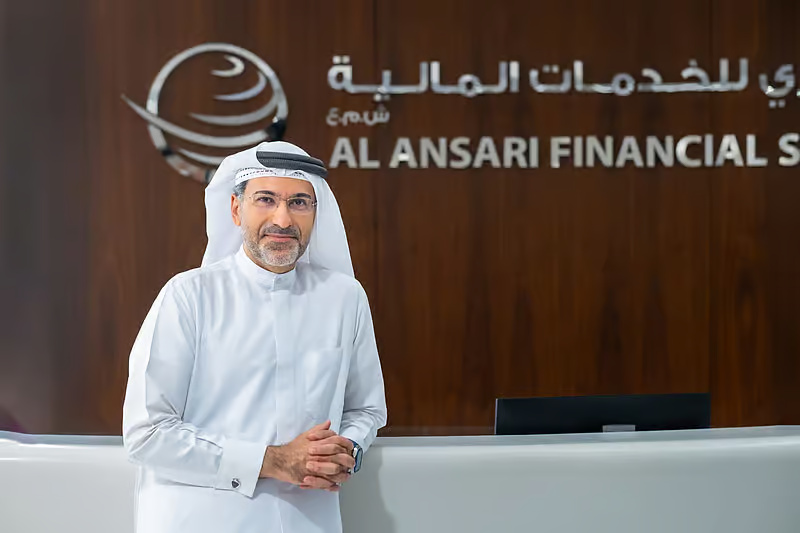
Technological advances have made remittances faster, but they have also brought stricter compliance requirements.
“The biggest challenge to speed today isn’t technology but compliance,” Rashed said.
Real-time checks on senders and recipients are required to identify suspicious names or accounts. When a transaction triggers a partial match, it may need to be reviewed manually, potentially slowing the process. To address this, the company is increasingly using AI to compare details such as dates of birth within seconds and clear false alerts that might otherwise require human intervention.
Crossing 300 Branches
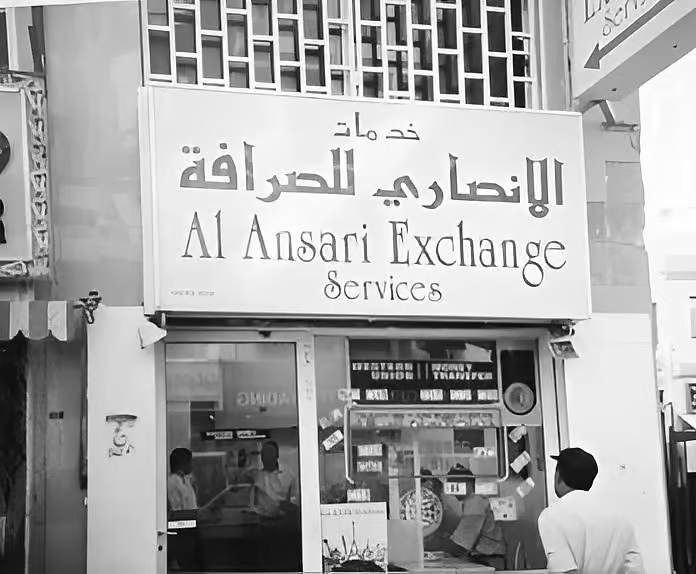
The Al Ansari story dates back to 1966. Its founder was originally involved in the food trading business, importing supplies into the region. As the UAE’s oil boom attracted large numbers of expatriate workers looking to send money home, he saw an opportunity to use his existing trade networks for money transfers.
He obtained a licence from the Emirate of Abu Dhabi five years before the UAE was formed and opened the company’s first branch in Abu Dhabi’s Central Market.
Recalling his school days, Rashed said he grew up around the business, quite literally.
“I used to go to Al Ahmadiyah Elementary School, and my father had a branch nearby. He used to tell me to come to the shop after school, and he’d take me home later.”
Those afternoons at the branch, watching his father serve customers and even answer phone calls himself, helped shape the values that continue to guide the company today: trust, reputation and keeping promises.
Six decades later, that small branch has grown into the UAE’s largest exchange and remittance company, with more than 280 branches and plans to cross the 300-branch mark soon.
“We’re not chasing a number. We’re adding one or two branches every few months because the customer wants it.”
The group has also expanded into Bahrain, where it is now the largest player, as well as Kuwait and India. It recently acquired Bahrain’s BFC Group for $200 million and is awaiting regulatory approval to enter Oman.
Digital Growth: From 1% to 30%
When Al Ansari Exchange launched its app in 2018, only around 1 per cent of remittance transactions were conducted digitally. The Covid-19 pandemic accelerated the shift dramatically.
“It was a dream for me when we had 1 per cent of our transactions digitally,” Al Ansari said. “Now we’re at 30 per cent, and I think we’ll reach 60 per cent in the next five years. Some months, the app alone processes more than 600,000 transactions.”
Despite the rapid growth of digital payments, many customers — particularly domestic workers and labourers — continue to prefer visiting branches. Factors such as familiarity, language barriers and limited access to smartphones can influence their preference for in-person services.

Six Decades Without a Fine
As the company marks its 60th anniversary this year, Al Ansari said he is particularly proud that the business has never been fined by the UAE Central Bank during its six decades of operations.
“We want to be a benchmark for others when it comes to compliance,” he said, adding that the company works closely with regulators to ensure new requirements do not place unnecessary burdens on ordinary customers.

