

Recruiters said that while industry experience is still highly valued, graduate training programmes continue to offer entry-level opportunities for fresh graduates.
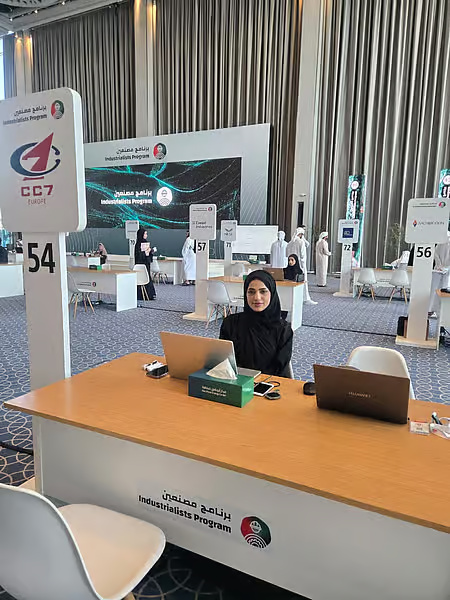
Industrial companies are continuing to recruit Emiratis beyond mandatory Emiratisation quotas, with employers at a major Abu Dhabi careers fair reporting strong demand for talent in artificial intelligence, engineering, and advanced technology roles.
The push comes as private-sector firms with 50 or more employees work to meet Emiratisation requirements, which mandate a growing share of skilled positions be filled by UAE nationals.
Several employers at the Industrialists Career Exhibition said they had already surpassed their Emiratisation targets and were continuing active recruitment efforts. Energy technology company SLB noted that it had exceeded the 10 per cent Emiratisation requirement even before it became mandatory.
“We were above the 10 per cent nationalisation target even before it became official,” said Dany Rahal, Managing Director of SLB UAE. “We continue to recruit because we believe strongly in the long-term sustainability and resilience of the business.”
The company plans to hire more than 90 Emiratis this year and aims to fill around 50 roles through the exhibition alone. Available positions span artificial intelligence, remote operations, digital technology, health and safety, and energy sector operations.
Rahal said AI and digital technologies are among the most attractive fields for young Emiratis entering the workforce. “Technology is very compelling for Emiratis, and within that, AI and digital are key areas for attracting talent,” he said.
Construction and engineering firm CC7 is also expanding its Emirati workforce, with about 20 vacancies in Abu Dhabi across civil engineering, electrical engineering, logistics, supply chain, and health and safety roles.
Recruiters noted that while industry experience remains highly valued, graduate training programmes continue to provide entry points for fresh graduates.
At the same time, employers observed a shift in mindset among Emirati job seekers.
Ibtisam Al Saadi, Acting Assistant Undersecretary for the Industrial Development Sector at the Ministry of Industry and Advanced Technology, said more young nationals are actively pursuing private-sector careers. “Today you see people actively seeking opportunities in the private sector because they recognise the learning opportunities available,” she said.
The industrial sector is also attracting young Emiratis who may not have previously considered careers in manufacturing and engineering. Hamda Al Mahri, a Technical Sales Engineer at Tenaris, said such careers offer far broader prospects than many assume. “It’s not what people imagine from textbooks; it’s a much wider world of opportunities,” she said.
Al Mahri, who studied industrial and systems engineering, said she initially considered computer science before discovering engineering’s broader scope. After graduation, she completed an internship at the Technology Innovation Institute, working on systems development projects with researchers and technical teams, before joining Tenaris.
She later became the first Emirati employee sent by the company to Argentina for specialist training, spending a month at its engineering facilities. “I learned a lot there,” she said, adding that exposure to global expertise broadened her perspective.
She said industrial careers provide access to international experience, advanced technologies, and specialised knowledge. “People think of factories when they hear industry, but it includes engineering, technology, and business functions too,” she said.
“As long as there is a system, I can be there and work there,” she added.
Accounting firms are reporting similar trends. Zayed Al Ali, founder of Zayed Chartered Accountants, said adaptability and AI literacy are now essential for new hires, as employers increasingly seek candidates who can keep pace with technological change.
He added that what students learn at university often differs from workplace reality, with growing demand for employees who can embrace automation and evolving tools.
The growing emphasis on AI skills was evident throughout the exhibition, with recruiters highlighting strong demand for talent in emerging technologies alongside traditional engineering fields.
Officials said industrial careers are rapidly evolving, spanning manufacturing, energy, genomics, food safety, digital operations, and advanced research.
For employers, the challenge is no longer just meeting Emiratisation quotas but ensuring a steady pipeline of qualified talent to support the UAE’s expanding industrial ambitions.
“We are willing to invest in Emirati talent,” Al Saadi said, noting that companies are focused on attracting and retaining skilled nationals.

