

Sheikha Fatima says women’s empowerment has long been central to the UAE’s development agenda.
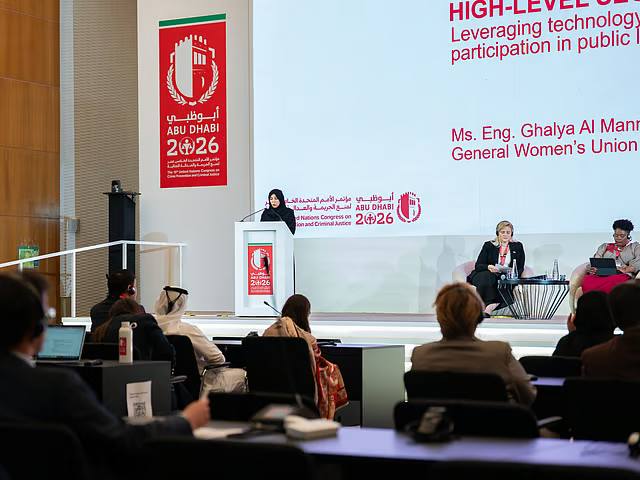
Abu Dhabi: Under the patronage of Sheikha Fatima bint Mubarak, “Mother of the Nation”, Chairwoman of the General Women’s Union, President of the Supreme Council for Motherhood and Childhood, and Supreme Chairwoman of the Family Development Foundation, the UAE has launched the global SAFE-T Initiative, aimed at harnessing technology to strengthen digital safety while promoting effective and sustainable participation.
The initiative is being implemented through a strategic partnership between the General Women’s Union (GWU), the Ministry of Justice, which provided support and initial funding, and the United Nations Office on Drugs and Crime (UNODC).
The initiative was unveiled on the sidelines of the 15th United Nations Congress on Crime Prevention and Criminal Justice – Abu Dhabi 2026, attended by ministers, UN officials and representatives from judicial and legislative bodies, as well as the public and private sectors.
Marking the launch, Sheikha Fatima said technology has become an integral part of education, employment, innovation and decision-making, creating wider opportunities for women to connect, innovate and gain access to knowledge and new opportunities.
She noted, however, that making full use of these opportunities requires a safe and trusted digital environment that safeguards rights, privacy and dignity while strengthening confidence in the use of modern technologies.
Sheikha Fatima said technology-facilitated violence against women and girls is a growing concern, with consequences extending beyond individual victims to affect their social and economic participation, as well as opportunities in leadership and innovation.
She said threats, harassment, blackmail and defamation carried out through digital platforms can limit women’s ability to express their views, take initiative and participate fully in public life.
Addressing these risks, she noted, requires a comprehensive approach that goes beyond providing access to technology. This includes strengthening legislation and policies, improving protection and access to justice, raising awareness and encouraging shared responsibility among governments, international organisations, technology companies and civil society.
Sheikha Fatima said women should not be viewed simply as beneficiaries of digital transformation, but as active partners in shaping and leading it. She highlighted their role in driving innovation, developing solutions and helping societies adapt to rapid technological change, adding that greater knowledge, confidence and responsibility can create more opportunities for meaningful and sustainable participation.
She also emphasised that supporting women has long been a key part of the UAE’s development approach, reflecting the country’s recognition of their role in nation-building and shaping the future.
She pointed to the Cyber Pulse Initiative for Women and Family, launched by the General Women’s Union in cooperation with the UAE Cyber Security Council, as an example of national efforts to equip women with cybersecurity knowledge and skills. The programme also seeks to strengthen their role in protecting families, promoting awareness and improving community preparedness for technology-related risks.
Following the initiative’s growing reach, it was expanded from a national programme into the international Cyber Pulse Academy for Women and Family, allowing knowledge and expertise to be shared more widely and helping women strengthen digital security in their communities.
Sheikha Fatima welcomed the SAFE-T Initiative, launched by UNODC with support from the Ministry of Justice, saying it offers a practical framework to enhance the ability of countries and institutions to address technology-facilitated violence and translate international commitments into actionable tools and solutions.
Sheikha Fatima also welcomed the launch of the UN Women Strategy on Preventing and Eliminating Technology-Facilitated Violence Against Women and Girls. She expressed hope that the strategy would bring efforts together, enhance multilateral cooperation and strengthen systems for prevention, protection and accountability, allowing women and girls to benefit from the opportunities offered by the digital age with confidence and dignity.
She said the shared responsibility is to ensure technology remains a tool that benefits people, expands opportunities and promotes justice. She also called for continued cooperation to build a future in which women play an active role in shaping and leading digital transformation, using their knowledge, expertise and ambition to contribute to safer, more prosperous and sustainable societies.
Noura Khalifa Al Suwaidi, Secretary-General of the General Women’s Union (GWU), said the organisation’s longstanding efforts to support and empower women across different sectors are reflected in its continued participation in international initiatives and partnerships. She said the GWU remains committed to using technology to advance women’s empowerment while protecting their rights in the digital sphere.
Al Suwaidi said safeguarding the security and sustainability of families and communities requires coordinated action and close cooperation among local and international stakeholders.
Through partnerships with organisations and other relevant entities, she said the GWU aims to help create a secure and equitable digital environment where women and girls can participate confidently and effectively in sustainable development and human progress.
First phase of SAFE-T
The first phase of SAFE-T will focus on establishing the initiative’s core infrastructure through the UN Women Strategy on Preventing and Eliminating Technology-Facilitated Violence Against Women and Girls, the Global Coalition for Digital Safety and a digital safety toolkit.
The framework also incorporates a strategic model called UPSTANDER, which is structured around nine interconnected strategies.
These include widening educational, technological, professional and leadership opportunities for women to help narrow the digital divide, strengthening effective partnerships, and providing support and assistance to victims and survivors of technology-facilitated violence.
The model also emphasises greater transparency, oversight and accountability within the technology sector, alongside stronger community solidarity and advocacy and a zero-tolerance approach towards digital abuse.
Other priorities include strengthening law enforcement and accountability, expanding education, training and digital literacy, and developing comprehensive and standardised systems for reporting and collecting data. These measures are intended to provide stronger evidence for policymaking and support more effective prevention strategies.
The launch concluded with a renewed commitment from the international community to strengthen multilateral cooperation and support the implementation of SAFE-T and its strategic objectives.
The initiative aims to foster safer and more inclusive digital environments in which women and girls can participate fully and confidently while contributing to a more sustainable and equitable future.

