

Dubai gold prices steady below June peak as markets balance dips and Fed risks.
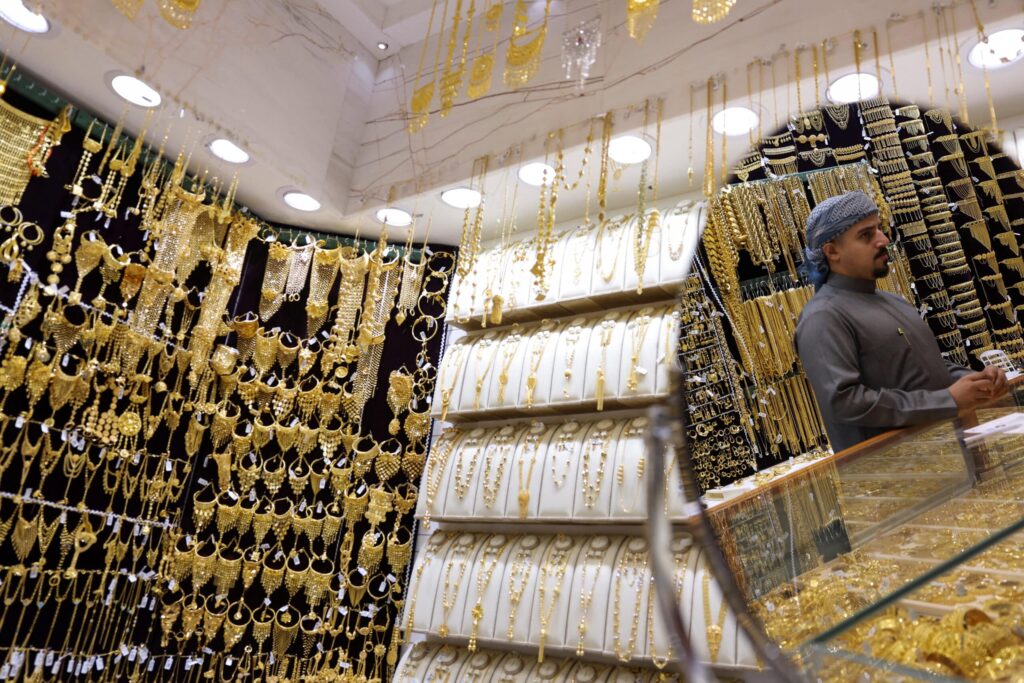
Dubai: Gold prices in Dubai rose slightly on Tuesday morning but stayed significantly lower than earlier this month, offering shoppers a brief opportunity to reconsider purchases ahead of the next shift in global bullion trends.
At 9:13am on Tuesday, 24-karat gold was priced at Dh522.25 per gram, up from Dh521.50 on Monday, while the more commonly traded 22-karat gold was priced at Dh483.50, compared with Dh482.75 the previous day.The modest rise still keeps local prices well below the month’s peak. On June 2, 24-karat gold was priced at Dh542.50 per gram, while 22-karat stood at Dh502.25. Prices remained elevated on June 3 and June 4, with 24-karat gold at Dh536 and Dh538.50, before easing to Dh522.50 on June 5.
Since then, UAE gold rates have traded in a narrow range, with 24-karat gold hovering around Dh521.50–Dh522.25 and 22-karat gold staying close to Dh483.
This means shoppers considering 22-karat jewellery are currently paying nearly Dh19 per gram less than the June 2 peak, even after Tuesday’s slight increase.
A buying window, but not a clear bottom
The recent pullback has provided some relief for UAE residents planning wedding jewellery purchases, festive buying or gold investment, but analysts caution that the market has not yet fully stabilised.
Gold prices have eased globally after a strong rally earlier this year, as stronger US economic data has reduced expectations of an early interest rate cut by the Federal Reserve. Higher interest rates typically weigh on gold, since the metal does not generate yield, making interest-bearing assets like cash and bonds more attractive during periods of tighter monetary policy.
Linh Tran said in a note that gold prices continue to face corrective pressure, with the metal pulling back toward the $4,300 per ounce level, reflecting a decline of nearly 9% over the past month.
“This movement suggests that gold’s bullish momentum has weakened significantly after the strong rally seen earlier,” Linh Tran said. “However, from a longer-term perspective, current prices remain well above levels seen in the same period last year, indicating that the broader uptrend has not been broken.”
Dollar and yields keep pressure on gold
Tran added that the main pressure on gold is coming from a stronger US dollar and rising Treasury yields. The dollar index has been trading around 99.7–99.8, while US Treasury yields are holding near 4.5%–4.6%, supported by better-than-expected labour market data.
Recent figures show nonfarm payrolls rose by 172,000 jobs, while the S&P Global flash manufacturing PMI climbed to 55.3 in May. Inflation also remains persistent, with April CPI up 0.6% month-on-month and one-year inflation expectations at 3.5%.
These indicators have reduced expectations of an imminent interest rate cut. The US Federal Reserve is maintaining rates in the 3.50%–3.75% range, with the resilient economic backdrop giving policymakers room to keep interest rates higher for longer.
Linh Tran said this environment increases the opportunity cost of holding gold and continues to weigh on the precious metal in the short term.
ETF outflows show caution
Investor sentiment has also become more selective. Global gold ETFs recorded around $2 billion in net outflows in May, reflecting caution after the metal’s earlier strong rally.
However, the broader picture remains mixed rather than outright negative. Year-to-date gold ETF inflows are still positive at about $17 billion, indicating that while momentum has cooled, longer-term demand has not fully disappeared.
“Buying interest has not disappeared, but it has weakened and become more selective,” Tran said.
Central bank demand continues to provide underlying support for gold, with ongoing reserve diversification and higher allocations helping to sustain the metal’s long-term outlook. However, in the near term, this support is being outweighed by pressure from a stronger US dollar, elevated Treasury yields and expectations of tighter Federal Reserve policy.
Middle East risk eases, but inflation concerns persist
Gold prices remained stable after Israel and Iran agreed to halt attacks that had raised fears of wider regional instability and disrupted market sentiment. The ceasefire followed an appeal by Donald Trump for de-escalation, after the conflict had heightened concerns over energy flows through the Strait of Hormuz and driven oil prices higher.
Rising oil prices can contribute to inflationary pressures, making central banks more cautious about cutting interest rates. This creates a mixed environment for gold: while geopolitical uncertainty typically supports demand for safe-haven assets, higher yields and a stronger dollar can limit upside by making non-yielding assets like gold less attractive.
Linh Tran said gold could decline further if short-term pressures intensify, noting that the $4,000 per ounce level may act as a key area where markets reassess the metal’s appeal after its earlier rally.
“However, this does not mean that gold’s long-term trend has reversed,” Tran said. “Compared with the same period last year, gold remains at an elevated level, while central bank demand and the ongoing trend of reserve diversification continue to provide fundamental support.”

