

An 18% annual increase in international seat capacity strengthens Dubai’s dominance in global aviation.
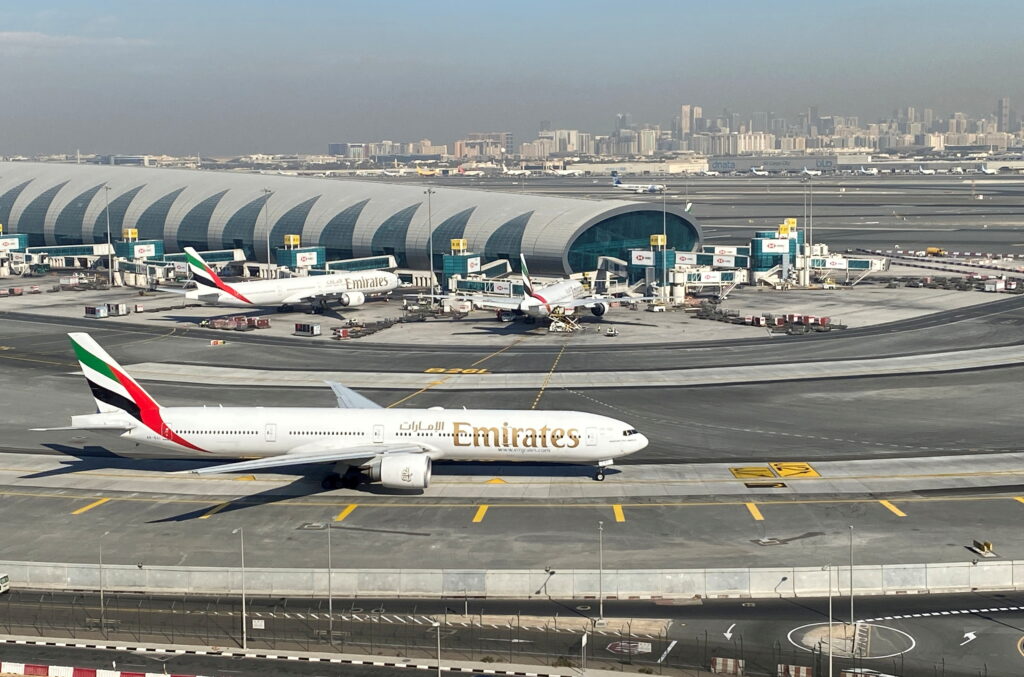
Dubai International Airport has secured the top position globally for scheduled international seat capacity in July 2026, further strengthening its role as a key hub for long-haul travel as demand rebounds across major international routes.
According to data released by UK-based aviation analytics firm OAG, the airport is set to provide 4.35 million international seats during the month, ranking ahead of major global hubs including Heathrow Airport, Amsterdam Airport Schiphol, Incheon International Airport and Charles de Gaulle Airport.
Heathrow Airport ranked second globally with 4.23 million international seats, marking a 1% decline compared with the previous year. Amsterdam Airport Schiphol followed with 3.82 million seats, representing a 1% increase. Incheon International Airport recorded 3.75 million seats, while Paris Charles de Gaulle Airport reached 3.70 million, with both airports maintaining levels broadly similar to last year, according to 24.ae.
Dubai’s international seat capacity increased by 18% year on year, highlighting the airport’s continued growth in global connectivity and long-haul travel demand.
The airport had already secured the top spot in global rankings earlier in 2026, overtaking Hartsfield–Jackson Atlanta International Airport in January with 5.5 million scheduled seats and retaining its lead in February with 4.9 million seats, according to OAG’s monthly data.
On an annual basis, Dubai International Airport maintained its position in 2025 as the world’s busiest airport for international passenger seat capacity, offering 62.4 million seats — a 4% increase compared with 2024.
The airport also recorded its highest-ever annual passenger numbers, handling 95.2 million travellers during the year, according to Dubai Airports.
This growth trajectory has continued into 2026, with the airport welcoming 18.6 million passengers in the first quarter as regional airspace conditions improved and airlines increased capacity to meet rising demand.
Dubai Airports has continued expanding its network capacity, backed by enhanced passenger processing systems and greater operational efficiency to support sustained growth.
Digital innovation has been a key factor in supporting Dubai International Airport’s rapid growth. In partnership with the General Directorate of Residency and Foreigners Affairs, Dubai Airports has launched a pre-travel eligibility verification tool for smart gates, enabling passengers to confirm their access status before arriving at passport control.
The technology forms part of Dubai’s wider smart travel ecosystem, which uses biometric-enabled gates to allow registered travellers to complete immigration procedures through iris and facial recognition within seconds.
Additional advancements include the “Red Carpet” seamless travel corridor, introduced in August 2025, which enables multiple passengers to complete passport procedures simultaneously without the need to present physical documents.
Powered by real-time biometric verification, the system can process travellers in as little as six to 14 seconds, improving efficiency while enhancing the overall passenger experience.
Additional initiatives, including off-site baggage check-in, dedicated priority lanes for families and people of determination, real-time baggage monitoring, and digital navigation tools, have helped streamline passenger movement and improve the overall airport experience. These measures support Dubai’s ambition to remain at the forefront of global aviation and maintain its position as a leading international travel hub.

