

AI is set to disrupt social and economic structures in the short term, but will become a major enabler for countries such as the UAE in the long run, said Omar Al Olama, UAE Minister of State for Artificial Intelligence.
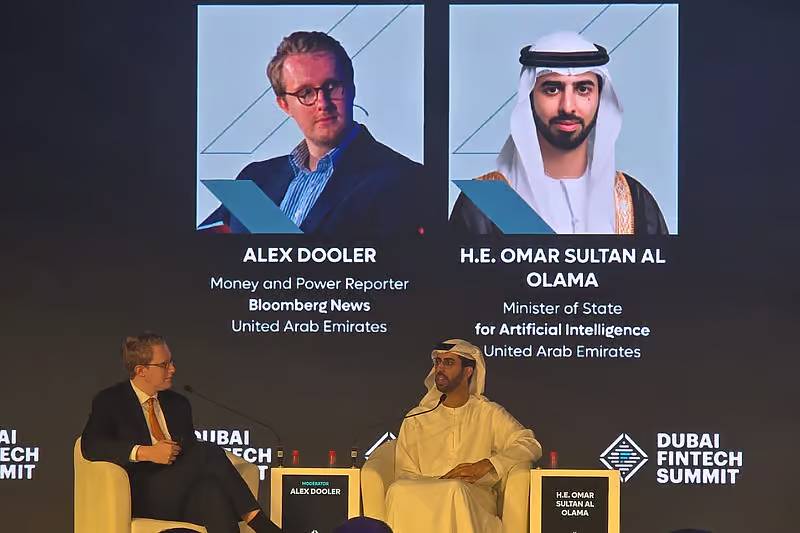
In the medium term, companies in the artificial intelligence sector are likely to consolidate into a handful of larger players, each specialising in a particular area of the technology, the UAE’s AI minister said.
“We’re going to see a multi-billion-dollar company that’s just focused on AI and life sciences,” said Omar Al Olama, Minister of State for AI, Digital Economy and Remote Work Applications.
“In finance, for example, we’re going to see certain players that are just going to focus on certain echelons of finance, whether it’s insurance or whether it’s investment or other things.”
AI is likely to disrupt social and economic structures in the short term, but could become a powerful enabler for countries such as the UAE in the longer run, he added. Given the size of the UAE economy and its demographic mix, Al Olama said the technology would serve as an important enabler for the country.
“The long-term trajectory looks like it’s only going to be upwards from here, and that this technology is going to become the internet of the coming age, or even something beyond that that’s going to completely revolutionise our lives,” he said, adding that he was not concerned about its long-term impact.
Credit rating agency Fitch recently said that the rapid expansion of AI-related investment would continue to pose risks to central credit.
Al Olama said volatility in the AI sector was likely to persist because the technology was still relatively new. He compared its development to earlier technological advances that experienced periods of rapid growth followed by market corrections.
The internet, for instance, went through a major downturn in the late 1990s and early 2000s, during the collapse of the dot-com bubble. The Nasdaq index fell 77 per cent from its peak during that period.
Critical infrastructure
As the regional situation stabilises, the UAE plans to introduce standards that would classify data centres as critical infrastructure, alongside measures to protect them during periods of conflict, Al Olama said.
“The conflict is definitely something that has affected certain plans, not in a negative way, but just made us plan differently,” he told the audience at the summit.
“No short-term turbulences are going to affect our long-term thinking,” he added. “Every time there’s a problem, we don’t let that affect our thinking about the future. We actually double down on the direction that we’re going in. And that allows us to leapfrog.”
The minister said many countries face intense scrutiny over decisions to invest in data centres, with such projects sometimes becoming politically contentious and potentially affecting politicians’ electoral prospects.
“It’s a taboo subject,” Al Olama said of the issue in other countries. “Here, we’re doubling down on building infrastructure.”

