

Sunspots 4478 and 4479 may continue to be visible in the coming days under safe viewing conditions.
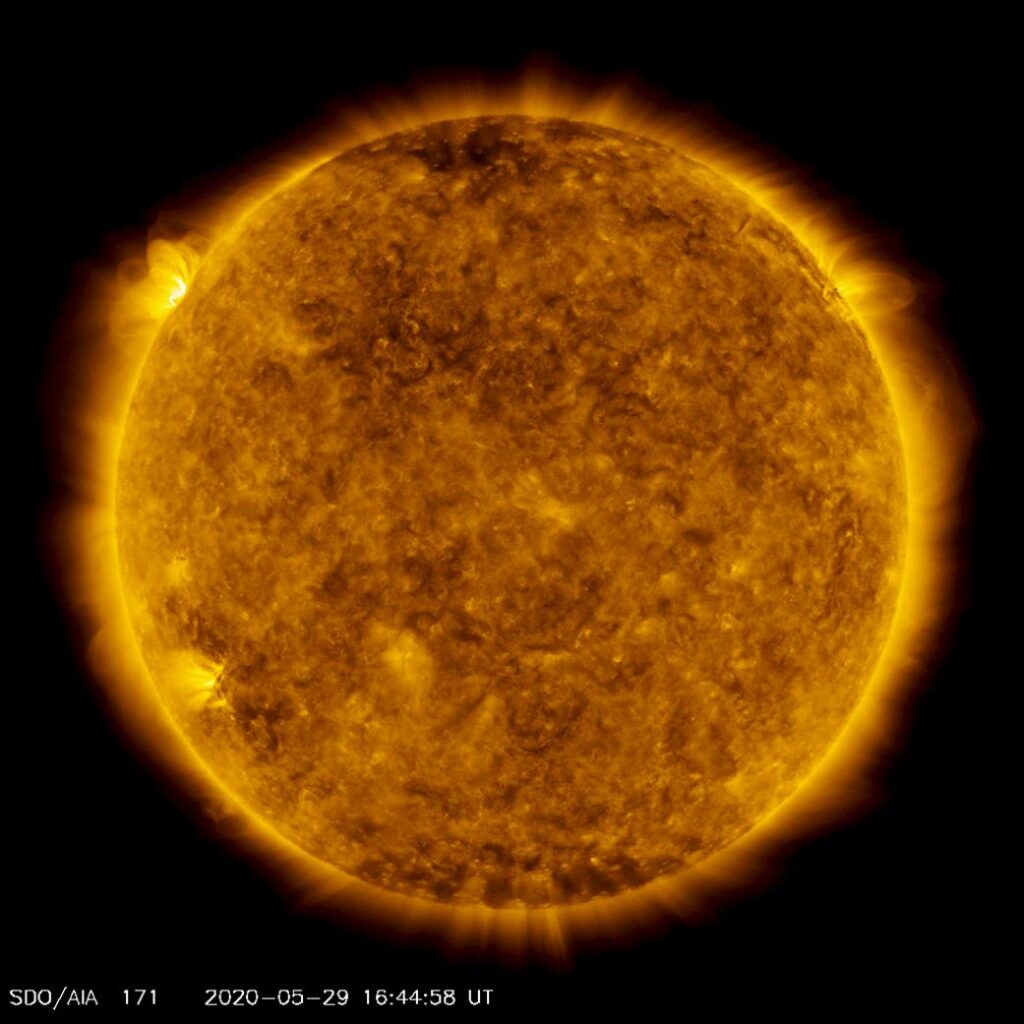
Dubai: Two massive sunspots, each estimated to be around 10 times wider than Earth, were observed from the UAE on Friday morning during a period of increased solar activity.
Ibrahim Al Jarwan, Chairman of the Emirates Astronomy Society and a member of the Arab Union for Astronomy and Space Sciences, said the sunspots—identified as 4478 and 4479—were captured from UAE skies by astrophotographer Tamim Al Tamimi, a member of the society.
Al Jarwan said the two regions had generated powerful solar flares, causing ionisation in the upper atmosphere.
He added that residents in the UAE and around the world may be able to view the sunspots in the coming days under suitable conditions, particularly at sunrise or sunset.
However, he cautioned against viewing the Sun directly, warning that unsafe observation can cause permanent retinal damage, especially for those without experience or proper protective equipment.
Astronomers said anyone attempting to observe the phenomenon should use approved solar filters or indirect projection methods, such as projecting the Sun’s image onto a white sheet of paper, rather than viewing it directly.
Sunspots are dark patches on the Sun’s visible surface, known as the photosphere. When viewed through a proper solar filter, they appear darker than the surrounding area, featuring a very dark core called the umbra and a lighter surrounding region known as the penumbra.
Al Jarwan explained that the number of sunspots rises and falls in a roughly 11-year cycle, and the Sun is currently in a phase of heightened activity. This is why unusually large sunspots such as 4478 and 4479 are being observed.
He added that sunspots are formed by the Sun’s strong magnetic field. Inside the Sun, plasma moves violently, twisting and tangling magnetic field lines. When these magnetic fields push toward the surface, they can restrict heat flow from the solar interior, cooling the affected area by about 1,500°C compared with surrounding regions.
That temperature difference is what makes sunspots appear dark when viewed from Earth, even though they are still extremely hot. Sunspots usually form in pairs, corresponding to positive and negative magnetic poles.
Their movement and lifespan depend on their size and the Sun’s rotation. Since the Sun does not rotate as a solid body, regions near the equator rotate faster than those closer to the poles. As a result, sunspots appear to slowly drift across the solar disc from east to west.
A typical sunspot takes about two weeks to cross the visible surface of the Sun before disappearing over the edge to the far side. Smaller sunspots may last only a few days, while larger and more complex ones can persist for multiple solar rotations, sometimes lasting two to three months.

