

The 50km driverless system will connect nine stations as Al Maktoum International Airport targets 260 million passengers annually.
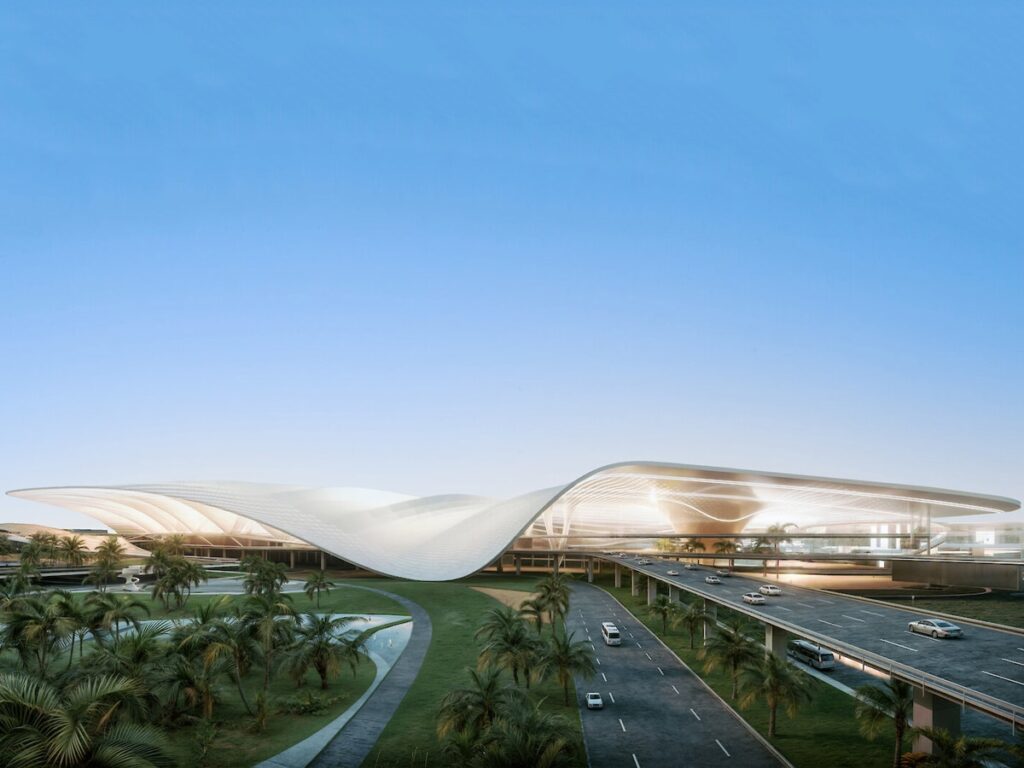
Dubai: A 50-kilometre automated people mover (APM) will be built at Dubai’s Al Maktoum International Airport, creating what Mitsubishi Heavy Industries (MHI) describes as the world’s largest airport APM system by length. The driverless network will connect nine stations across the airport and support its planned expansion to accommodate up to 260 million passengers annually.
The system will connect nine stations across the future airport and comprise 165 automated people-mover vehicles, Mitsubishi Heavy Industries (MHI) said.
MHI, which previously worked on the Dubai Metro project completed in 2011, said the APM system is scheduled for completion in December 2031, ahead of the planned opening of the expanded airport in 2032.
The system is part of Dubai’s major expansion of Al Maktoum International Airport, which is being developed to eventually handle up to 260 million passengers annually.
Mega mover
Dubai Aviation City Corporation (DACC), a Dubai government entity, has awarded the contract to MHI as part of a three-company consortium with MHI Mobility Engineering Services (MHI-MESC) and Indian engineering and construction group Larsen & Toubro (L&T).
MHI and MHI-MESC will lead the design, procurement and testing of the APM vehicles and signalling system, along with overall system integration. L&T will be responsible for the design, procurement, testing and on-site construction of other subsystems, MHI said.
The approximately 50km network will be more than six times longer than the current longest airport APM system, the 8km Skylink at Dallas Fort Worth International Airport in the US, according to MHI.
Another major airport people mover is the Plane Train at Hartsfield–Jackson Atlanta International Airport, one of the world’s busiest airport transport systems.
Nine stations
The APM will connect DWC’s terminals and key facilities, providing an internal transport network for passengers travelling across the vast airport campus.
MHI said the system is designed to improve passenger convenience, reduce travel times and support more efficient airport operations as passenger numbers increase.
The internal transport network will become increasingly important as DWC expands towards its planned capacity of 260 million passengers annually.
Latest technology
The people mover is being developed as part of a broader effort to establish DWC as one of the world’s largest aviation hubs.
The airport expansion is a Dubai government project targeting an opening in 2032, with capacity eventually set to reach 260 million passengers a year and further expansion planned over time.
Dubai Airports CEO Paul Griffiths previously told Gulf News that the second phase of Al Maktoum International would be built around advanced technology, with a strong focus on convenience and passenger experience.
“We have to have the latest technology, the best design, because we are determined to create an airport experience like none other that will be far and away the most advanced and the most friendly and convenient for our customers.”
Griffiths said the airport would continue to evaluate emerging technologies as development progresses, allowing newer systems and innovations to be incorporated into the final design.
“We will be putting in all sorts of new technology and probably making some of those decisions quite late in the day to allow the latest techniques and developments to be adopted for the longer term.”
The new APM contract provides a clearer picture of one of the key transport systems that will form part of the future airport.
Rail links
The people mover will operate entirely within DWC and is separate from planned rail connections that will link the airport with the wider Dubai transport network.
Meanwhile, Dubai’s Roads and Transport Authority is separately advancing plans for an Airport Express Line connecting Dubai International Airport (DXB) in Garhoud with Al Maktoum International.
MEED reported last week that six groups had submitted proposals to study and design the 55km Airport Express Line.
The proposed route would link DXB with DWC via Al Jaddaf and Al Khail Road, with a new station planned at Jumeirah Village Circle (JVC). Two spur lines are also proposed, including one towards Al-Fardan Exchange Metro Station near Emirates Golf Club and another towards Business Bay.
Three key connections
Griffiths previously identified three major surface transport projects that he said would play an important role in DWC’s future connectivity.
These include the Etihad Rail high-speed railway, the planned Airport Express Line and Dubai Metro’s Gold Line.
He also welcomed the planned Airport Express, saying it would connect major population centres across Dubai with DWC through an efficient rail journey.
The Gold Line would provide another link between key residential and commercial areas and DWC, with Griffiths highlighting its importance for daily commuters.
Together, the internal APM and planned external rail connections point to a significant transformation in how passengers will reach and move through DWC once the new airport becomes operational.
Griffiths previously described the airport’s role as creating an efficient link between journeys on the ground and in the air.
“An airport’s major role in life is to provide a very effective and efficient interface between journeys on the ground and journeys in the air.”
He added that the planned surface transport projects would help make DWC’s connections with the rest of Dubai among the most efficient in the world.

