

Freedom of navigation and AI-ready infrastructure lie at the core of the United Arab Emirates’s energy strategy.
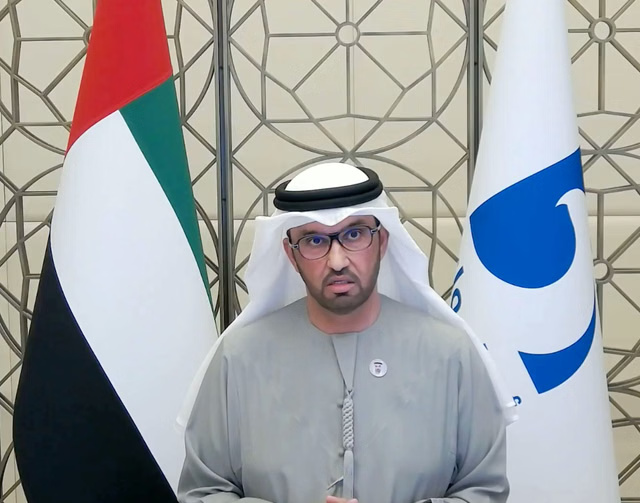
ABU DHABI: Renewed infrastructure investment, a strong focus on artificial intelligence, and an unwavering commitment to freedom of navigation through the Strait of Hormuz are essential to strengthening global energy resilience, a senior UAE official said.
Sultan Al Jaber said that allowing any single country to control a critical global waterway would undermine the principle of freedom of navigation.
Speaking at the Atlantic Council, he called for greater investment across the energy value chain to reinforce the stability of the global energy system.
He also outlined plans for expanded infrastructure, including a second pipeline aimed at doubling export capacity through Fujairah Port, which would bypass the Strait of Hormuz as part of efforts to enhance supply security.
He said that global energy flows remain overly dependent on a small number of chokepoints, which creates systemic vulnerability. He noted that the United Arab Emirates had decided more than a decade ago to invest in infrastructure that bypasses the Strait of Hormuz, and that it advanced construction of a second pipeline in 2025. He added that the project is now about 50 percent complete and is being fast-tracked toward expected completion in 2027.
Sultan Al Jaber said the Abu Dhabi National Oil Company (ADNOC) remains committed to its US$150 billion (AED 551 billion) five-year capital expenditure programme aimed at strengthening operations, supporting growth, and meeting rising global energy demand.
He warned that the global energy sector is significantly underinvested, noting that upstream investment is around $400 billion annually—barely enough to offset natural production decline. He added that global spare capacity stands at roughly 3 million barrels per day, which he said should be closer to 5 million.
He further pointed out that global stockpiles had been drawn down by about 250 million barrels within two months, leaving only around 30 to 35 days of effective cover. He said this buffer should at least be doubled to improve energy security and market stability.
Sultan Al Jaber said the Strait of Hormuz should be understood as more than an oil corridor, describing it as central to the global movement of goods across the modern economy.
He explained that current geopolitical tensions have exposed vulnerabilities not only in oil and gas supply chains, but also in critical sectors such as chemicals, minerals, and fertilisers that underpin global economic activity.
He stressed that flows through Hormuz include LNG, jet fuel, fertiliser, aluminium, helium, critical minerals, plastics, consumer goods, and general cargo—effectively linking the full spectrum of global supply chains.
He added that disruptions are already having broad economic consequences, citing rising fuel, fertiliser, and air travel costs, and warning that the burden disproportionately affects the most vulnerable populations.
Sultan Al Jaber said that just over 80 days into the conflict, nearly 80 countries have already introduced emergency measures to stabilise their economies, underscoring the global scale of disruption.
He noted that while the Abu Dhabi National Oil Company (ADNOC) can increase oil production within weeks, restoring normal oil flows through the Strait of Hormuz would take significantly longer—about four months to reach 80% of pre-conflict levels, with full recovery not expected until the first or second quarter of 2027.
He renewed calls for an immediate end to disruptions affecting trade through the Strait of Hormuz and urged global leaders to reinforce freedom of navigation through the strategic waterway.
He warned that allowing any single country to effectively control such a critical maritime corridor would set a dangerous precedent, arguing that failure to defend this principle now could lead to long-term global instability.
Sultan Al Jaber said the United Arab Emirates has accelerated its strategy to deliver low-cost, low-carbon energy globally, supported by what he described as a “sovereign, strategic decision” to exit the Organisation of the Petroleum Exporting Countries in late April. He said the move was taken “with clarity, conviction and confidence” to enable greater flexibility in investment, expansion, and long-term value creation.
He noted that with oil demand expected to remain above 100 million barrels per day into the 2040s, the world will continue to require more of the UAE’s low-cost, low-carbon crude. He added that the UAE also needs greater energy capacity to match its own ambitions, highlighting the growing strategic importance of natural gas for power generation, artificial intelligence infrastructure, manufacturing, and broader economic growth.
He stressed that the decision to leave OPEC was not a reaction or rupture and was not directed against any institution, adding that the UAE would continue engaging with international partners.
He also pointed to ADNOC’s expanding global investment strategy beyond traditional energy, including artificial intelligence infrastructure, data centres, semiconductors, advanced manufacturing, and critical minerals. He further underlined the importance of the UAE–US relationship, noting that the United States remains the UAE’s largest export market in the Middle East for 17 consecutive years.
Sultan Al Jaber said the United Arab Emirates and the United States share a deep strategic partnership spanning technology, investment, industry, energy, and defence, describing it as a relationship built on trust rather than transactions.
He noted that the UAE has invested more than US$1 trillion in the United States, with further investments expected over the next decade. He added that energy-related investments through Abu Dhabi National Oil Company (ADNOC), Masdar, and XRG now exceed US$85 billion across 19 US states.
He said the UAE–US relationship goes beyond trade, describing both countries as co-investors in the economy of the next century, grounded in long-term trust.
He explained that ADNOC’s domestic and international investment programmes are supported by strong and resilient revenues, built on decades of diversified infrastructure development and prudent planning. He said the company maintained supply continuity during recent disruptions by coordinating closely with customers, redirecting shipments through alternative routes, and leveraging its global trading network to secure additional supplies, particularly for Asian markets.
He added that the UAE is working with partners to expand and replenish strategic storage capacity to improve resilience against future shocks, while continuously adapting its commercial strategy to ensure competitiveness and reliability.
He said strong financial performance across listed companies demonstrates the strength of the UAE’s strategy, business environment, and national resilience. He added that during recent challenges, essential services continued uninterrupted—people felt safe, energy flowed, airports remained open, and businesses operated normally—reinforcing investor confidence and attracting renewed global interest in the UAE due to its stability and infrastructure strength.
Sultan Al Jaber said recent events highlighted three key lessons for resilience. First, he stressed that resilience is essential and may appear costly until it is urgently needed, at which point it becomes invaluable. Second, he said artificial intelligence must be embedded into systems from the outset rather than added later, noting that speed of insight and decision-making is critical during crises. Third, he emphasised that energy security extends beyond production to include transport routes, access, storage, and redundancy.
He added that resilience is not a matter of chance but the result of long-term investments made before crises occur, including air defence systems, economic diversification, trusted partnerships, and the UAE’s foundational social contract built on inclusion and coexistence.
He said the United Arab Emirates had faced more than 3,000 missile and drone attacks targeting its development model, which he described as based on openness, tolerance, and economic integration. He said the country had been tested, and the outcome demonstrated the strength and durability of its system, reinforcing its identity as a resilient development model.
He concluded that the UAE’s experience showed it to be more than just infrastructure or natural resources, but a tested national model that held firm under pressure.
Responding to questions on artificial intelligence, he also warned that global expectations still underestimate how energy-intensive the AI revolution will be, adding that the investment gap in supporting infrastructure is widening.
Sultan Al Jaber said global data centre electricity demand is expected to double by the end of this decade, reaching about 1,000 terawatt-hours. He noted that growth is particularly rapid in the United States, where data centres could rise from around 5% of electricity demand today to nearly 15% by 2030.
He said this shift means the issue is no longer purely technological, but also one of energy, infrastructure, capital, and global competitiveness. He described the AI race as fundamentally an “electron race,” arguing that countries able to deliver reliable, scalable, and affordable power will hold a strategic advantage. He therefore stressed the continued importance of dependable baseload energy.
He also invited global energy leaders to gather in Abu Dhabi in November for the ENACT Majlis and ADIPEC 2026 to further align the global energy sector around resilience principles.
The remarks were made in an interview on the Atlantic Council’s AC Front Page Podcast, hosted by Helima Croft.

