

Suhail’s appearance before dawn signals the gradual easing of peak summer heat in the UAE.
Dubai: For centuries, Arab navigators, fishermen and farmers have looked to the summer sky for Suhail, or Canopus, a prominent star regarded as an important seasonal marker. Its appearance traditionally signals the gradual retreat of the Arabian Peninsula’s intense summer heat and the approach of cooler nights.
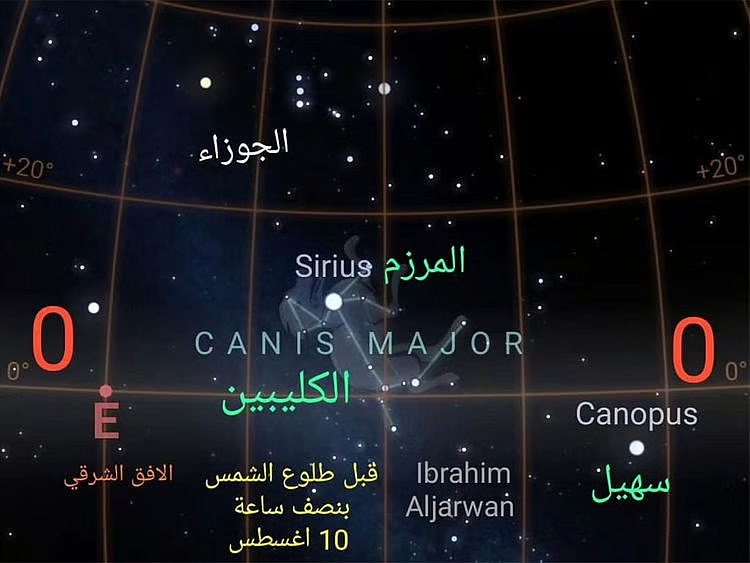
Ibrahim Al Jarwan, chairman of the Emirates Astronomy Society, has previously said that the next major seasonal milestone falls on August 24, when Suhail is traditionally expected to become visible before dawn above the south-eastern horizon.
Although Suhail’s appearance does not mark the immediate end of summer, its rising has long been associated with a gradual easing of temperatures, increasing humidity and the transition towards more moderate weather conditions.
When will the Suhail star appear in the UAE?
Suhail typically becomes visible across the Arabian Peninsula from early August through September, appearing low on the south-eastern horizon shortly before sunrise.
This year, the star is expected to become visible before dawn on August 24, marking the start of the traditional Suhail season, which lasts around 53 days.
The best opportunity to spot Suhail is from a dark, elevated location away from artificial lights. The star typically appears 30 to 50 minutes before sunrise, when it can be seen low on the horizon.
What does Suhail mean for UAE weather?
The appearance of Suhail has traditionally been seen as a sign that the UAE’s most intense summer heat is beginning to ease.
For generations, observers have noted that the star’s appearance coincides with a gradual drop in temperatures of a few degrees. The period is also traditionally associated with:
- Increasing humidity
- Cooler nights
- A greater chance of early morning fog
- Strengthening south-easterly winds
- A gradual shift towards more moderate temperatures, especially inland
These south-easterly winds typically blow towards Oman’s Hajar Mountains and the UAE’s east coast.
However, the appearance of Suhail does not signal an immediate end to summer. Instead, it marks the beginning of a gradual seasonal transition, with hot conditions expected to persist before temperatures eventually become more moderate.
Does Suhail signal cooler weather ahead?
Yes, traditionally, although the change happens gradually.
Suhail is regarded as a seasonal marker for the gradual easing of peak summer heat, rather than an immediate end to high temperatures.
Temperatures can remain high even after Suhail becomes visible, but traditional observations link its appearance with cooler nights, rising humidity and shifting wind patterns as the season progresses.
For centuries, the star has served as one of the Arabian Peninsula’s most familiar seasonal markers, signalling that the long, intense summer is gradually giving way to more moderate weather conditions.
How long does the Suhail season last?
The traditional Suhail season lasts approximately 53 days.
Al Jarwan has previously noted that about 45 days after Suhail appears, day and night become nearly equal in length, marking the gradual shift towards autumn-like conditions.
According to Al Jarwan, winter traditionally begins around 100 days after Suhail’s appearance.
The star therefore served as a natural seasonal calendar for communities across the Arabian Peninsula, helping people anticipate shifts in weather and seasonal conditions long before modern forecasting systems were available.
What is the Suhail star?
Suhail is the Arabic name commonly used for Canopus, one of the brightest stars visible in the night sky.
Canopus is located approximately 310 light-years from Earth in the constellation Carina. It is a yellow-white supergiant with a luminosity more than 10,000 times that of the Sun and an estimated mass about eight times that of the Sun.
The name Suhail is derived from the Arabic word “sahl”, meaning “level”, “even” or “smooth plain”. The name is linked to the star’s relatively low position above the horizon, as well as its longstanding cultural importance as a marker of seasonal change.
Why is Suhail important in Arabian culture?
Suhail has long held a prominent place in the astronomical and cultural heritage of the Arabian Peninsula. For generations, communities observed the appearance and movement of stars to track seasonal changes, anticipate rainfall patterns and recognise shifts between hotter and cooler periods.
The star was particularly significant for communities whose livelihoods depended on agriculture, livestock and seasonal weather cycles.
Its appearance was traditionally used to guide agricultural activities such as camel grazing, date harvesting and palm-tree pollination, with some of these seasonal practices beginning around 70 to 80 days after Suhail first appeared.

