

New York demonstration highlights safety and integration as key factors in future air taxi rollout.
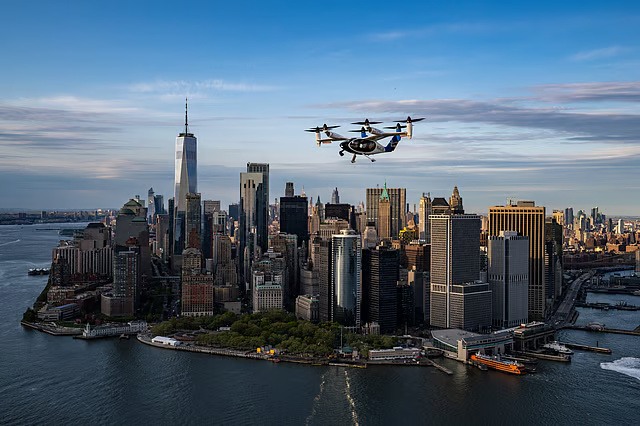
Joby Aviation’s first point-to-point electric air taxi flights in New York City show that short-hop urban air travel is moving from concept to testable reality.
The company said the flights connected John F. Kennedy International Airport with Manhattan heliports in under 10 minutes, using routes that could eventually become part of a commercial service.
The key takeaway is not just speed, but integration.
Over the next week, Joby’s electric air taxi will demonstrate a quieter, cleaner and faster way to travel across New York, in partnership with regulators including the New York government and the Federal Aviation Administration.
The first-ever point-to-point eVTOL flights in New York City’s history, linking John F. Kennedy International Airport to Manhattan’s heliport network within minutes, highlight how Joby Aviation plans to integrate with the region’s existing transport infrastructure.
“Our vision for New York is simple: make getting to the airport — one of the city’s most daunting experiences — one of its best, through partnerships with Delta Air Lines and Uber,” Joby said in a post on X.
These flights took place in Federal Aviation Administration-controlled airspace and were part of the White House-backed eVTOL Integration Pilot Program, designed to help regulators, airports and operators determine how electric vertical take-off and landing aircraft can be safely integrated into existing transportation systems.
The event is significant because it marks a live demonstration of how a future air taxi network could operate in one of the world’s busiest cities.
The New York campaign is also important because it used existing heliports, including Downtown Skyport, West 30th Street Heliport, and East 34th Street Heliport, rather than requiring entirely new infrastructure to be built.
Plug-and-play
This suggests Joby Aviation’s near-term strategy is to fit into the city’s existing aviation network and demonstrate that quieter, zero-emission aircraft can operate alongside regular air traffic.
For commuters, the appeal is clear: a journey that could take much longer by car may be reduced to just a few minutes.
For regulators and industry observers, the significance is much broader.
If these flights can be repeated safely and cost-effectively, they could speed up the arrival of an entirely new mode of transport in US cities.
In practical terms, this marks an important milestone in the push to make air taxis commercially viable. While the service is not yet available to the public, it shows that the journey from prototype to an operational network is becoming shorter.

