

US downs Iranian drones as tensions escalate near Strait of Hormuz.
Global oil benchmarks fell sharply early on Saturday as traders weighed a limited military exchange between the US and Iran near the Strait of Hormuz and judged that the immediate threat to regional oil supplies had eased.
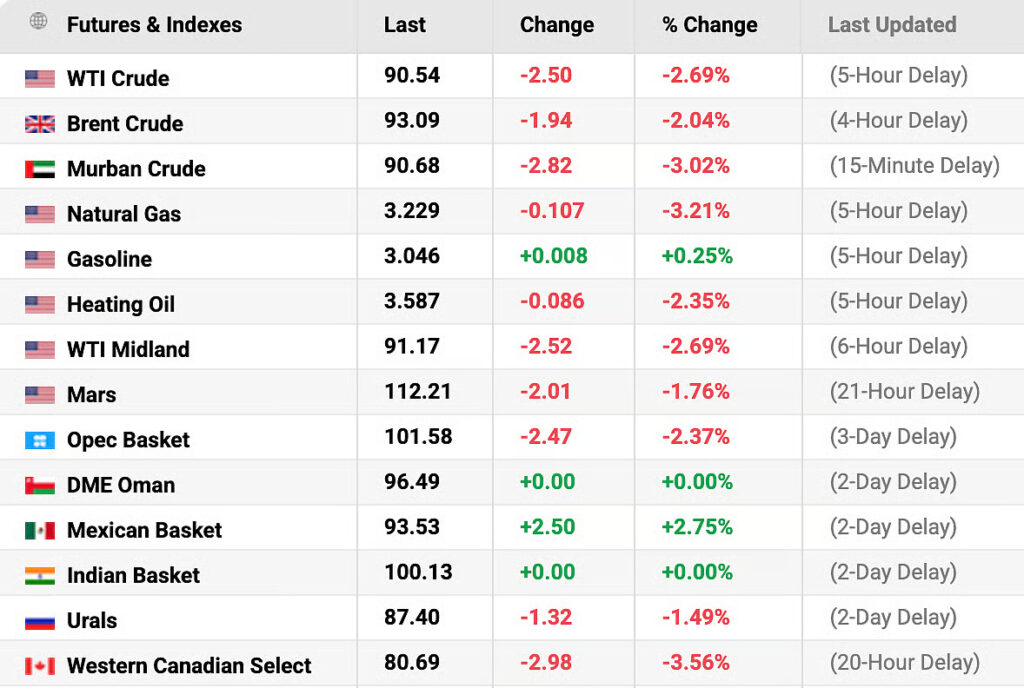
According to OilPrice.com data at around 10.26am Beijing time (2.26am GMT), US benchmark WTI crude dropped more than 2.6% to $90.54 a barrel, while Brent crude fell $1.94, or 2.04%, to $93.09 a barrel.
Murban crude recorded one of the steepest declines, shedding $2.82, or 3.02%, to $90.68 a barrel.
Other major benchmarks also moved lower. WTI Midland fell 2.69% to $91.17, Mars crude declined 1.76% to $112.21, and Western Canadian Select dropped 3.56% to $80.69.
Across energy markets, natural gas and heating oil prices also retreated, while gasoline futures bucked the trend with a modest gain of 0.25%. The declines suggest investors are reassessing geopolitical risks after initial concerns over potential disruptions to shipping and energy flows through the strategically important Strait of Hormuz.
Market reaction
US military action and tanker boarding
US Central Command said the four Iranian one-way attack drones posed an immediate threat to maritime traffic in and around the Strait of Hormuz. The command added that strikes on coastal surveillance radar sites on Iran’s mainland and on Qeshm Island were carried out in self-defence to prevent further attacks.
In a separate operation, US forces boarded the crude oil tanker MT Davina, which Washington has identified as part of Iran’s so-called “ghost fleet” — a network of vessels allegedly used to transport sanctioned Iranian oil and generate revenue for the Iranian government while evading international restrictions.
No casualties were reported in either operation.
Sanctioned tanker intercepted
On Friday, the US Department of Justice confirmed that MT Davina had been sanctioned for transporting Iranian crude oil. According to the US Indo-Pacific Command, the boarding operation conducted by US Marines was part of a maritime interdiction effort and a right-of-visit boarding of a sanctioned stateless vessel.
US officials said the action was intended to enforce sanctions and disrupt networks involved in the illicit transport of Iranian oil, amid heightened tensions and increased military activity in the region.
The MT Davina was sanctioned by the US Treasury in 2024 after authorities said it had transported Iranian oil to China.
Since the outbreak of the US-Israeli conflict with Iran in late February, Tehran has maintained a significant presence around the Strait of Hormuz, a strategic waterway critical to global energy supplies.
In response, the United States established a blockade targeting Iranian ports, diverting numerous vessels and reportedly engaging six ships that refused to comply with its directives.
The Strait of Hormuz remains at the centre of the 2026 US-Iran confrontation. Under normal circumstances, about one-fifth of the world’s seaborne oil trade passes through the narrow maritime chokepoint, making any disruption there a major concern for global energy markets.
US blockade and market impact
The US-led blockade of Iranian ports, along with efforts to maintain freedom of navigation through initiatives such as Project Freedom and US-escorted commercial transits, has disrupted regional shipping flows for months. These measures contributed to a sharp rise in oil prices earlier this year, although some of those gains were later reversed amid diplomatic overtures and hopes of de-escalation.
Oil markets have remained highly volatile as investors navigate a fragile ceasefire, ongoing proxy conflicts and conflicting signals surrounding sanctions relief and Iran’s nuclear programme. Periodic incidents and military tensions in the Gulf have continued to support a geopolitical risk premium in crude prices, even as expectations of an eventual easing of restrictions have occasionally tempered gains.
Saturday’s decline in oil prices suggests traders viewed Friday’s US-Iran military exchange as a limited and contained incident rather than the start of a broader escalation that could significantly disrupt energy exports or further restrict shipping through the Strait of Hormuz. As a result, markets pared back some of the supply-risk premium that had been built into crude prices in recent sessions.

