

Exposing the Global Economy’s Dependence on a Single Productivity Ecosystem.
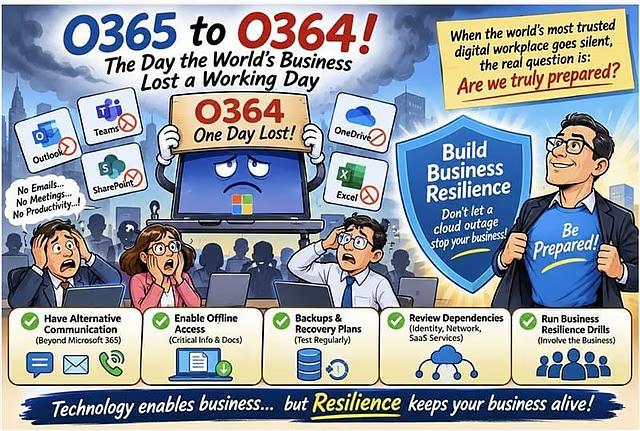
When the world’s most familiar digital workplace goes silent, the real question is not how quickly technology can be restored, but how prepared businesses are to function without it.
Imagine waking up on a Friday morning, opening your laptop and discovering that Outlook is not responding, Microsoft Teams cannot connect, SharePoint is inaccessible and OneDrive appears to have vanished. Excel refuses to cooperate, while the carefully planned meetings in your calendar have become meaningless reminders of what could have been.
Welcome to the day Microsoft O365 became O364 — one less productive day for the world’s digitally connected businesses!
While this is a humorous hypothetical scenario, it raises a serious question about modern enterprise resilience: just how much of the global economy depends on a single productivity ecosystem?
When the digital office takes an unexpected holiday
It is business as usual when the CEO calls the CIO.
“Why isn’t anyone responding to my emails?”
“Because, sir, Outlook is unavailable.”
“Then arrange an emergency Teams meeting!”
“Teams is unavailable too.”
“Fine, send me a message.”
“Sir, you instructed everyone to use official communication channels only.”
Silence.
For once, the CEO has no dashboard to review, no presentation to approve and no meeting to attend. Somewhere in the organisation, an employee discovers the forgotten art of having a face-to-face conversation.
The CFO is calculating productivity losses. HR is wondering how to record attendance when nobody can log in. Sales teams are scrambling to reach customers, while Marketing is considering announcing a global digital detox.
Meanwhile, the IT service desk is being flooded with tickets: Outlook is down, Teams is down, SharePoint is down and, apparently, productivity itself is down.
The irony? Nobody can access the service desk system to check the status of their tickets!
The uncomfortable reality of digital dependency
Behind the humour lies a genuine enterprise risk. Microsoft 365 and similar software-as-a-service (SaaS) platforms have become central to everyday business operations. Email, collaboration, document management, identity integration, workflow automation and executive communications increasingly rely on interconnected cloud services.
This convenience has transformed the way organisations work, but it has also concentrated operational dependencies.
A disruption affecting a widely used productivity ecosystem can trigger cascading consequences across organisations, suppliers, customers and business partners. The impact extends well beyond IT availability. It can disrupt financial approvals, regulatory reporting, customer service, supply-chain coordination, business transactions and executive decision-making.
The critical distinction is this: cloud availability is not the same as business resilience.
Organisations may measure service availability against contractual service-level agreements (SLAs), but how many have genuinely tested whether their critical business functions can continue when their primary productivity platform becomes unavailable?
From cloud convenience to business resilience
The answer requires a fundamental shift in thinking. Business continuity cannot be built around the assumption that technology will always be available. Instead, organisations must prepare for the possibility that even widely trusted platforms may experience disruption.
CIOs, CISOs, CTOs and business leaders should consider five priorities:
1. Independent communication: Establish alternative, secure communication channels for critical business operations so teams can coordinate even when the primary productivity platform is unavailable.
2. Offline business continuity: Ensure essential information, procedures, contact lists and operational documents remain accessible during cloud service disruptions.
3. Recovery and data protection: Maintain independent backups, understand recovery dependencies and regularly test data restoration capabilities.
4. Identity and integration resilience: Evaluate dependencies across identity providers, authentication systems, networks, DNS and connected services. A productivity platform may be operational, but an underlying dependency could still prevent users from accessing it.
5. Business-led resilience exercises: Simulate a complete productivity-suite outage and assess how long critical business processes can continue without the primary platform.
Most importantly, resilience testing must involve business owners, not just IT teams. The true measure of success is not how quickly the technology team restores a service, but how effectively the organisation protects its customers, revenue, regulatory obligations and reputation during a disruption.
The final punchline: Will resilience get budget approval?
When services finally return, employees celebrate. Emails start flowing, Teams meetings resume, and everyone returns to the familiar routine of attending meetings about meetings.
The CEO sends a message:
“Dear All, please ensure tomorrow’s productivity compensates for today’s losses.”
The CIO replies:
“Certainly, sir. But may I request approval for our business continuity investment?”
The CEO responds:
“Let’s discuss it in our next Teams meeting.”
The CIO smiles.
“Certainly, sir. Provided O365 doesn’t become O363!”
The real lesson is that while Microsoft 365 may support our digital workplace throughout the year, a resilient business must be prepared for the day that workplace takes an unexpected holiday.
Technology should enable business continuity, never become a single point of failure.

