

Gulf crude oil flows recover despite Strait of Hormuz disruptions and tanker attacks.
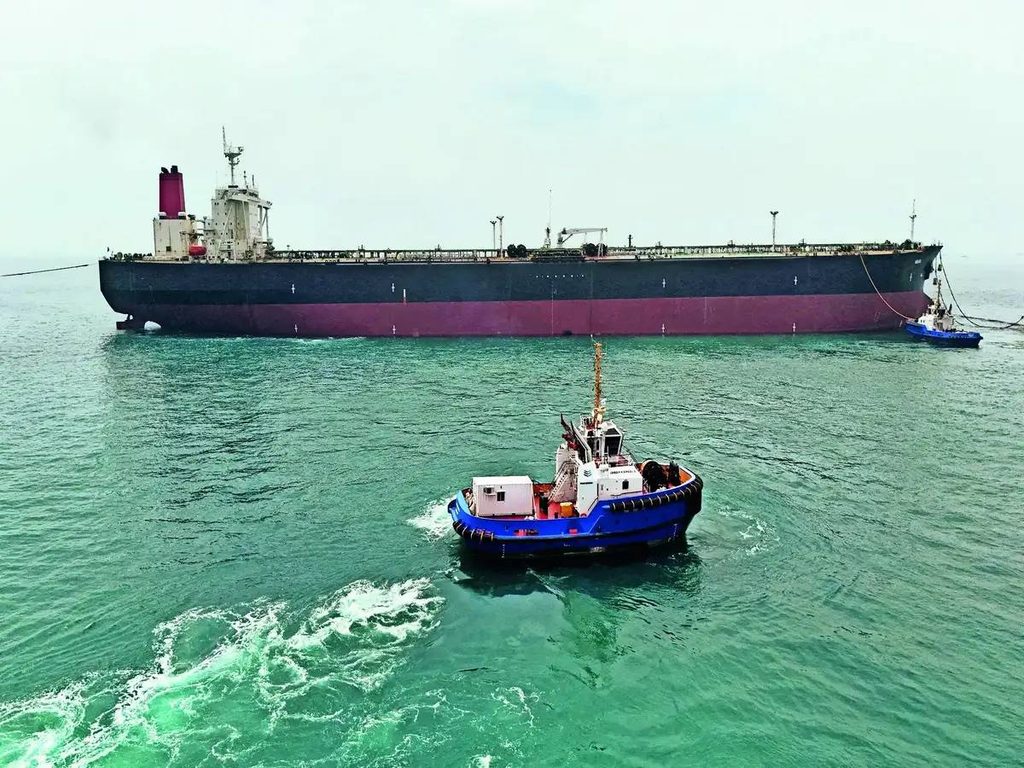
Dubai: Middle East crude oil exports climbed above pre-war levels on several days during the final weeks of September, according to shipping data from maritime intelligence firm Kpler, despite continued attacks on commercial vessels around the Strait of Hormuz.
Provisional Kpler data cited by Reuters showed regional crude exports reaching between 19.5 million and 22.5 million barrels per day (bpd) on September 24 and again from September 27 to 29.
The seven-day moving average stood at 18.5 million bpd on October 1, exceeding the pre-war average of around 18 million bpd.
The figures point to a strong recovery in Gulf oil shipments following the sharp disruption that occurred after the US-Israeli war with Iran began in late February.
Kpler: Gulf crude exports return to pre-war levels
Kpler’s latest analysis provides further insight into how Gulf producers have restored crude flows despite continued disruption along the region’s traditional export routes.
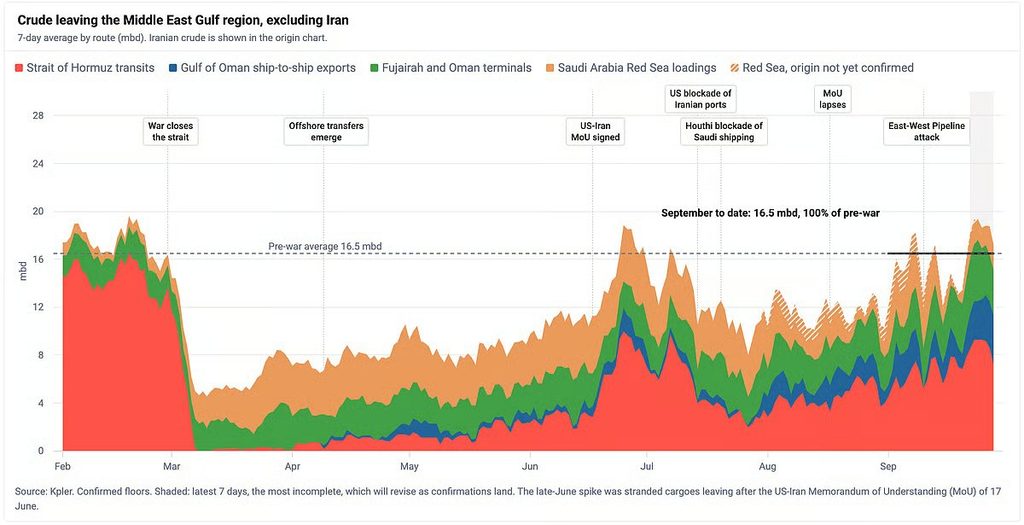
Kpler’s analysis, published in early October, found that at least 16.5 million bpd of crude and condensate left the Middle East Gulf region between September 1 and September 28, broadly matching the pre-war average when Iran is excluded.
That was 10.5 million bpd higher than the March monthly average, highlighting the scale of the recovery in regional oil shipments. Kpler defines the pre-war period as March 2025 to February 2026.
However, the rebound has also brought a significant shift in how Gulf oil reaches international markets.
Before the conflict, around 83 per cent of Middle East Gulf crude exports passed through the Strait of Hormuz. By September, that share had fallen sharply, with about 40 per cent of regional crude exports leaving through routes that bypassed the strait.
Saudi Arabia and the UAE have stepped up the use of pipelines and alternative export terminals, while ship-to-ship transfers have taken on a growing role in maintaining oil flows.
According to Kpler, more than 70 per cent of crude passing through the Strait of Hormuz in August was transferred between tankers offshore.
Oil is moving, but the route has changed
Kpler said the region’s oil export network has effectively been reshaped around a combination of alternative shipping routes, pipelines and offshore transfers.
The firm’s analysis found that the recovery has already endured three major disruptions.
The recovery has faced three major disruptions:
- Pressure on the Red Sea shipping route
- The expiry of the US-Iran memorandum of understanding
- The September attack on Saudi Arabia’s East-West Pipeline
In each case, oil flows were redirected through alternative routes, helping exporters maintain shipments despite the disruption.
Ship-to-ship transfers create a new bottleneck
The growing reliance on offshore transfers, however, has introduced a new set of logistical challenges.
Kpler said ship-to-ship activity in the Gulf of Oman reached a record high in September. Large crude carriers are increasingly being deployed as shuttle vessels, with some very large crude carriers (VLCCs) making repeated journeys between the Gulf and offshore transfer points.
While this system allows exporters to reduce their reliance on the Strait of Hormuz, it also adds time, complexity and cost to transporting crude.
The rebound in export volumes, therefore, does not necessarily mean the region’s oil supply chain has returned to normal.
A radically different Gulf oil map
The latest figures point to a fundamental shift in how Gulf crude reaches international markets, with pipelines, alternative terminals and offshore transfers playing a much larger role than before the conflict.
Kpler cautioned that its recent figures represent minimum confirmed volumes, as additional shipments may be added when further evidence becomes available.
The data nevertheless indicates that the Gulf oil industry has shown a greater ability to adapt to prolonged disruption than initially expected.
However, continued attacks on tankers around the Strait of Hormuz mean the region’s oil export network remains exposed to significant security and logistical risks, even as overall shipment volumes recover.

