

Etihad CEO Antonoaldo Neves Highlights Fuel Costs, Capacity Growth and Next Major Fleet Investment.
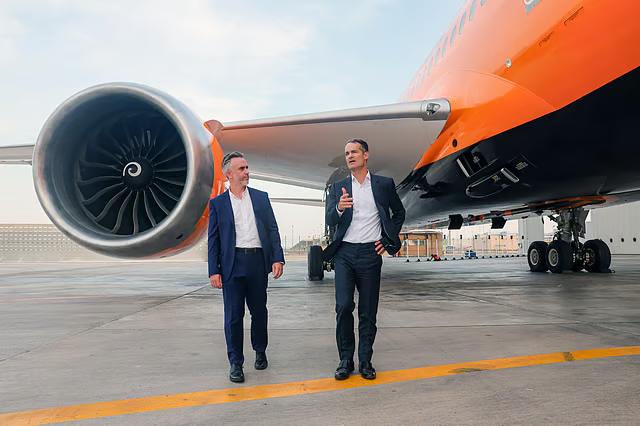
Abu Dhabi: Etihad Airways chief executive Antonoaldo Neves has identified rising jet fuel costs as the biggest challenge facing airlines in 2027, warning that airfares could come under pressure from the second quarter as airlines’ fuel hedging positions begin to run down.
Fuel accounts for a significant share of airline operating expenses, estimated by Neves at around 35 to 40 per cent. As protection from advance fuel purchases diminishes, carriers may have limited room to absorb higher costs indefinitely.
“Jet fuel right now is about all in $150 a barrel of Brent,” Neves told Gulf News. He was referring to the combined cost of the underlying oil benchmark and the refining premium, known in the industry as the crack spread.
He said many airlines had secured fuel supplies in advance through hedging arrangements this year, but those positions were expected to be considerably lower from the second quarter of 2027.
“You’ve seen many CEOs of airlines saying, ‘Look, if jet fuel doesn’t come down, we may see prices going up, and that’s going to happen,'” he said.
“Something’s got to give, but we hope for that to go down, and we like low prices. We like low prices because this is a way to stimulate demand.”
The comments come as airlines weigh capacity expansion against rising operating costs and the possibility of passing higher expenses on to passengers.
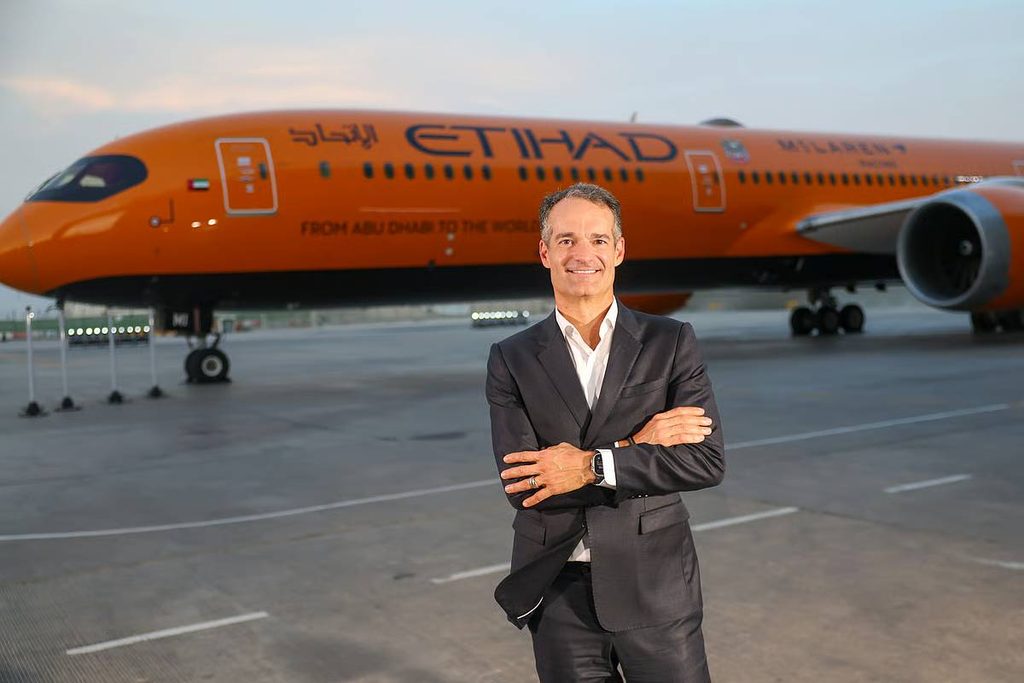
Fuel pressure
Neves said the fuel challenge was not unique to Etihad and was affecting airlines across the global aviation industry. However, he does not expect higher fuel costs to alter the carrier’s immediate network strategy.
Asked whether fuel prices would influence the markets Etihad targets next year, Neves said: “As of now, no.” The airline operates its network as an interconnected system, with stronger markets helping to offset weaker ones.
“We see this as a network. So, one compensates for the other. What we do for one geography, we do for the other geography,” he said.
However, he acknowledged that airlines have less flexibility to raise fares in markets where passengers have lower purchasing power.
“Geographies that have less, I would say, purchasing power, you cannot pass on as much. It’s a balance in the end.”
Demand remains strong
Despite cost pressures, Neves said Etihad was entering the final months of 2026 with stronger passenger demand and greater capacity than a year earlier.
The airline is operating approximately 15 per cent more seats than last year, while demand has also increased by 15 per cent, according to the CEO.
“Our planes are full,” he said, putting the airline’s load factor at around 85 to 87 per cent during the week of the interview. He compared this with the typical 78 to 82 per cent load factor among network carriers, although he did not cite a specific industry dataset.
Etihad has been adding aircraft and launching routes as it expands its network, which now serves more than 120 destinations. Neves said the airline was carrying between 25 million and 27 million passengers annually and expected that figure to reach 30 million next year, a target the carrier has consistently pursued over the past several years.
The growth is being supported by investment in premium services, including chauffeur arrangements, meet-and-assist services for First Class passengers and additional aircraft equipped with First Class cabins.
December outlook
Etihad is also preparing for the busy November and December travel period, when Abu Dhabi welcomes international visitors for the Formula 1 Etihad Airways Abu Dhabi Grand Prix and the wider winter season.
Neves said the airline’s plans for the period remained solid, despite uncertainty that had affected aviation markets earlier in the year.
“We came back stronger from the time that we had to reduce capacity back in March,” he said.
Demand varies across the airline’s network. Neves identified travel between Europe and Southeast Asia as particularly strong, while corporate travel to and from Abu Dhabi was also performing better than a year earlier.
“Abu Dhabi is strong,” he said. He expects Etihad’s supply and demand balance to remain broadly similar through the end of the year and is confident that the first quarter of 2027 will record growth of at least 10 per cent year on year.
Experience matters
Beyond adding aircraft and routes, Etihad’s next phase of growth will depend on delivering a more consistent passenger experience across its fleet.
Neves said the airline would begin retrofitting aircraft next year, with the aim of bringing 95 per cent of its fleet into a new configuration by the end of 2028.
“The next step for Etihad is consistency,” he said.
He pointed to the airline’s investment in premium cabins, including the return of the Airbus A380, its Airbus A321 aircraft featuring a First Class cabin and the introduction of new Airbus A330 aircraft next year.
The airline has also introduced a home luggage collection service, allowing passengers to have their bags picked up before they travel to the airport.
However, Neves acknowledged that operating aircraft with different configurations and cabin products can make it challenging to deliver a consistent experience.
“We are going to have a big bang by the end of 2028. By the end of 2028, 95 per cent of our fleet are going to be brand new,” he said.
Antonoaldo Neves, CEO of Etihad Aviation Group
Antonoaldo Neves, CEO of Etihad Aviation Group
“If fuel costs don’t go down, we’ll have to pass them on through fares, and we don’t want to do that. We like low fares.”
Personalisation push
Technology and passenger data are expected to play an increasingly important role in Etihad’s customer service strategy.
Neves said the airline was equipping flight attendants with iPads to give cabin crew access to information that could help them respond to individual passenger preferences and resolve issues during flights.
He cited the example of First Class passengers, whose preferences are recorded, from how they like their coffee served to their preferred arrangements when using the onboard shower.
“In two, three years, our objective is to be able to really understand on an individual basis what every customer wants,” he said.
The airline also wants cabin crew to resolve service issues during the journey, rather than leaving passengers to pursue complaints after landing.
“If you have a contingency, we’re going to solve your contingency on the spot during the flight,” Neves said.
He gave the example of a passenger who had ordered a special meal but did not receive it because of an operational issue. In such cases, he said, Etihad wants to be able to offer compensation while the passenger is still onboard.
Selling Abu Dhabi
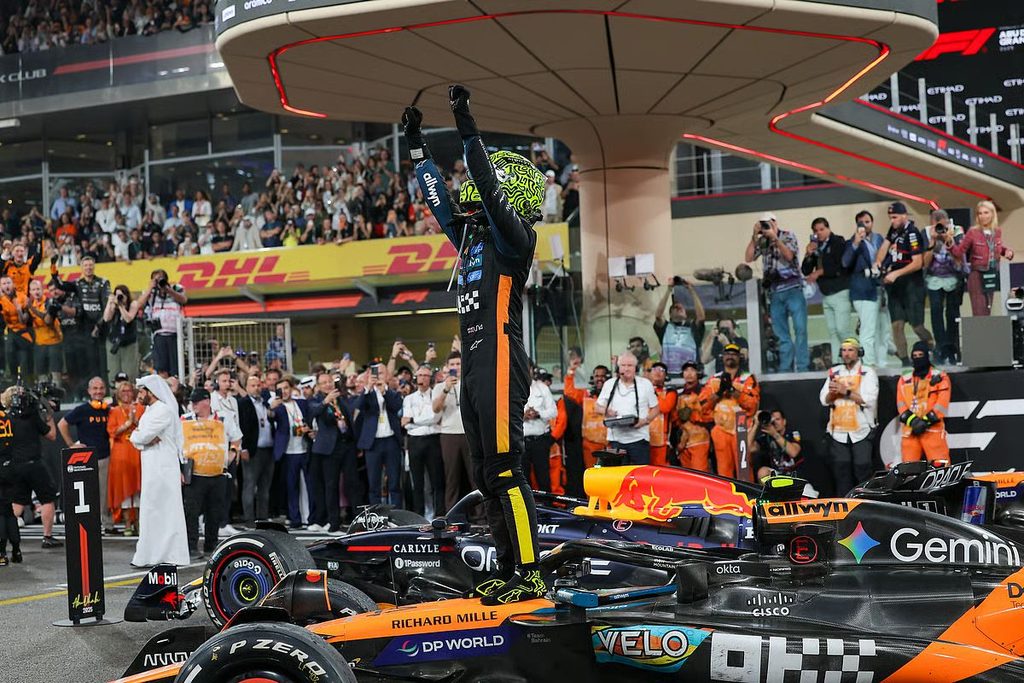
Etihad’s partnership with McLaren is another part of its strategy to build international brand awareness as its network expands. Neves said the relationship was not simply about promoting the Abu Dhabi Grand Prix, which the airline has sponsored since 2009.
The aim is to associate the Etihad brand with McLaren throughout the Formula 1 calendar, including races in markets such as Las Vegas.
“We didn’t do that because we do Formula One. We did that because we do Formula One,” he said, explaining that the partnership was designed to extend the airline’s visibility beyond the UAE’s annual race.
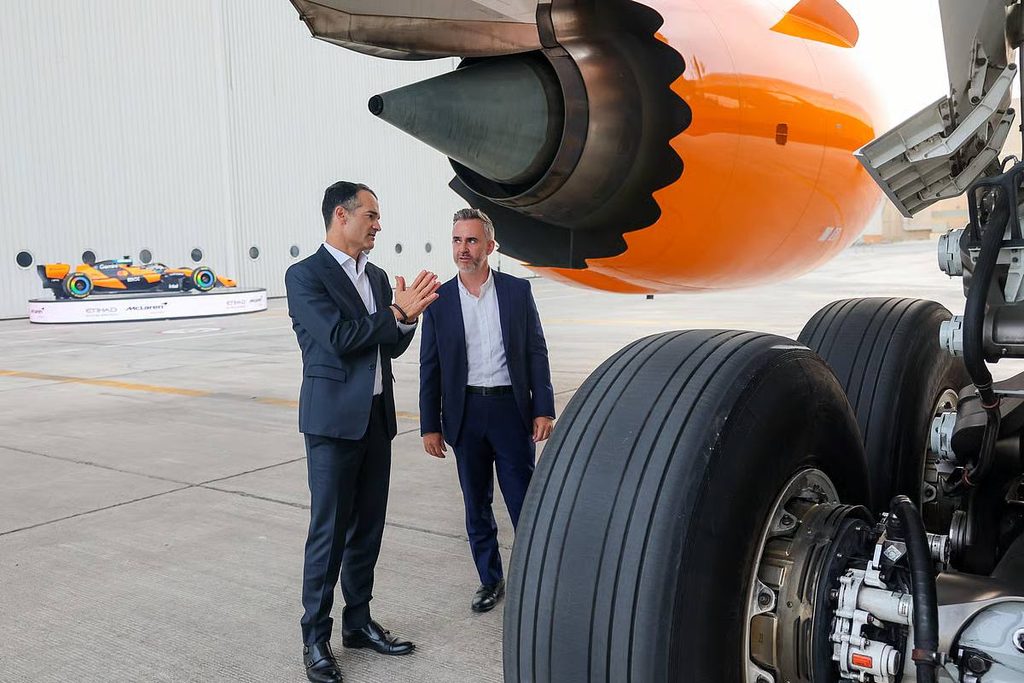
The McLaren partnership gives Etihad exposure at races around the world, while its specially branded Boeing 787 will carry the team’s signature papaya colours across the airline’s network.
Neves said the airline and the racing team faced similar commercial challenges: both needed to deliver consistent performance and build customer loyalty.
“We deal with the public, with a big number of fans. To a certain extent, our customers also have to become our fans, and fly more with Etihad.”
For an airline targeting 30 million passengers next year, the challenge will be to turn greater brand visibility and capacity growth into lasting customer loyalty, while managing fuel costs that could make air travel more expensive in 2027.

