

Dubai gold prices drop sharply as a strong dollar and rate concerns weigh on bullion.
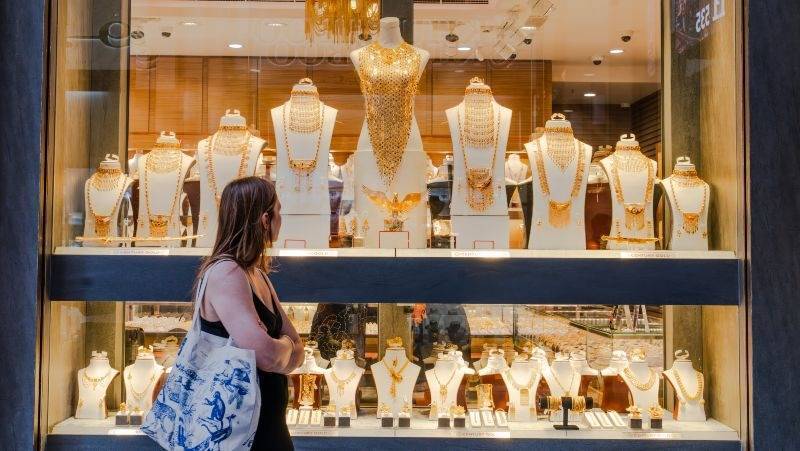
Dubai: Gold buyers in the UAE saw a brief respite on Monday morning as local bullion prices fell by approximately Dh10 per gram, partially retracing the strong rally that had pushed prices near record highs earlier this month.
By 9:30 a.m. on March 9, the price of 24K gold in Dubai stood at Dh613.25 per gram, down from Dh623.25 on Sunday. The popular 22K variety also declined by around Dh10, settling at Dh567.75 compared with Dh577.25 a day earlier.
The decline follows a period of heightened global market volatility, with gold being influenced by geopolitical tensions, currency fluctuations, and expectations around interest rates.
Recent Surge Pushes Prices Higher
Gold prices in the UAE have experienced sharp swings in recent weeks, mirroring turbulence in global markets. In early February, 24K gold traded near Dh598 per gram before gradually rising above Dh610 by mid-month. Prices then climbed further toward the end of February, reaching Dh636 in several sessions.
Momentum intensified at the start of March, with 24K gold briefly surging to around Dh641 per gram—one of the strongest levels recorded this year. The rally, however, did not hold, and prices retreated toward the Dh620 range before Monday’s drop brought them closer to Dh613.
The 22K variety followed a similar pattern. Prices started February near Dh554, climbed steadily above Dh580 by month’s end, and spiked close to Dh593 in early March before cooling, eventually falling below Dh570 on Monday morning.
Strong Dollar Pressures Bullion
International gold prices have been weighed down by a stronger US dollar and growing expectations that interest rates may remain elevated for an extended period.
Global bullion prices fell sharply, dropping as much as 3% during trading and briefly hitting around $5,015 an ounce before recovering some losses. The decline marked the first weekly drop in over a month.
Energy markets have added further volatility, with oil prices surging toward the $120 mark after major Gulf producers reduced output amid ongoing tensions involving the US, Israel, and Iran.
Rising crude prices often stoke inflation concerns in the US, increasing the likelihood that the Federal Reserve maintains higher interest rates. Gold and other precious metals typically struggle under such conditions, as they do not generate interest income.
At the same time, the US dollar has strengthened against major currencies, drawing investors toward dollar liquidity during this period of market stress.
Analysts say the current weakness in gold could be temporary if geopolitical tensions continue.
Mohanad Yakout, Senior Market Analyst at Scope Markets, noted that gold is currently balancing between safe-haven demand and the strength of the US dollar.
“Gold prices are navigating a complex environment between escalating geopolitical risks and a robust US dollar,” Yakout said. “While the intensified conflict involving the US, Israel, and Iran has driven a surge in safe-haven demand, the impact on gold has been muted by the simultaneous rally of the greenback.”
Investors are increasingly seeking dollar liquidity amid ongoing market turbulence, which has constrained gold’s ability to sustain its rally despite heightened geopolitical risks.
Investors are increasingly seeking dollar liquidity, and the currency’s strength is currently outweighing upward pressure from safe-haven flows, keeping gold prices relatively stable and preventing a sharp breakout above recent highs, according to Mohanad Yakout, Senior Market Analyst at Scope Markets.
Long-Term Drivers Remain Intact
Despite the recent pullback, gold has delivered strong gains this year and continues to attract institutional demand. Prices have risen roughly 18% since the start of 2026, supported by persistent geopolitical uncertainty and ongoing purchases by central banks aiming to diversify their reserves.
China’s central bank extended its gold-buying streak to 16 months in February, reinforcing long-term demand in the global bullion market.
Mohanad Yakout believes that prolonged geopolitical tensions could eventually drive gold prices higher.
“Despite this short-term consolidation, the outlook for gold remains decidedly bullish if the conflict persists,” he said. “A prolonged war could disrupt global trade and energy supply, and combined with potential inflationary pressures, this is expected to push gold prices upward.”
Long-term structural trends also remain supportive.
“Continued central bank diversification and the ongoing debasement trade suggest that current price levels may act as a floor before the next major leg of the rally, potentially toward the $5,500 to $6,000 range,” Yakout added.

