

Umm Al Emarat Park stages Abu Dhabi’s first biennale with children at its heart.
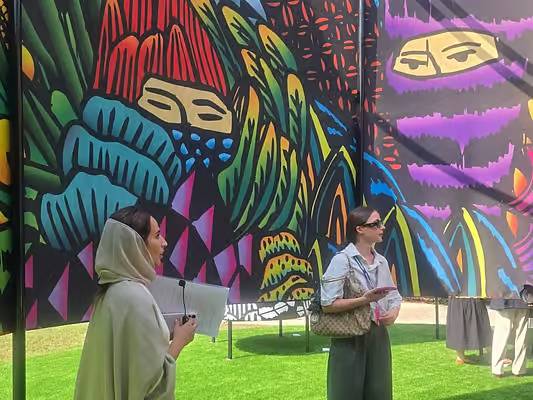
Abu Dhabi: Art exhibitions typically invite visitors to look, observe and move on. But at Umm Al Emarat Park in Abu Dhabi, children are encouraged to engage with art in a different way – by touching, listening, experimenting and even contributing to the artworks.
This interactive approach is central to the Children’s Biennale, themed ‘How the World Feels’, which runs at Umm Al Emarat Park from November 6 to December 6.
Presented by Abu Dhabi Festival, the event features seven newly commissioned works by UAE artists, alongside an installation by Indonesian artist Eko Nugroho. The programme puts children’s experiences and perspectives at the heart of its curatorial vision.
For curator Dana Almazrouei, the aim was not merely to introduce art into a public park, but to rethink how young visitors engage with artworks and their surroundings.
“I wanted children to leave seeing the park a little differently. A place they might have visited many times suddenly becomes somewhere to discover stories or even experience something through touch and movement,” she says.
This philosophy is reflected in the way the installations have been created. Instead of presenting artworks for children to view from a distance, Almazrouei encouraged participating artists to design experiences that allow young visitors to engage, explore and interpret the pieces themselves.
“I encouraged them to think about children as active participants, capable of interpreting, questioning and even transforming an artwork,” she says during the preview tour.
The outdoor location also played an important role in shaping the exhibition. Unlike a traditional gallery, Umm Al Emarat Park is a constantly changing setting, where trees, sounds, weather and visitors all contribute to the overall experience.
“The artworks needed to belong to that environment rather than compete with it,” Almazrouei says. “The park became part of the artistic experience.”
Learning through play
Play is another central element of the Biennale’s approach. For Almazrouei, it is not simply an additional activity designed to make art more attractive to younger audiences. Instead, it provides children with a way to explore ideas, understand their surroundings and express themselves.
“Play is how children make sense of the world. It’s how they test ideas, build relationships, solve problems and express things they might not yet have the words for,” she says.
Almazrouei believes children should have the freedom to explore without being directed towards a particular lesson or discovery. This is where the park’s natural setting becomes important, allowing young visitors to engage with their surroundings at their own pace.
“In a sense, children don’t need us to simplify art for them,” she says. “And I think the most meaningful artworks are often those that leave room for children to surprise us.”
She explains that a child might spend 20 minutes exploring one installation and only a few seconds looking at another. Both responses are equally meaningful, regardless of the time spent engaging with the work.
Workshops and guided tours
The programme goes beyond the installations, with family workshops scheduled for November 6 and 7, as well as November 13 and 14, starting at 6.30pm.
Among the interactive experiences is a garden of memories, where children can draw imaginary flowers and create stamps using objects found in nature. They can also explore beehives through touch and learn about bees and biodiversity.
Other activities include drawing, weaving, lantern-making, sound exploration and collaborative art projects. Guided morning tours for schools will also take place throughout the exhibition.
Open to children of all ages, the tours offer opportunities to explore the artworks in an outdoor environment designed to encourage curiosity and creative thinking.
“It is really about recognising that children experience the world differently from adults. They are naturally curious about things we often overlook,” Almazrouei adds.
The Biennale also takes place during the UAE’s 2026 Year of Family, highlighting the importance of shared experiences among children, parents and educators.
For Almazrouei, however, the connection children develop with the park could be just as important as their engagement with the artworks. She sees young visitors as custodians of the space, believing that familiarity and a sense of belonging can encourage them to take greater responsibility for their surroundings.
“I hope that curiosity eventually becomes care. Because when children feel connected to a place, they are more likely to want to look after it,” she says.
Across the different artistic approaches, Almazrouei says she was struck by the artists’ shared willingness to let children form their own interpretations rather than dictate what they should take away from the experience.
Working with the artists
Almazrouei describes collaborating with the participating artists to develop the installations as a particularly rewarding experience.
“What stayed with me was how differently each artist approached the idea of childhood,” she says.
While some explored memory and storytelling, others focused on sound, nature, care and the relationship people develop with their surroundings.
“Yet across these very different approaches, there was a shared interest in giving children space to imagine and make their own connections,” she adds.
The installations explore themes including ecology, biodiversity, memory, Emirati culture and humanity’s relationship with nature.
The international contribution comes from Indonesian artist Eko Nugroho through Kenangan Kunang-Kunang (Memories of Fireflies), an immersive installation inspired by traditional Eastern Javanese lanterns.
Originally commissioned for the National Gallery Singapore’s 2019 Gallery Children’s Biennale, the work is being presented in Abu Dhabi through a partnership between the Singapore institution and Abu Dhabi Music & Arts Foundation (ADMAF).

