

According to an official, UAE defence systems continued operating without slowdown despite 40 days of sustained pressure and hundreds of missile launches.
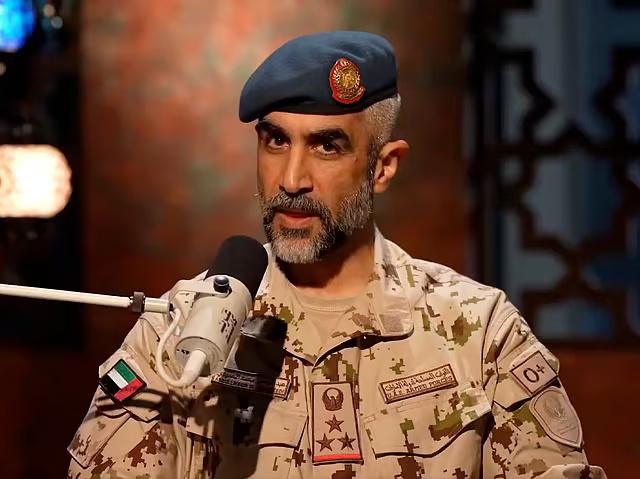
Abu Dhabi: The UAE armed forces are maintained in a state of constant readiness to defend the nation in all circumstances, a senior defence official said, adding that recent operational performance demonstrates a framework focused on sustained resilience over short-term reaction.
Speaking on the “Aan Podcast” with Fahad Heikal, Brigadier Pilot Abdulnasser Al Hammadi, the Ministry of Defence spokesperson, said the UAE armed forces operate “around the clock” in both peacetime and wartime conditions, emphasizing that military preparedness is continuous rather than situational. He added that the country’s defence architecture has been tested in recent weeks.
He said Emirati pilots and air defence systems displayed “high efficiency” in responding to a series of attacks that unfolded with minimal warning.
Despite the sudden escalation, he said the UAE’s air defence network was already active and able to respond “from the very first moment,” intercepting incoming threats as they emerged. He described the scale of the attacks as unprecedented, noting that while similar patterns of missile and drone threats had been seen before from regional militias, the volume and intensity of the latest escalation marked a significant change. “We were targeted by hundreds of ballistic missiles, cruise missiles and drones within a matter of days,” he said. Al Hammadi added that the vast majority of threats were intercepted and destroyed, with only limited damage caused by debris from successful interceptions, and emphasised that overall losses remained contained relative to the scale of the attacks.
What stood out, he suggested, was not only the ability to respond but also to sustain performance. The UAE’s defence system maintained a high operational tempo for 40 consecutive days without any decline in effectiveness. “We are confident that even if such attacks continue, the system will maintain the same level of performance and efficiency,” he said.
Al Hammadi described the UAE’s defence capabilities as “integrated, comprehensive and highly advanced,” supported by one of the world’s most sophisticated air defence systems. He explained that the system operates across multiple domains, enabling defence in all directions, at varying altitudes, and over long ranges, including threats beyond the Earth’s atmosphere such as ballistic missiles. This layered approach, he added, allows the country to respond flexibly to a wide range of threats, from high-speed ballistic missiles to low-flying drones.
While assessing national strength, Al Hammadi argued that military power is no longer defined primarily by offensive capability. Instead, he said, the true measure lies in a country’s ability to defend itself, maintain stability, and ensure that institutions continue functioning during periods of crisis.
Over the past 40 days, he said, the UAE demonstrated this resilience, with government institutions operating normally and daily life continuing with minimal disruption. “Society continued to live normally,” he noted, suggesting that resilience, rather than firepower, is becoming the defining metric of national strength.
Al Hammadi also highlighted the role of leadership during the crisis, saying the UAE’s leadership was present “in the field alongside the soldiers,” which he said had a direct impact on morale. He added that community support served as an important pillar in sustaining the armed forces during a period of heightened tension.
Beyond the battlefield, he said the response relied heavily on coordination between military, security, and civilian institutions. This level of integration, he noted, proved critical and underscored the need for even closer alignment in future crises.
The spokesperson emphasised the expanding role of the UAE’s domestic defence industry, which he said has become globally competitive across land, air, naval, and space systems. This capability, he added, has enhanced military self-reliance, particularly during periods of global supply chain disruption. In the recent crisis, locally developed systems and production capacity helped sustain operations and reinforce national capabilities within short timeframes.
Al Hammadi also addressed the growing use of drones, describing them as a relatively new and complex challenge for militaries worldwide. He said the UAE has developed integrated detection and interception systems capable of tracking and neutralising drones before they pose a threat.
He said the systems integrate ground-based air defence with interceptor aircraft, enabling a layered response to non-traditional threats. Weather conditions and time of day, often treated as operational constraints, have not significantly affected performance, he added, noting that advanced capabilities allow the network to operate efficiently in rain, low visibility, and across both day and night conditions.
Technology and the human factor
Al Hammadi said artificial intelligence has become a core component of the UAE’s defence ecosystem, particularly in analysing data and supporting the selection of appropriate responses to incoming threats. These technologies, he added, enhance human decision-making and improve the speed and precision of operational responses.
He also praised the Emirati soldier, describing them as highly trained and widely respected for their discipline and effectiveness, shaped by years of training and operational experience, including regional missions.
Reflecting on recent events, Al Hammadi said the experience reinforced several key lessons, particularly the importance of early preparation and sustained readiness. He noted that the defence system’s performance was not achieved overnight, but built over years of planning, investment, and development.
He also emphasised the importance of forward-looking strategies, including anticipating future threats and strengthening institutional integration.
“The level we have reached today is the outcome of decades of preparation,” he said. “Maintaining that level requires constant readiness, coordination, and the ability to adapt to what comes next.”

